
Injection Molding vs 3D Printing: Best Manufacturing Fit
Injection Molding vs 3D Printing: The Short Answer for Buyers
When comparing injection molding vs 3d printing, the best manufacturing fit depends on quantity, part function, material requirements, surface finish, and how stable the design is. As a rule, 3D printing is usually the faster and lower-risk option for early prototypes and design iteration, while injection molding is the better long-term solution for repeatable quality, tighter unit cost at scale, and production volumes from hundreds to 100,000+ parts.
For sourcing teams, engineers, and product designers, the real decision is not which process is “better” in general. It is which process is better for this stage of your project. If you need one to 20 parts in a few days, 3D printing is often the smarter move. If your geometry is frozen and you need 1,000, 10,000, or 100,000 parts in consistent plastic materials, injection molding usually wins.
A simple way to evaluate injection molding vs 3d printing is to ask four practical questions:
- Is the design still changing every few days?
- Do I need end-use plastic properties or just form and fit?
- Will this part scale into repeat orders?
- Is unit cost or launch speed the bigger priority?
| Injection molding vs 3d printing factor | 3D printing advantage | Injection molding advantage |
|---|---|---|
| Design iteration | Fast changes with no tooling | Slower to change once tool is built |
| Startup cost | Very low upfront cost | Tooling investment required |
| Unit cost at volume | Higher per part | Lower per part as volume rises |
| Material consistency | Good for prototyping, varies by process | Strong repeatability in production-grade resins |
| Surface finish and cosmetics | Often requires post-processing | Better consistency with SPI, VDI, or textured molds |
| Best quantity range | 1-100 parts in many cases | 100-100,000+ parts |
The most effective manufacturers help buyers use both processes strategically rather than forcing one answer too early. That is why the best comparison is not abstract. It should be tied to your product roadmap, tolerance needs, and commercial target.
Injection Molding vs 3D Printing Market Trends Shaping Modern Product Development
The injection molding vs 3d printing comparison has become more important because product development cycles are shorter, launch windows are tighter, and buyers want lower-risk validation before committing to production tooling. Across consumer products, medical devices, automotive components, and industrial equipment, teams are combining additive and molding workflows instead of treating them as competing silos.
In real manufacturing operations, injection molding vs 3d printing is no longer a one-time choice. Many companies now use 3D printing for early concept verification and switch to molding once design, demand, and tooling ROI become clear. Manufacturers like TEAM Rapid are well positioned for this shift because they support both development-stage and production-stage manufacturing, from rapid prototypes to molded parts and secondary assembly.
Several market forces are driving this comparison more often:
- Product teams need physical parts earlier in development
- Startups want low-risk validation before investing in steel tooling
- Established OEMs want bridge production while waiting for molded first articles
- Procurement teams are under pressure to reduce total landed cost, not just tool cost
- Engineers increasingly want one supplier that can support prototype, pilot run, and volume production
That last point matters. Buyers are looking for partners that can support more than one process family. TEAM Rapid, for example, combines 3D printing, vacuum casting, CNC machining, rapid tooling, Injection Molding, die casting, sheet metal fabrication, finishing, assembly, and direct shipping. From a sourcing perspective, that reduces transition risk when a project moves from proof-of-concept to volume manufacturing.
The demand pattern also differs by business model. Startups often prioritize speed and low upfront spend, so 3D printing stays attractive longer. Larger OEMs often move to injection molding earlier because they already know annual demand, packaging requirements, and quality plans. In both cases, the injection molding vs 3d printing choice is increasingly tied to lifecycle planning rather than a single RFQ event.
One more trend is worth noting: international sourcing has compressed the gap between “prototype supplier” and “production supplier.” A company that can review files in hours, issue DFM quickly, and deliver parts globally can act like an integrated launch partner, even if manufacturing is happening in China. That is one reason experienced suppliers with cross-cultural project management remain attractive in B2B manufacturing.
Injection Molding vs 3D Printing Materials, Part Geometry, and Technical Specifications
In the injection molding vs 3d printing decision, material and geometry usually matter more than marketing claims. A part that prints easily may still fail in long-term use because the material is too brittle, too porous, or too inconsistent from build to build. On the other hand, a part designed for molding may be over-engineered for early prototypes, making tooling unnecessary too soon.
For most buyers, the key technical comparison starts with three areas: resin choice, geometric rules, and dimensional control. This is where experienced suppliers such as TEAM Rapid add value, because they can assess whether a design should stay in additive development longer or move into molded production with a proper DFM review.
Materials in injection molding vs 3d printing
When evaluating injection molding vs 3d printing, material breadth is one of the clearest differences. 3D printing offers fast access to many prototype materials, but molded thermoplastics usually provide stronger production realism, more stable properties, and broader long-run repeatability.
TEAM Rapid’s molding capability is a useful example of production-grade flexibility. It supports ABS, PC, PP, PA/Nylon, POM, PEEK, TPU, TPE, silicone, and more. That covers a wide range of end uses, from rigid housings to living hinges, clear plastic parts, flexible grips, and heat-resistant technical components.
| Injection molding vs 3d printing material view | 3D printing | Injection molding |
|---|---|---|
| Typical role | Concept models, functional prototypes, low-volume specials | Production parts, bridge runs, repeat manufacturing |
| Material realism | Process-dependent, sometimes approximate | True production-grade thermoplastics and elastomers |
| Clear parts | Often visually clear but not optical-grade | Better optical finish potential in clear molded parts |
| Flexible parts | Good for rapid validation | Better repeatability for TPU, TPE, and silicone applications |
| Engineering resins | Available but often limited by print process | Wide resin choice for performance and compliance targets |
For example, if you are testing snap fits, a printed resin may show the geometry, but molded PP or Nylon will tell you far more about fatigue behavior. If you need transparent covers, printed clear materials can work for concept review, but optical-grade clear plastic molding generally performs better for production appearance and consistency.
Geometry and manufacturability rules
The next layer in injection molding vs 3d printing is design freedom. 3D printing handles internal channels, complex lattice structures, and low-volume customization with minimal setup. Injection molding has more design rules, but once the part is properly engineered, it delivers high repeatability and faster cycle-based production.
A good engineering review should look at:
- wall thickness uniformity and sink risk
- draft angles for ejection
- rib-to-wall ratios and boss support
- gate location and weld line impact
- undercuts, slides, lifters, and thread-forming strategy
Manufacturers like TEAM Rapid typically use DFM analysis to identify these risks before tooling begins. That is especially important for molded parts where gate placement, cooling layout, shrinkage behavior, and ejection marks can affect cosmetics and function at the same time.
In contrast, 3D printing has its own constraints: support structures, layer orientation, anisotropic strength, stair-stepping on curved surfaces, and limits on production repeatability across larger batches. Those factors are manageable, but they should not be ignored when buyers compare the two processes.
Tooling and mold options
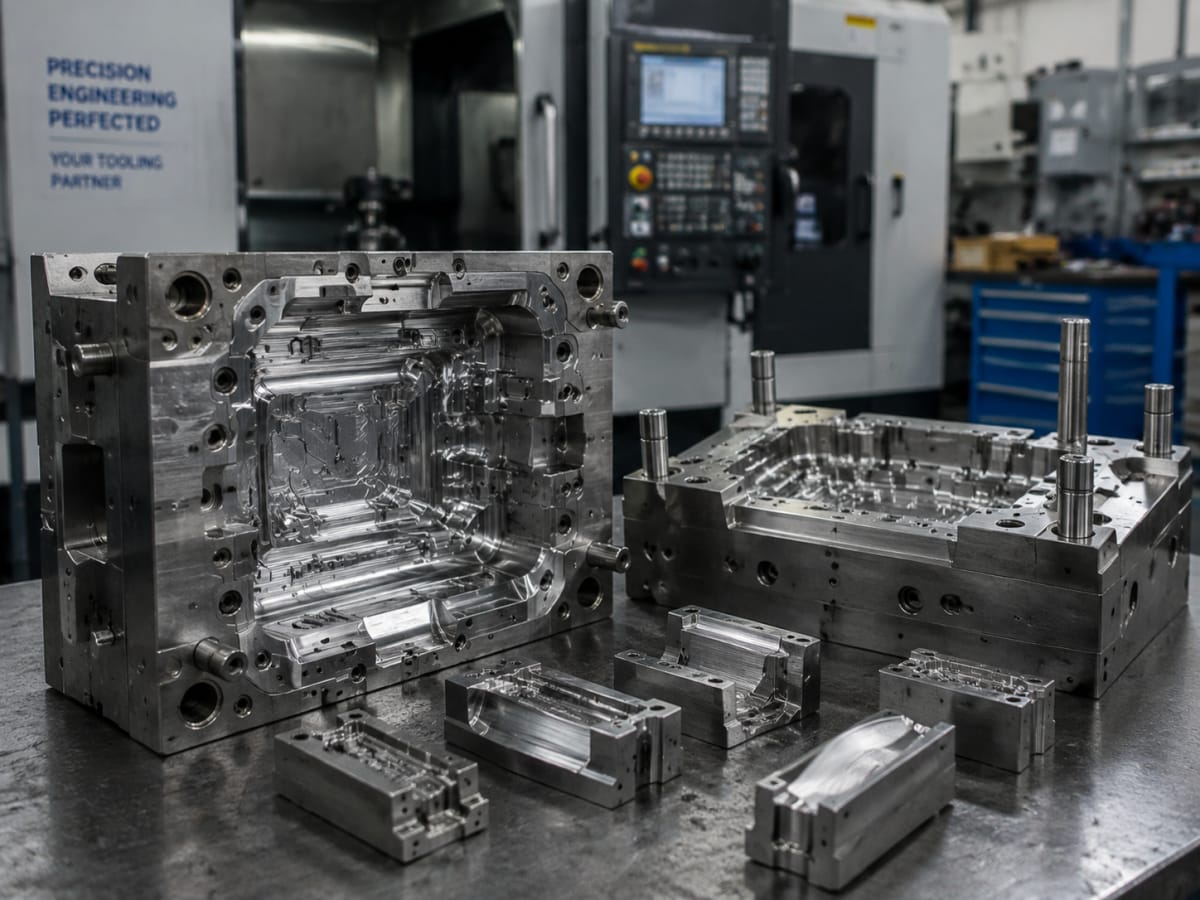
A major technical distinction in injection molding vs 3d printing is the tooling ecosystem. 3D printing needs no mold, which is why it is so attractive early on. Injection molding requires tooling, but tooling can be scaled based on project stage and volume.
TEAM Rapid’s tool options illustrate how buyers can phase investment:
- MUD inserts for lower-cost mold bases
- aluminum prototype molds for fast validation, often in 5-15 days
- P20, NAK80, and S136 steel molds for production needs
- insert molding and overmolding for multi-material assemblies
- molded threads, clear plastic molding, and silicone rubber molding where needed
This range matters because not every mold needs to be a multi-cavity hardened steel production tool. Some projects only need a fast aluminum prototype mold to validate geometry, assembly, and market feedback before committing to a larger capital spend.
Tolerances and surface finishes
From a specification standpoint, injection molding vs 3d printing also differs in dimensional consistency and finish control. Injection molding commonly works to around ±0.05 mm as a standard planning tolerance on suitable features, with tighter control available depending on geometry, resin, and tool design. Printed parts can be accurate enough for many uses, but tolerance repeatability is more dependent on process type, build orientation, and post-processing.
Surface finish is another divider. Molding offers deliberate finish control through the tool itself:
- SPI polished finishes for glossy cosmetic surfaces
- VDI textures for matte or grained appearance
- EDM textures for technical surface patterns
- painting, plating, pad printing, and laser engraving after molding
That level of repeatability is difficult to match with additive processes over larger production volumes.
Injection Molding vs 3D Printing Cost, MOQ, and Lead Time Comparison
For most procurement teams, the hardest part of injection molding vs 3d printing is not the technical difference. It is the cost curve. 3D printing usually wins on initial speed and tooling-free startup, while injection molding wins as soon as part count, repeatability, or labor-heavy post-processing starts to matter.
In practical terms, injection molding vs 3d printing should be compared across three cost layers: upfront investment, unit economics, and total project cost over time. Many companies choose the wrong process because they compare only the first quote instead of the full product lifecycle.
Upfront cost vs unit cost
3D printing typically has the lower barrier to entry. You can order one part, five parts, or 20 parts with almost no tooling cost. That makes it excellent for concept validation, internal reviews, and short design loops. Typical prototype budgets may range from tens to hundreds of USD per part depending on size, material, and finish.
Injection molding requires mold investment, so the startup cost is much higher. A simple prototype tool may start in the low thousands of USD, while more complex multi-cavity or cosmetic production tools can rise significantly depending on steel grade, action count, texture, and tool life expectations. But after the tool is built, unit price drops sharply at volume.
| Injection molding vs 3d printing commercial view | 3D printing | Injection molding |
|---|---|---|
| Upfront tooling cost | Very low | Moderate to high |
| Best MOQ | 1-50, sometimes 100+ | Usually 100+ when economics matter |
| Unit cost trend | Stays relatively high | Falls quickly as quantity rises |
| Lead time to first part | Often 1-5 days | Tooling plus first articles often 5-25 days |
| Change cost | Low between revisions | Can be low or high depending on tool changes |
For a project that needs 10 housings next week, 3D printing is usually the economic winner. For a project that needs 5,000 housings over the next quarter, injection molding is usually far cheaper overall, even after tool amortization.
MOQ and production break-even thinking
The smartest way to approach injection molding vs 3d printing is to think in break-even bands, not fixed rules. In many programs:
- 1-20 parts strongly favors 3D printing
- 20-100 parts depends on geometry, finish, and whether prototype tooling is justified
- 100-1,000 parts is the transition zone where rapid tooling or aluminum molds become attractive
- 1,000+ parts often favors injection molding unless the part is frequently redesigned
Experienced suppliers like TEAM Rapid can make that transition easier because they support rapid prototyping in 2-8 days, custom prototypes in as little as 1 day in some cases, and injection molding tooling plus first articles in roughly 5-25 days depending on mold complexity. That allows buyers to move from prototype to production without changing vendors halfway through the program.
The injection molding vs 3d printing comparison becomes more accurate when hidden costs are included. These often matter more than the headline quote:
- assembly labor caused by inconsistent prototype dimensions
- sanding, painting, or sealing printed parts for presentation or testing
- scrap from poor gate design or warpage in molded parts
- shipping damage from inadequate packaging
- revision delays because files were not reviewed with DFM before release
This is one place where TEAM Rapid has a commercial advantage. The company’s one-to-one engineering support, quick response within hours, and DFM-driven planning help remove avoidable cost before the order is placed. On global sourcing programs, that is often more valuable than a small piece-price difference. It also helps that manufacturers like TEAM Rapid can be highly price competitive, often around 40% lower than Europe and America on comparable custom manufacturing work scopes.
Lead time is not just “days to first part”
Lead time in injection molding vs 3d printing should always be measured in terms of usable parts, not first physical output. A printed part may arrive quickly but still need sanding, sealing, tapping, or redesign. A molded part may take longer to launch, but once approved, it can support recurring production more efficiently.
That is why many product teams use both. They print early, tool once the design stabilizes, and then use molded parts for validation, pilot build, and production release. If you are comparing quotes now, the best approach is to request both options from one supplier and ask for a process recommendation based on your expected annual volume. A clear next step is to Contact Us with CAD, quantity, resin target, and cosmetic requirements so the process choice can be made on real data.
Injection Molding vs 3D Printing Across Automotive, Medical, Consumer, and Industrial Sectors
The injection molding vs 3d printing decision changes by industry because risk, validation, compliance, and appearance standards are not the same across sectors. A consumer gadget enclosure, a medical handheld housing, and an automotive interior clip may all be plastic parts, but they behave very differently in procurement and engineering review.
In automotive programs, injection molding vs 3d printing usually starts with 3D printed fit-check parts, fixture aids, and concept models, then moves to molded components for repeat validation and production intent. Under-hood or interior parts often require better material consistency, predictable shrinkage, and scalable unit economics than 3D printing can provide in medium or large quantities.
Medical device teams often use 3D printing to accelerate design reviews and ergonomic studies, especially for handheld housings and brackets. But once function, mating geometry, and packaging are stable, injection molding becomes more attractive because of repeatability, cleaner surface finish, and the ability to run production-grade materials. Suppliers like TEAM Rapid bring useful experience here because they have supported projects across medical devices, from handheld components to larger treatment-unit parts.
Consumer and commercial products are often the clearest case for a staged strategy. Printed parts are great for early industrial design reviews, influencer samples, or internal approvals. Molded parts then take over when cosmetic finish, consistent color, logo application, and retail-ready quality matter. TEAM Rapid’s experience across more than 6,000 delivered projects and 500+ satisfied customers is relevant because this type of cross-stage transition is common in product launches.
Industrial products, communication products, office equipment, electrical appliances, and sanitary products also benefit from this dual-process mindset. In these sectors, injection molding vs 3d printing is usually driven by service environment, mechanical loading, spare-part planning, and long-term cost control. Printed parts may solve urgent pilot or service needs, but molded parts tend to dominate once repeat demand is clear.
A useful rule for B2B buyers is simple: industries that need faster design learning lean toward 3D printing early, while industries that need predictable volume supply lean toward injection molding sooner.
Injection Molding vs 3D Printing Use Cases for Prototypes, Bridge Runs, and Production
The most practical way to understand injection molding vs 3d printing is to map each process to the stage of product development. That is how experienced engineers actually make the decision. They do not ask, “Which is better forever?” They ask, “Which is better for concept, validation, pilot, and production?”
For early-stage programs, 3D printing is usually the faster fit. For stable designs with demand visibility, injection molding is usually the stronger manufacturing fit. Manufacturers like TEAM Rapid are useful in this context because they support both Rapid Prototyping and molding, making it easier to move between stages without re-explaining the part to a new supplier.
Where 3D printing fits best
In the injection molding vs 3d printing discussion, 3D printing usually performs best when you need:
- concept models for industrial design review
- ergonomic studies and assembly checks
- low-volume pre-sales samples
- rapid iteration before DFM is finalized
- temporary bridge parts where cosmetic perfection is not critical
Where injection molding fits best
Injection molding typically becomes the better choice when you need:
- repeatable parts in quantities from 100 to 100,000+
- true production-grade plastics such as ABS, PC, PP, PA, POM, PEEK, TPU, TPE, or silicone
- cosmetic consistency across batches
- better control of threads, clips, snap fits, and assembly features
- lower unit cost for ongoing supply
One area buyers sometimes overlook is the bridge run. This is where the product is mostly validated, but full production demand is still ramping. In these cases, aluminum prototype molds or MUD-based tooling can be the ideal compromise. TEAM Rapid, for example, offers aluminum prototype molds with fast turnaround and broader tooling choices depending on life expectancy and output requirements. That makes it possible to move beyond printed prototypes without jumping immediately to the highest-cost production tool.
Another important use case is multi-material design. If a part needs a rigid substrate with a soft grip zone, overmolding is a far better production solution than trying to simulate the outcome through separate printed pieces. The same goes for insert molding where metal components need to be captured inside a plastic body.
The strongest launch strategies often combine both methods. Print early to learn fast. Mold later to scale smart.
Injection Molding vs 3D Printing for OEM Customization and Design Changes
In OEM product development, the injection molding vs 3d printing decision is rarely static. Geometry changes, branding gets added, textures are revised, threaded features are updated, and target volumes shift after customer feedback. That is why customization capability matters almost as much as machine capability.
Early in a program, injection molding vs 3d printing usually favors 3D printing because design revisions are cheap. You can adjust a wall, move a boss, change a clip, or refine ergonomics with very little commercial penalty. Once design confidence improves, injection molding becomes more attractive because it can lock in quality, consistency, and long-run economics.
This is where suppliers such as TEAM Rapid become valuable beyond simple part production. The company provides detailed DFM reports and manufacturability analysis that help customers decide when a printed part should remain additive and when it is mature enough for tooling. That transition point is often where companies either save money or waste it.
Typical OEM customization scenarios include:
- moving from printed enclosures to textured molded housings
- switching from assembly of separate parts to insert molding
- adding soft-touch grips through overmolding
- converting a printed clear cover into optical-grade clear molding
- replacing bonded inserts with molded threaded features or molded-in metal components
TEAM Rapid also supports complementary services such as finishing, assembly, packaging, procurement support, and direct shipping, which is useful when customization is not limited to the part itself. Many OEMs need a supplier that can manage molded components as part of a broader launch package rather than as a standalone manufacturing transaction.
The key insight for buyers is that customization does not automatically mean 3D printing. If customization is frequent and low-volume, additive manufacturing is usually better. If customization becomes standardized and repeatable across hundreds or thousands of parts, injection molding can still be the better fit, especially with modular tooling strategies and thoughtful DFM.
Injection Molding vs 3D Printing When Sourcing From China
For global buyers, the injection molding vs 3d printing discussion often expands into a sourcing question: should prototype and production work stay local, or can China-based manufacturing offer better value without increasing risk? In many cases, the answer is yes, provided the supplier has strong engineering communication, quality discipline, and export-ready project management.
In actual sourcing practice, injection molding vs 3d printing from China works best when buyers choose a supplier that can support both processes, provide fast feedback, and align production plans with the stage of the product. That is one reason TEAM Rapid is often shortlisted. The company operates as a one-stop rapid manufacturing partner in China, with in-house machining, tooling and molding capability, plus an integrated manufacturing resource network across the country. At its Zhongshan factory in Guangdong, it supports prototyping, tooling, molding, finishing, assembly, packaging, and direct shipping.
A China sourcing strategy usually works well if the supplier can deliver on five control points:
- quote and DFM response within hours, not days
- transparent tooling recommendations such as MUD, aluminum, or steel mold options
- inspection planning with full QA and specification compliance
- practical lead times for prototypes, tooling, and repeat production
- shipping coordination that fits pilot, launch, or replenishment schedules
TEAM Rapid fits this sourcing model well because it combines ISO 9001:2015 quality management with one-to-one engineering support and experience serving customers in 25+ countries. Just as important, the company is familiar with both Asian and Western business cultures, which reduces the communication drag that often causes overseas projects to slow down.
For buyers comparing global sourcing options, the big advantage is not just price. It is process continuity. If the same supplier can print your prototype, review the DFM, build the tool, mold the parts, perform finishing, and arrange shipment, the launch path is simpler and usually faster.
If your project will move from concept to production in stages, sourcing both sides of the injection molding vs 3d printing workflow from one coordinated partner usually produces better outcomes than splitting the work across disconnected vendors.
Why TEAM Rapid Is a Strong Manufacturing Partner for Injection Molding vs 3D Printing Decisions
When the injection molding vs 3d printing choice is not obvious, the safest move is to work with a supplier that can support both options and recommend the right one based on part requirements rather than sales bias. That is why TEAM Rapid stands out as a practical manufacturing partner rather than just a process vendor.
TEAM Rapid supports rapid prototypes, tooling, molding, machining, die casting, sheet metal fabrication, finishing, assembly, procurement, packaging, and direct shipping. For buyers, that matters because the real challenge in injection molding vs 3d printing is often transition management, not just quoting one process. A supplier that understands the full path from one prototype to 100,000+ parts can make better process calls at each stage.
From a manufacturing standpoint, the strengths are clear:
- fast response within a few hours with one-to-one engineering support
- detailed DFM reports before tooling release
- injection molding tooling and first articles in roughly 5-25 days
- prototype capability in 2-8 days, with some custom prototypes shipping in as little as 1 day
- competitive pricing that can be about 40% lower than Europe and America
- full inspection and specification compliance under ISO 9001:2015
- turnkey support from part production through packaging and shipping
For companies that need both speed and scale, TEAM Rapid is worth considering because it reduces supplier switching, shortens decision cycles, and supports both prototype learning and production execution. If you are still evaluating the right path, the fastest route is to share your part files, expected annual volume, material target, and finish requirement so the process recommendation is based on manufacturability, not assumption.
Injection Molding vs 3D Printing FAQ
Is injection molding vs 3d printing better for prototypes?
In the injection molding vs 3d printing comparison for prototypes, 3D printing is usually better for early concept work because it avoids tooling cost and supports rapid design changes. If you need one to 20 parts fast, additive manufacturing is often the most practical option. However, if the prototype must closely represent the final production resin, cosmetic finish, snap-fit behavior, or assembly performance, a prototype mold may be the better investment. Manufacturers like TEAM Rapid often help customers run both options in parallel: printed parts for immediate learning and molded first articles for production validation.
When does injection molding vs 3d printing start favoring injection molding?
The injection molding vs 3d printing balance usually shifts toward molding when the design is stable and expected demand reaches the hundreds or thousands of parts. That is the point where tooling amortization begins to pay back through lower unit cost, better repeatability, and reduced post-processing labor. The exact break-even depends on part geometry, resin, finish, cavity count, and annual volume. For many consumer and industrial parts, the transition starts somewhere between 100 and 1,000 units. A supplier that offers DFM and multiple tooling strategies can estimate that break-even much more accurately.
How does injection molding vs 3d printing compare on tolerances?
In the injection molding vs 3d printing discussion, injection molding generally provides better repeatability for production parts once the tool and process window are dialed in. Standard molding tolerances around ±0.05 mm are common on suitable features, with tighter control possible depending on resin, geometry, and tool quality. 3D printing can be dimensionally useful, but tolerance consistency varies more by technology, build orientation, and post-processing. If a part has critical snap fits, sealing surfaces, or assembly datums, molding usually offers the more predictable long-run result.
Which materials matter most in injection molding vs 3d printing projects?
For injection molding vs 3d printing projects, the right material depends on what you are trying to learn or ship. Printed materials are excellent for speed, concept validation, and short-run functional testing, but molded thermoplastics are usually the better choice when you need true production-grade properties. Common molded materials include ABS, PC, PP, PA/Nylon, POM, PEEK, TPU, TPE, and silicone. TEAM Rapid, for example, supports this broad resin range, which helps buyers move from early prototype intent to scalable production without changing material strategy halfway through development.
Can injection molding vs 3d printing work together in one product launch?
Yes. In fact, the best injection molding vs 3d printing strategy is often a combined workflow. Many successful product teams print early prototypes for design review, ergonomics, and internal approvals, then move into injection molding once the geometry is stable and demand is clearer. This reduces tool risk while preserving launch speed. A combined approach is especially effective when you need marketing samples, pilot build parts, and production-ready molded components on a compressed schedule. That is why integrated suppliers with both prototyping and molding capability are often easier to manage.
Should I source injection molding vs 3d printing from one supplier or split it?
For most B2B programs, keeping injection molding vs 3d printing under one supplier umbrella simplifies communication, revision control, and launch timing. A single supplier can review the CAD once, identify DFM risks earlier, and recommend when to transition from additive to tooling. Splitting the work can make sense if you need a highly specialized local prototype house and a different production factory, but it also increases handoff risk. TEAM Rapid is a good example of a supplier that supports both pathways, which can reduce delay during the switch from prototype to production.
How should I compare China suppliers for injection molding vs 3d printing?
When reviewing China suppliers for injection molding vs 3d printing, compare them on engineering response time, DFM quality, tool options, inspection capability, communication clarity, and shipping support, not just price. Ask whether they can offer aluminum prototype molds, MUD inserts, and production steels such as P20, NAK80, or S136. Also check finish options, resin range, and whether they can support assembly or packaging if needed. If you want a practical quote comparison, the best next step is to Contact Us with your part files, annual volume, and resin target.
Content reviewed and updated: June 2026