How to Control the Injection Molding Color
Color is an important consideration when manufacturing custom plastic injection molded parts. Whether producing consumer products, automotive components, electronic housings, or industrial parts, manufacturer need to control color in injection molding by selecting the right coloring method, maintaining consistent resin and colorant ratios, and stabilizing processing parameters to ensure uniform color across all production batches.
Different plastic materials, colorant properties, production volumes, and processing parameters can all affect the final appearance. How do you select the right colorant? Should you use color masterbatch, liquid colorants, dry pigment powder, or pre-colored resin? How can you maintain color consistency from prototypes to mass production?
This article explains the key factors involved in injection molding color matching and practical ways to control color during production.

Four Common Coloring Methods for Injection Molding
Color Masterbatch
Color masterbatch contains concentrated pigments dispersed in a carrier resin. It is mixed with natural plastic resin at a specified ratio before injection molding.
Masterbatch is widely used because it offers convenient color dosing, good color consistency, and flexibility when changing colors or production quantities. However, the carrier resin must be compatible with the base plastic material.
Liquid Colorants
Liquid colorants contain pigments or other coloring ingredients in a liquid carrier. They are added to plastic resin using suitable dosing equipment.
They can be useful for certain materials and production applications, but their suitability depends on the resin, formulation, dosing system, and required color performance.
Dry Pigment Powder
Dry pigment powder can be mixed directly with plastic resin in suitable applications. This method may reduce the need for a masterbatch carrier, but achieving uniform dispersion and controlling dust and dosing can be more challenging.
Appropriate mixing equipment and process control are important to avoid uneven coloring, pigment agglomeration, and contamination.
Pre-Colored Resin
Pre-colored resin is plastic material that has already been compounded with pigments or colorants to achieve the required color. It is supplied ready for injection molding, so the manufacturer does not need to add a separate colorant during the molding process.
This option can provide good color consistency because the pigment is incorporated during the resin compounding process. It is particularly useful for mass production, repeated production orders, and projects requiring stable color across large quantities.
However, pre-colored resin may have a higher purchase cost, supplier minimum order quantity, and longer material procurement lead time. It can also be less flexible when customers need frequent color changes or small production quantities.
How to Choose the Right Coloring Method
The choice depends on several factors:
- Required color and appearance
- Plastic resin type and grade
- Pigment compatibility and heat resistance
- Production quantity and supplier MOQ
- Color consistency requirements
- Material cost and procurement lead time
- Whether the project requires frequent color changes
For small production runs, standard masterbatch or suitable liquid colorants may be practical. For larger and repeated production orders, pre-colored resin or custom masterbatch may offer better control over color consistency and material supply.
The most suitable method should be evaluated according to the total project cost and quality requirements, rather than production volume alone.
Color or Appearance
Color and appearance are related, but they are not exactly the same. A plastic part may have the correct color formulation but still look different because of its surface finish, texture, gloss, or thickness.
For example, a high-gloss surface may reflect more light and appear brighter than a textured surface. Transparent and translucent plastic parts also show color differently depending on wall thickness and light transmission.
When matching a custom injection molding color, consider:
- Color shade and saturation
- Surface gloss and texture
- Transparency or opacity
- Part thickness
- Mold surface finish
- Lighting conditions during inspection
If the customer provides a physical color sample, the manufacturer should consider both its color and surface appearance when preparing the molded sample.
Resin Material Affects Color
Different plastic materials can affect the final color of injection molded parts. Resin transparency, natural color, processing temperature, and material properties all influence the appearance of the finished product.
For example:
- ABS: Commonly used for colored housings and consumer products. It offers good colorability and surface appearance.
- PC: Often used for transparent or high-performance components. Its processing temperature and moisture control must be considered.
- PP: Commonly used for automotive and household products. Its natural appearance and material formulation can influence color matching.
- PA (Nylon): Moisture absorption and processing conditions can affect appearance and dimensional stability.
- PMMA: Frequently selected for transparent and high-gloss components.
- PET: Drying and processing conditions are important for maintaining material quality and appearance.
The same pigment formulation may produce different results in ABS, PC, PP, or PA. Therefore, color matching should be carried out using the actual resin grade intended for production whenever possible.
Acceptance Standards for Color Variation
It is difficult to achieve absolutely identical colors across every molded part and production batch. Small differences may occur because of variations in raw materials, pigment dispersion, machine conditions, and surface appearance.
To control color quality, manufacturers and customers should agree on an acceptable color tolerance before production.
A spectrophotometer can measure color using the CIELAB color space, which describes color through three values:
- L*: Lightness, from black to white.
- a*: Green-to-red color position.
- b*: Blue-to-yellow color position.
The color difference between a reference sample and a production sample can be expressed as ΔE.
A lower ΔE generally indicates a closer color match. However, there is no single ΔE tolerance suitable for every product. The acceptable limit should be agreed upon according to the application, visual requirements, and customer expectations.
For critical appearance parts, it is also useful to inspect samples under consistent lighting conditions.
Injection Molding Processing Conditions
Even with the correct pigment and resin, processing conditions can affect the final color.
Important parameters include:
- Melt temperature
- Mold temperature
- Injection speed and pressure
- Screw speed and back pressure
- Material residence time
- Cooling conditions
Excessive melt temperature or residence time may cause resin or pigment degradation, resulting in discoloration. Poor mixing can also create uneven pigment distribution.
In addition, changes in mold temperature and surface conditions may affect gloss and perceived color.
Maintaining stable processing conditions is essential for producing consistent injection molded colors.
How Does Production Volume Affect Injection Molding Color Selection
Production volume is another important factor when selecting pigments and coloring methods. The most economical coloring solution for a small prototype run may not be suitable for bridge production or mass production.
The choice between standard masterbatch, custom masterbatch, liquid colorants, dry pigments, and pre-colored resin depends on the required color, supplier MOQ, material compatibility, and production quantity.
Coloring for Low-Volume Injection Molding
Low-volume injection molding is commonly used for prototypes, product validation, market testing, and small production runs.
For these projects, standard color masterbatch or suitable liquid colorants can be practical choices. They can help manufacturers avoid the cost and minimum order quantity associated with developing a custom pigment formulation.
Pre-colored resin is another option when the required color is already available from a material supplier. However, purchasing a dedicated pre-colored material may be uneconomical for very small quantities because of supplier MOQ and material inventory requirements.
If a special color is required, manufacturers should consider:
- Custom pigment or masterbatch preparation costs
- Colorant or pre-colored resin supplier minimum order quantities
- Material waste during color changes
- Remaining colorant or resin inventory after production
- Whether the selected coloring method is compatible with the resin
For a small quantity of parts, the cost of a custom color formulation may be disproportionately high. A suitable standard color, available pre-colored resin, or existing masterbatch may offer a more economical solution.
However, if the product requires an exact brand color, a custom color match may still be necessary.
Coloring for Bridge Production
Bridge production fills the gap between prototype manufacturing and full-scale mass production. It allows companies to produce parts for market testing, initial sales, or production while permanent tooling and supply arrangements are being finalized.
Color consistency becomes particularly important during this stage.
Manufacturers should:
- Use a consistent pigment and colorant formulation.
- Confirm that the colorant or pre-colored resin supply can support the planned production quantity.
- Use the intended production resin grade.
- Maintain consistent dosing and molding parameters.
- Keep an approved color reference for future production.
If the project will move to mass production, it is worth considering whether the same pigment formulation and coloring method can be maintained. Changing the pigment supplier, masterbatch carrier, pre-colored resin supplier, or colorant concentration later may affect the final appearance.
Coloring for Mass Production
For mass production, custom masterbatch or pre-colored resin may be practical options.
A dedicated masterbatch formulation can support consistent color control when the resin grade, pigment concentration, and molding conditions are kept stable. Pre-colored resin can also simplify material preparation because the color is already incorporated into the resin before it reaches the molding factory.
Manufacturers should establish controls for:
- Pigment and masterbatch batch consistency
- Pre-colored resin batch consistency
- Colorant dosing ratios, where applicable
- Mixing and dispersion
- Resin drying and preparation
- Injection molding parameters
- In-process color inspection
For long-term production, material and colorant supply should also be planned carefully. Changes in pigment batches, resin suppliers, or compounding formulations can affect color consistency, so incoming material inspection and production records are important.
Comparing Coloring Requirements at Different Production Volumes
| Consideration | Low-volume production | Bridge production | Mass production |
| Common coloring methods | Standard masterbatch, suitable liquid colorants, or available pre-colored resin | Masterbatch, custom color formulation, or pre-colored resin | Custom masterbatch or pre-colored resin |
| Main priority | Minimize initial cost and material waste | Balance cost, color matching, and repeatability | Maintain long-term color consistency |
| Color flexibility | High, depending on the coloring method | Moderate to high | Depends on material procurement and color formulation |
| Inventory planning | Avoid excess colorant or resin inventory | Ensure sufficient supply for planned batches | Plan long-term resin and pigment supply |
| Quality control | Approve initial samples and inspect production parts | Maintain color consistency between batches | Control material batches and establish regular inspection |
The most economical approach depends on the total project cost and quality requirements, not production volume alone.
How Does the Color-Matching Process Work for Custom Injection Molded Parts
Custom injection molding color matching involves more than selecting a pigment from a color chart. The manufacturer needs to prepare a suitable pigment formulation, test it with the intended plastic resin, and confirm the appearance using molded samples.
A typical color-matching process includes the following steps.
Step 1: Provide a Color Reference
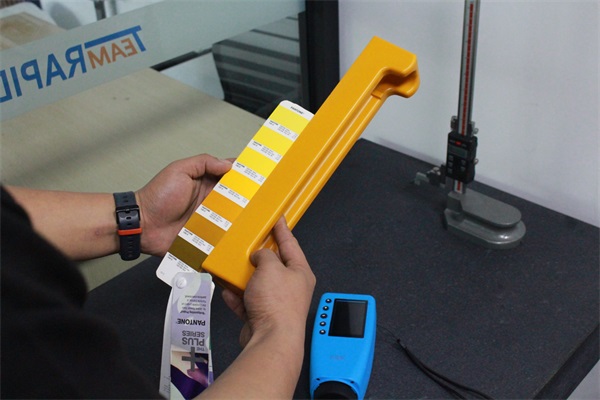
Customers can provide a Pantone reference number or a physical sample showing the required color.
Pantone references are useful starting points, but a printed color swatch may not look exactly the same as a molded plastic part. Plastic material, surface finish, thickness, and gloss can all affect the appearance.
For critical color requirements, providing a physical plastic sample is often preferable.
Step 2: Analyze the Required Color
The manufacturer evaluates the reference color and identifies a suitable pigment combination.
A spectrophotometer can measure the reference sample and provide CIELAB color values. This helps the color-matching team develop a more accurate formulation.
Step 3: Prepare the Pigment Formulation
The appropriate pigments and coloring method are selected according to the resin material, processing temperature, color requirements, and production volume.
The manufacturer also considers whether to use masterbatch, liquid colorants, dry pigment powder, or pre-colored resin. Pigment concentration and carrier compatibility should be considered where applicable.
Step 4: Produce a Color Sample
A sample plaque or molded part is produced using the intended plastic material and coloring formulation.
The sample should have a suitable surface area and finish for reliable visual or instrument-based comparison.
Step 5: Review and Approve the Color
The customer reviews the sample under suitable lighting conditions. If necessary, the manufacturer adjusts the pigment formulation or coloring method and produces another sample.
Production should proceed using the approved color reference and agreed acceptance criteria.
How to Control Injection Molding Color During Production
After color matching is approved, maintaining the same color throughout production becomes the next challenge.
Color variation can occur because of inconsistent raw materials, incorrect pigment dosing, poor dispersion, material degradation, and unstable machine settings.
The following practices help manufacturers maintain injection molding color consistency.
Use Consistent Plastic Resin, Pigments, and Pre-Colored Materials
Different resin grades and pigment batches may produce different color results, even when the same color formulation is used.
To reduce variation:
- Use the approved plastic resin grade.
- Keep the pigment or masterbatch formulation consistent.
- Use the approved pre-colored resin formulation and supplier whenever possible.
- Check incoming material batches.
- Avoid changing pigment or pre-colored resin suppliers without testing.
- Record the material and pigment batch numbers.
When using pre-colored resin, manufacturers should maintain the same resin grade, supplier, and approved color formulation whenever possible. Different material batches may produce slight color differences. Incoming material inspection and batch traceability help reduce these variations.
Using consistent raw materials is an important foundation for stable color production.
Control Pigment Dosage and Dispersion
Even when the correct pigment has been selected, inconsistent dosing or poor dispersion can cause color variation in injection molded parts.
To maintain consistent color during production:
- Follow the pigment or masterbatch supplier’s recommended dosage.
- Keep the pigment-to-resin mixing ratio consistent between batches.
- Use suitable mixing equipment to achieve uniform pigment dispersion.
- Avoid changing pigment suppliers or formulations without conducting color trials.
- Check for pigment agglomeration, streaks, and uneven color distribution in molded samples.
For masterbatch coloring, the dosing percentage should be controlled carefully. Too little masterbatch can produce a lighter shade, while excessive addition may result in a darker shade or other appearance changes. The actual result also depends on pigment concentration, resin properties, dispersion, and processing conditions.
Consistent pigment dosing and dispersion are particularly important when producing multiple batches or transitioning from bridge production to mass production.
Control Material Drying and Preparation
Some plastic materials absorb moisture from the environment. If they are not dried properly, moisture can cause surface defects, discoloration, or other processing problems.
Materials such as PC, PA, and PET often require controlled drying before injection molding.
Manufacturers should follow the resin supplier’s recommended drying temperature and time. Proper material preparation helps maintain stable processing conditions and consistent part appearance.
Pre-colored resin must also be handled and dried according to the base resin supplier’s recommendations. Adding color does not remove the material’s moisture sensitivity.
Maintain Stable Injection Molding Parameters
Changes in machine settings can affect both the material and the final appearance of molded parts.
Important parameters include:
- Melt temperature
- Mold temperature
- Injection speed
- Screw speed and back pressure
- Material residence time
- Cooling time
For example, excessive melt temperature or prolonged residence time may cause thermal degradation, resulting in discoloration. Inconsistent mixing may also create uneven color distribution.
Manufacturers should establish suitable molding parameters during the initial production trial and maintain them throughout production.
Approve the First Molded Parts Before Production
Before continuing with a production run, the first molded parts should be checked against the approved color sample.
This first-piece approval helps identify color differences before a large quantity of parts is produced.
The inspection should consider:
- Color shade
- Surface gloss
- Texture
- Transparency or opacity
- Visible streaks or spots
If the color does not meet the agreed requirements, the manufacturer should investigate the cause and adjust the process before proceeding.
Inspect Color During Production
Color inspection should not be limited to the first molded parts. Manufacturers should also check samples at appropriate intervals throughout production.
Visual inspection under consistent lighting can identify obvious color differences. For more critical applications, a spectrophotometer can measure color values and ΔE against the approved reference.
The inspection frequency should depend on production volume, application requirements, and the agreed quality control plan.
Control Color Changes Between Production Batches
When production involves multiple batches, maintaining color consistency becomes especially important.
Manufacturers should keep records of:
- Resin grade and batch number
- Pigment or masterbatch supplier and batch number
- Pre-colored resin supplier and batch number, where applicable
- Pigment concentration or masterbatch dosing ratio
- Drying conditions
- Injection molding parameters
- Approved color reference
- Inspection results
These records help identify the cause of color differences and make it easier to reproduce the approved color in future production.
Common Injection Molding Color Problems and Solutions
| Color problem | Possible causes | Recommended actions |
| Parts appear too light | Low pigment concentration, incorrect dosing, poor dispersion | Check dosing ratio and mixing quality |
| Parts appear too dark | Excessive colorant addition, resin or pigment batch variation | Verify material batches and formulation |
| Uneven color or streaks | Poor pigment dispersion, inconsistent mixing | Improve mixing and check masterbatch compatibility |
| Color changes after machine stoppage | Excessive material residence time or thermal degradation | Follow suitable restart and purging procedures |
| Different gloss or perceived color | Mold surface condition, mold temperature, processing variation | Check surface finish and stabilize molding conditions |
| Color differences between batches | Changes in resin or pigment batches, inconsistent dosing | Use approved materials and maintain batch records |
The actual cause should be investigated before changing the pigment concentration or machine settings. Otherwise, an adjustment may solve one appearance problem while creating another.
Maintain an Approved Color Reference
An approved physical sample should be retained as the reference for future production.
Manufacturers can also record the corresponding CIELAB values, ΔE tolerance, resin grade, pigment formulation, and molding conditions.
Using the same reference and inspection method helps reduce subjective differences between operators and production batches.
Benefits of Custom Injection Molding Color Matching
Custom color matching provides several benefits for plastic product manufacturing.
- Consistent product appearance: Helps maintain the required color across different parts and production batches.
- Brand identity: Allows manufacturers to produce plastic components that match a customer’s brand colors.
- Material flexibility: Supports different plastic resins and application requirements through suitable pigment selection.
- Better quality control: Establishes measurable color references and acceptance standards.
- Production flexibility: Supports prototypes, low-volume production, bridge production, and mass manufacturing.
The right pigment formulation and coloring process help manufacturers achieve the required appearance while reducing unnecessary adjustments, rejected parts, and material waste.
Custom Injection Molding Color Matching at TEAM Rapid
At TEAM Rapid, we provide custom injection molding services for prototypes, low-volume production, bridge production, and mass production.
We work with customers to understand their plastic material, color requirements, and production quantities. Customers can provide a Pantone reference or physical sample for color matching.
The color-matching process considers pigment selection, resin compatibility, coloring method, and molding conditions. Depending on the project requirements, suitable options may include color masterbatch, liquid colorants, or pre-colored resin. Sample parts can be reviewed before production to confirm that the color meets the agreed requirements.
Whether you need a small batch of custom-colored plastic parts or a larger production run, selecting the right pigment and coloring method and maintaining stable processing conditions are essential for consistent results.
Contact TEAM Rapid to discuss your custom injection molding project and color requirements.
Frequently Asked Questions About Injection Molding Color
Q: How do you control color in plastic injection molding?
A; Color in plastic injection molding is controlled by selecting suitable pigments and coloring methods, maintaining consistent resin and colorant ratios, and stabilizing molding parameters such as melt temperature, mold temperature, and residence time. Manufacturers can also use spectrophotometers to measure color differences and maintain consistency between production batches.
Q: What is the difference between color masterbatch and pre-colored resin?
A: Color masterbatch is a concentrated pigment formulation mixed with natural plastic resin at a controlled ratio before injection molding. Pre-colored resin has already been compounded with pigments to achieve the required color and can be used directly in the molding process. Masterbatch offers greater flexibility when changing colors, while pre-colored resin can simplify material preparation and support consistent color in repeated production runs.
Q: What types of pigments are used in plastic injection molding?
A: Plastic injection molding commonly uses organic and inorganic pigments. Organic pigments generally provide bright, vivid colors, while inorganic pigments often offer good heat stability, opacity, and weather resistance. The right pigment depends on the plastic resin, processing temperature, required appearance, and application conditions.
Q: Which coloring method is best for low-volume and mass injection molding?
A: For low-volume injection molding, standard color masterbatch or suitable liquid colorants can help reduce initial costs and avoid large material minimum order quantities. For mass production, custom masterbatch or pre-colored resin may provide better long-term color consistency and material supply planning. The best option depends on the required color, resin compatibility, supplier MOQ, and total production cost.
Q: How do manufacturers measure color differences in injection molded parts?
A: Manufacturers can use a spectrophotometer to measure color in the CIELAB color space (L*, a*, and b*). The difference between the approved reference sample and the production part is expressed as ΔE. A lower ΔE generally indicates a closer color match. The acceptable ΔE tolerance should be agreed upon by the customer and manufacturer before production.