Aluminum vs P20 Injection Mold: Cost, Tool Life, and Lead Time
Choosing between an aluminum vs P20 injection mold is an important decision when planning an injection molding project. The mold material directly affects tooling cost, manufacturing lead time, mold durability, cooling performance, and long-term production costs. Choose aluminum molds when lower initial cost and faster machining are the priorities, but choose P20 steel molds when mold durability, production stability, and consistent part quality are more important.
Aluminum molds are commonly used for prototypes, rapid tooling, and low-volume injection molding because aluminum is easier to machine and transfers heat efficiently. P20 steel molds, on the other hand, offer better wear resistance, higher mechanical strength, and longer service life, making them suitable for bridge tooling and production applications.
However, aluminum is not always the cheapest option, and P20 steel is not always necessary. The right choice depends on the expected production quantity, plastic material, part geometry, dimensional requirements, and project budget.
In this article, we compare aluminum and P20 injection molds in terms of cost, tool life, lead time, and manufacturing applications to help you select the right tooling material for your project.
What Is the Difference Between Aluminum and P20 Injection Molds
Aluminum and P20 are two commonly used materials for injection mold manufacturing. Their differences mainly come from mechanical strength, hardness, thermal conductivity, machinability, and wear resistance.
Aluminum Injection Molds: Properties and Applications
Aluminum injection molds are typically manufactured using high-strength aluminum alloys such as 6061 and 7075. These materials are relatively easy to machine, allowing mold makers to produce cavities and cores in less time than conventional tool steel.
The main characteristics of aluminum molds include:
- Good machinability: Aluminum can be cut at relatively high speeds, reducing CNC machining time and tooling costs.
- High thermal conductivity: Aluminum transfers heat faster than P20 steel, which can help reduce cooling time.
- Lower tooling investment: Aluminum molds generally require less machining time and have a lower initial manufacturing cost.
- Easy modification: Aluminum is easier to machine when design changes are required during prototype development.
- Lower wear resistance: Aluminum is softer than P20 steel and is more susceptible to wear, deformation, and damage under demanding molding conditions.
Aluminum molds are commonly used for prototype injection molding, rapid tooling, product validation, and low-volume production.
P20 Steel Injection Molds: Properties and Applications
P20 is a pre-hardened mold steel widely used in injection mold manufacturing. It offers a good balance of strength, toughness, machinability, and wear resistance.
Unlike some hardened tool steels, P20 is generally supplied in a pre-hardened condition, reducing the need for additional heat treatment during mold manufacturing.
Its main characteristics include:
- Good mechanical strength: P20 maintains its structural integrity under repeated injection molding operations.
- Better wear resistance: It is more resistant to abrasion and surface damage than aluminum.
- Good machinability: Although machining P20 takes longer than aluminum, it can still be machined efficiently using conventional CNC processes.
- Suitable for production tooling: P20 is commonly used for bridge tooling and production molds requiring longer service life.
- Good polishing capability: P20 can achieve suitable cavity surface finishes for many commercial injection molding applications.
P20 steel molds are commonly used for medium-volume and high-volume plastic injection molding projects, depending on the required mold life and production conditions.
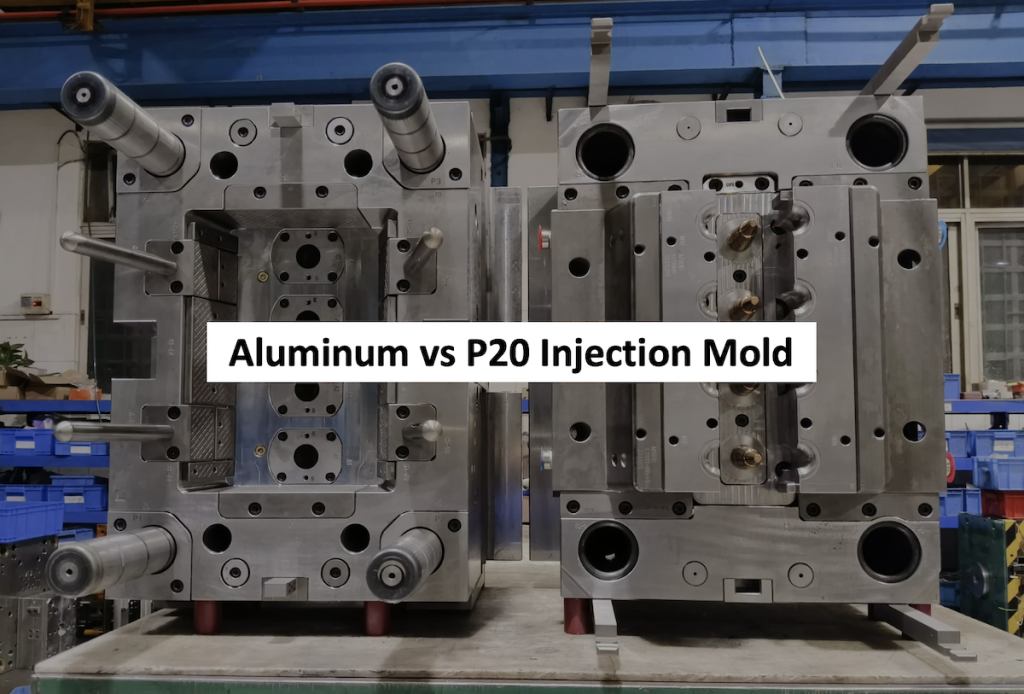
Aluminum vs P20 Injection Mold: Key Differences Compared
The following table summarizes the main differences between aluminum and P20 injection molds.
| Comparison | Aluminum 6061/7075 | P20 Steel |
| Material hardness | Lower | Higher |
| Machinability | Excellent | Good |
| Thermal conductivity | High | Lower |
| Wear resistance | Lower | Higher |
| Initial tooling cost | Generally lower | Generally higher |
| Mold manufacturing time | Generally shorter | Generally longer |
| Mold tool life | Shorter | Longer |
| Design modifications | Relatively easy | More machining effort |
| Cooling performance | Generally faster heat transfer | Generally slower heat transfer |
| Typical applications | Prototypes and low-volume production | Bridge and production tooling |
The actual performance of each mold depends on the aluminum alloy, steel grade, mold design, plastic resin, and operating conditions.
Mold Material and Hardness
One of the most important differences between aluminum and P20 is hardness.
Aluminum 6061 and 7075 offer good machinability and strength for rapid tooling applications. However, their lower hardness makes them more vulnerable to wear, especially around gates, parting lines, shut-offs, and other contact areas.
P20 steel has higher hardness and mechanical strength. Its pre-hardened condition provides better resistance to repeated clamping, injection pressure, and abrasive wear.
For projects requiring extended production runs or more demanding molding conditions, P20 is generally the more durable choice.
Machinability and Mold Manufacturing Time
Aluminum is easier to machine than P20 steel. It allows higher cutting speeds and faster material removal, helping reduce CNC machining time.
P20 requires slower machining and more attention to cutting tools, finishing, and fitting. Complex cavities, ribs, deep features, and tight dimensional requirements may further increase manufacturing time.
For this reason, aluminum is often preferred when short tooling lead time is a priority, particularly during product development.
Thermal Conductivity and Cooling Performance
Thermal conductivity is another important difference between aluminum and P20 molds.
Aluminum has significantly higher thermal conductivity than P20 steel. For example, aluminum 7075 has a typical thermal conductivity of approximately 130–160 W/m·K, while P20 steel is approximately 29–32 W/m·K.
This means aluminum can transfer heat away from the molded plastic more efficiently.
Potential benefits include:
- Faster heat transfer from the plastic part.
- Shorter cooling time under suitable molding conditions.
- More uniform temperature distribution in some mold designs.
- Potential improvements in overall injection molding cycle time.
However, higher thermal conductivity does not automatically guarantee a shorter molding cycle. Cooling channel design, part wall thickness, resin properties, mold temperature, and cooling system efficiency also influence the actual result.
Wear Resistance and Maintenance Requirements
P20 steel offers better wear resistance than aluminum, making it more suitable for repeated production cycles.
Aluminum molds require closer attention to areas exposed to high friction, repeated contact, and abrasive plastic materials. Gates, parting lines, and shut-off surfaces may wear faster.
P20 molds generally require less frequent repair or replacement of worn molding surfaces. However, regular maintenance is still necessary.
Proper cleaning, rust prevention, cooling channel maintenance, and mold inspection help extend the service life of both materials.
Aluminum vs P20 Mold Cost: Which Is More Economical
Tooling cost is often the first consideration when choosing between aluminum and P20 injection molds. Aluminum molds generally have a lower initial manufacturing cost because aluminum is easier to machine and requires less machining time.
However, purchasing buyers should also consider the total tooling investment over the expected production quantity.
Aluminum Injection Mold Cost
Aluminum injection molds generally cost less to manufacture than comparable P20 steel molds.
The main reasons include:
- Lower material removal time during CNC machining.
- Higher machining speeds.
- Less cutting tool wear in many machining operations.
- Easier cavity and core modifications.
- Shorter mold manufacturing schedules.
For prototypes and small production batches, aluminum can be an economical solution because it reduces the initial investment without requiring the durability of a production steel mold.
P20 Steel Injection Mold Cost
P20 molds generally require a higher initial investment.
Although P20 is supplied in a pre-hardened condition, it still requires more machining time than aluminum. Complex mold structures, EDM machining, polishing, fitting, and mold assembly can further increase manufacturing costs.
However, the higher initial investment can be justified when the project requires repeated production runs or a longer mold service life.
Total Cost Comparison Based on Production Volume
The most economical mold material depends on the expected lifetime production quantity.
For example:
- 1–1,000 parts: Aluminum is often a cost-effective choice for prototypes and initial production.
- 1,000–10,000 parts: Aluminum may remain economical, depending on resin, part geometry, and mold conditions.
- 10,000–50,000 parts: Compare aluminum and P20 based on expected tool life, maintenance, and replacement costs.
- Above 50,000 parts: P20 is often worth considering because of its longer service life and better wear resistance.
These quantities are practical selection guidelines, not strict material limits. A well-designed aluminum mold may support more shots, while an abrasive resin or demanding mold design may shorten its service life considerably.
When comparing quotations, consider both the initial mold price and the expected cost per molded part. A cheaper mold may become more expensive if it requires frequent repairs or replacement before the production program is complete.
Aluminum Injection Mold Tool Life vs P20 Steel Mold Life
Mold tool life refers to the number of injection molding cycles a mold can complete before it requires significant repair, refurbishment, or replacement.
Aluminum generally has a shorter tool life than P20 steel because of its lower hardness and wear resistance.
Aluminum Injection Mold Tool Life
The expected tool life of an aluminum injection mold depends on the alloy, mold structure, plastic resin, and operating conditions.
As a general planning benchmark, aluminum 6061 and 7075 molds may support approximately 10,000–50,000 shots in suitable applications.
Aluminum molds are particularly suitable for:
- Prototype parts and functional testing.
- Product design validation.
- Low-volume injection molding.
- Bridge production before mass production.
- Projects with frequent design modifications.
However, aluminum molds may experience faster wear around gates, parting lines, and cavity details when processing abrasive materials or operating under demanding conditions.
P20 Steel Injection Mold Tool Life
P20 steel provides better durability and wear resistance than aluminum.
As an indicative planning benchmark, P20 injection molds may support approximately 100,000 to 300,000+ shots, depending on mold design, resin selection, maintenance, and molding conditions.
P20 is a practical choice for projects that require:
- Repeated production runs.
- Medium-volume and higher-volume manufacturing.
- More demanding clamping and injection conditions.
- Better resistance to cavity and parting-line wear.
- Longer-term production consistency.
The actual tool life should always be evaluated against the specific project requirements rather than relying on material name alone.
Factors Affecting Injection Mold Tool Life
Regardless of whether you choose aluminum or P20, several factors influence mold durability.
Plastic Material
Different plastic materials create different levels of wear and processing demands.
Glass-fiber-reinforced plastics, mineral-filled resins, and other abrasive materials can accelerate mold wear. P20 or more wear-resistant steel grades may be more appropriate for these applications.
Injection Pressure and Clamping Force
High injection pressure and excessive clamping force can increase stress on the mold, particularly around the parting line and shut-off surfaces.
Mold Temperature and Cooling Conditions
Uneven temperature distribution and repeated thermal changes can contribute to dimensional variation and material fatigue.
Part Geometry and Mold Design
Thin ribs, sharp corners, small shut-offs, deep cavities, and complex mold actions can create areas that require additional attention during manufacturing and maintenance.
Mold Maintenance
Regular cleaning, lubrication, rust prevention, and inspection help reduce unnecessary wear and extend mold life.
Aluminum vs P20 Injection Mold Lead Time
Mold manufacturing lead time is an important consideration for product launches, prototype testing, and production schedules.
Aluminum molds generally have shorter manufacturing lead times because aluminum is easier to machine. P20 molds require more machining and finishing time, particularly for complex cavity structures.
Aluminum Mold Manufacturing Lead Time
Aluminum molds can generally be manufactured faster than comparable P20 molds.
The easier machining process allows mold makers to complete cavity machining, core machining, and mold modifications more efficiently.
For TEAM Rapid’s tooling planning benchmarks, aluminum mold projects typically take approximately 1–4 weeks, depending on mold complexity and project requirements.
Aluminum is particularly useful when customers need molded samples quickly for:
- Prototype evaluation.
- Functional testing.
- Product design validation.
- Initial market testing.
- Small-batch production.
P20 Steel Mold Manufacturing Lead Time
P20 steel molds generally require more machining and finishing time.
The manufacturing process may include CNC milling, EDM machining, drilling, polishing, fitting, mold assembly, and trial molding.
For planning purposes, more complex P20 tooling projects may require approximately 8–10 weeks. However, this is not a fixed industry standard or a mandatory lead time for every P20 mold.
Actual delivery schedules depend on mold size, cavity count, mold structure, part complexity, machining requirements, and factory capacity.
At TEAM Rapid, standard injection mold manufacturing lead time is generally around 10–35 days, depending on project requirements and mold complexity. Customers should confirm the specific schedule when requesting a quotation.
How to Reduce Injection Mold Lead Time
Several practical steps can help reduce mold manufacturing time.
- Finalize the 3D part design before mold manufacturing starts.
- Provide complete 2D drawings and dimensional requirements.
- Select suitable mold materials based on expected production quantity.
- Simplify mold structures where possible.
- Use standardized mold bases when appropriate.
- Review potential undercuts and side actions early.
- Coordinate sample inspection and feedback efficiently.
Early communication between the customer and mold manufacturer can prevent unnecessary mold modifications and resampling.
Aluminum vs P20 Mold Tooling for Different Production Volumes
Production quantity is one of the most important factors when selecting between aluminum and P20 mold tooling.
The right material should support the expected production volume without creating unnecessary tooling investment.
Prototype and Low-Volume Production
Aluminum molds are often a good choice for prototype and low-volume injection molding.
They offer lower initial tooling costs and shorter manufacturing lead times, making them suitable for companies developing new products or validating designs before committing to production tooling.
For startups and product development teams, aluminum rapid tooling can reduce initial investment while providing real injection molded parts for assembly checks, functional evaluation, and market testing.
P20 may also be considered when the project requires a more durable mold or when the expected production quantity is higher than the aluminum tooling can reliably support.
Bridge Tooling and Medium-Volume Production
Bridge tooling connects prototype development with full-scale production.
Both aluminum and P20 molds can be used for bridge production, depending on the expected number of parts, plastic material, and project schedule.
Aluminum tooling is suitable when production quantities are relatively limited and the project prioritizes fast delivery and lower initial investment.
P20 tooling becomes more attractive when customers expect repeated production batches, longer product lifecycles, or more demanding processing conditions.
The decision should consider not only the first production order but also future orders and expected lifetime demand.
High-Volume Production
P20 steel is generally more suitable for high-volume injection molding than standard aluminum tooling.
Its higher hardness and wear resistance help maintain cavity details, parting lines, and shut-off surfaces over repeated production cycles.
For projects involving long production runs, consistent dimensional requirements, and abrasive resins, P20 or a more wear-resistant steel may be a better investment.
For especially demanding applications, hardened steels such as H13 or corrosion-resistant S136 may also be considered.
Aluminum vs P20 Mold: Which Plastic Materials Can They Process
Plastic material selection is another important factor when choosing an injection mold material.
Different plastics have different melting temperatures, processing requirements, shrinkage characteristics, and abrasive properties. These factors can influence mold wear, cooling performance, and dimensional stability.
Common Plastics for Aluminum Injection Molds
Aluminum molds can process many common thermoplastics when the mold design and processing conditions are suitable.
Typical materials include:
- ABS
- PP (Polypropylene)
- PE (Polyethylene)
- PS (Polystyrene)
- PC (Polycarbonate)
- PMMA (Acrylic)
- POM (Acetal)
For these applications, aluminum can provide an economical tooling solution for prototype and low-volume production.
However, material selection should also consider processing temperature, injection pressure, additives, and required surface finish.
Common Plastics for P20 Steel Injection Molds
P20 molds can process a wide range of common thermoplastics and engineering plastics.
Typical applications include:
- ABS
- PC
- PC/ABS
- PA (Nylon)
- POM
- PP
- PE
- PBT
P20 is generally a more durable option when processing conditions are demanding or production quantities are higher.
For glass-filled nylon and other abrasive materials, however, P20 may not always provide sufficient wear resistance for the required production life.
When to Consider Hardened Steel Instead of P20
Some applications require better wear resistance or corrosion resistance than P20 can provide.
For example:
- Glass-fiber-reinforced plastics may require more wear-resistant cavity materials.
- Corrosive plastics, such as certain PVC formulations, may require corrosion-resistant mold materials.
- High-volume applications may benefit from hardened tool steels.
- Demanding surface finish requirements may influence the selection of cavity steel.
H13 and S136 are two common alternatives for applications requiring specific combinations of hardness, wear resistance, or corrosion resistance.
The final selection should be based on the actual resin grade, production conditions, and required mold life.
How to Choose Between Aluminum and P20 Injection Molds
There is no single mold material that is suitable for every injection molding project. Engineers and purchasing buyers should evaluate production requirements before selecting the tooling material.
Choose Aluminum Molds When:
- You need a fast tooling solution for prototypes.
- Your project requires low-volume injection molding.
- Initial tooling investment is a major consideration.
- The product design may still change.
- The expected production quantity is within the practical life of aluminum tooling.
- The selected plastic material and molding conditions are suitable for aluminum.
Choose P20 Steel Molds When:
- You expect repeated production runs.
- Longer mold service life is important.
- Better wear resistance is required.
- The project involves more demanding molding conditions.
- You want to reduce the risk of frequent mold replacement.
- The production program justifies a higher initial tooling investment.
Before making a final decision, consider these five questions:
- How many parts do you expect to produce over the product’s lifetime?
- Which plastic material will be used?
- Does the part have complex features, undercuts, or tight dimensional requirements?
- How quickly do you need the first molded samples?
- Will the product require repeated production orders?
Answering these questions helps determine whether aluminum, P20, or another mold steel is the most suitable option.
Aluminum vs. P20 Injection Molds for Insert Molding and Overmolding
Insert molding and overmolding require stable mold structures and accurate positioning because the molding process involves placing metal inserts or previously molded plastic components into the mold before injecting another material. Mold stability is important for maintaining insert position, controlling material flow, and achieving consistent part dimensions and bonding quality.
For typically applications, P20 steel molds are generally a more reliable choice than aluminum molds, especially when repeatability and production stability are important. P20 offers better strength and wear resistance, helping the mold maintain its dimensions through repeated molding cycles. This is particularly useful when metal inserts, multiple mold operations, or frequent loading and unloading are involved.
Aluminum molds can still be considered for simple insert molding or overmolding prototypes and limited trials where tooling cost and machining speed are the main priorities. However, their lower wear resistance may make them less suitable for repeated production.
At TEAM Rapid, we prefer P20 steel for prototype molds and bridge tooling, including insert molding and overmolding projects, because it provides a better balance of tooling durability, dimensional stability, and consistent production quality.
Aluminum vs P20 Injection Molds at TEAM Rapid
TEAM Rapid provides custom injection mold manufacturing and injection molding services for customers worldwide. Our capabilities cover prototype tooling, rapid tooling, bridge tooling, and production tooling.
We understand that mold material selection affects not only tooling cost but also production efficiency, delivery schedules, and long-term manufacturing costs.
Aluminum and P20 Mold Material Selection
TEAM Rapid selects mold materials according to customer requirements, expected production quantities, plastic resin, part geometry, and application conditions.
Aluminum 6061 and 7075 can be considered for rapid tooling and low-volume injection molding projects where fast machining and lower initial investment are priorities.
P20 steel is a practical option for projects requiring better wear resistance and longer mold service life.
For more demanding applications, we can also evaluate other mold steel options based on project requirements.
Rapid Tooling and Production Tooling Capabilities
TEAM Rapid supports customers at different stages of product development and manufacturing.
Our tooling capabilities include:
- Prototype tooling: For early-stage product validation and functional testing.
- Rapid tooling: For shorter mold manufacturing lead times and initial production.
- Bridge tooling: For low-to-medium-volume production before full-scale manufacturing.
- Production tooling: For longer production runs and ongoing manufacturing requirements.
We evaluate each project based on its actual requirements rather than selecting mold materials solely by their initial cost.
From Mold Manufacturing to Low-Volume and Mass Production
TEAM Rapid provides injection mold making and custom injection molding services, supporting customers from initial prototypes to ongoing production.
We offer low-volume injection molding for customers who need small batches, as well as bridge production and higher-volume manufacturing.
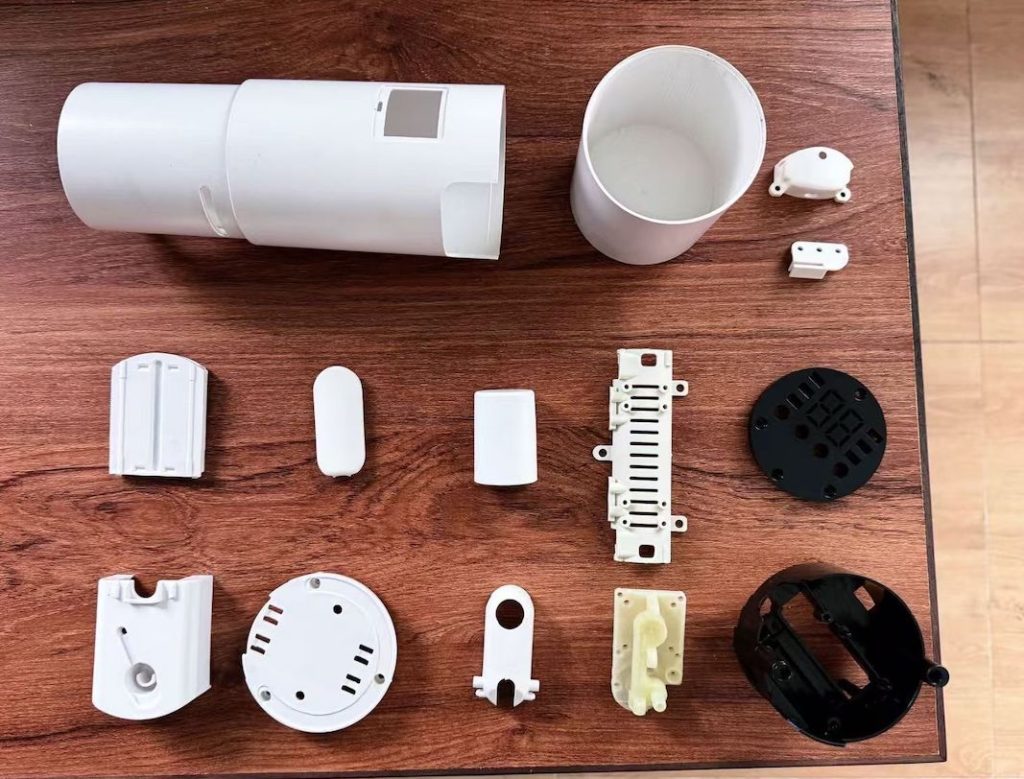
Our team can review customer drawings and 3D files, evaluate tooling requirements, manufacture the mold, and produce injection molded parts according to the agreed project specifications.
Whether you need an aluminum rapid tool for a small production batch or a P20 steel mold for longer production runs, selecting the right tooling solution helps control costs and reduce manufacturing risks.
For your next injection molding project, contact TEAM Rapid to discuss your part requirements, expected production quantity, and suitable mold material.
Frequently Asked Questions About Aluminum vs P20 Injection Molds
Q: Is an Aluminum Injection Mold Better Than a P20 Steel Mold?
A: Neither material is universally better. Aluminum is generally better for rapid tooling, prototypes, and low-volume production because of its lower initial cost and faster machining, while P20 steel is more suitable for projects requiring longer mold life and better wear resistance.
Q: How Many Shots Can an Aluminum Injection Mold Last?
A: As an indicative planning range, an aluminum injection mold may last approximately 10,000–50,000 shots in suitable applications. Actual tool life depends on aluminum alloy, plastic material, mold design, injection conditions, and maintenance.
Q: How Many Shots Can a P20 Injection Mold Last?
A: A P20 steel injection mold may typically support approximately 50,000–150,000 shots under suitable molding conditions. The actual service life depends on resin abrasiveness, mold construction, operating conditions, and maintenance.
Q: Is P20 Steel More Expensive Than Aluminum for Injection Molds?
A: Yes. P20 steel molds generally have a higher initial manufacturing cost because they require more machining time and additional finishing work. However, their longer service life can make them more economical for larger production quantities.
Q: Can Aluminum Injection Molds Be Used for Production?
A: Yes. Aluminum injection molds can be used for prototype production, low-volume manufacturing, and selected bridge production projects. Their suitability depends on expected shot quantity, resin properties, part geometry, and operating conditions.
Q: Can Aluminum Injection Molds Process Glass-Filled Plastics?
A: Aluminum molds can process some glass-filled plastics, but abrasive glass fibers can accelerate cavity and gate wear. For longer production runs involving glass-filled materials, P20 with suitable wear protection or more wear-resistant steel may be a better choice.
Q: Which Is Better for Rapid Tooling: Aluminum or P20?
A: Aluminum is generally preferred for rapid tooling because it is easier to machine and allows shorter mold manufacturing schedules. P20 is worth considering when the rapid tooling project also requires higher durability or a larger production quantity.
Q: Does Aluminum Tooling Reduce Injection Molding Cycle Time?
A: Aluminum’s higher thermal conductivity can improve heat transfer and potentially reduce cooling time. However, actual cycle time also depends on part thickness, cooling channel layout, resin properties, mold temperature, and machine settings.