Producing custom parts for your project allows you to custom-made the various aspects of the parts or components, including tweaking the geometries or technical specifications of each part according to your own custom configurations. However, with the regular manufacturing process you will use to make these custom parts, problems might appear on the surface area of your custom parts. That is, unless you do something such as polished surface finish to your custom parts. Surface roughness, defects, imperfections, and uneven colors might lessen the appeal of your custom parts, and thus need to be resolved before sending the finished products to your clients. Polished surface finish of custom parts will help resolve any problems with your custom parts surface, the things you need to know in 2024 as below.
Table of Contents
- 1 Polished Surface Finish for Custom Parts – The Step-by-Step Process
- 2 Grade of Polishing
- 3 Benefits of Polished Surface Finish for Custom Parts
- 4 Are There Any Disadvantages of Polished Surface Finish for Custom Parts
- 5 Conclusion of polished surface finish
- 6 Contact Us
- 7 Frequently Asked Questions (FAQs)
Polished Surface Finish for Custom Parts – The Step-by-Step Process
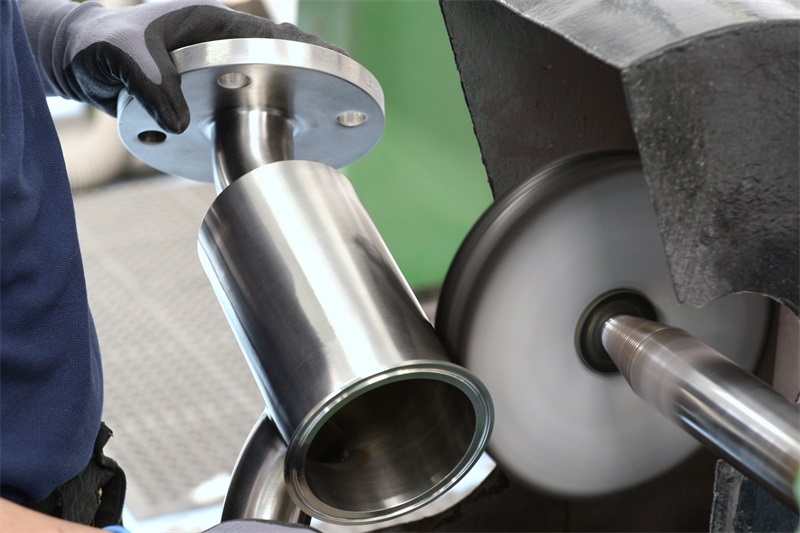
To create the polished surface finish for your custom parts, you will need to go through several processes. These processes will involve roughing the surface, polishing, brightening, and coating or protecting. Here’s the step-by-step process of polished surface finish for custom parts:
Roughing process to eliminate surface imperfections
Various manufacturing processes such as CNC machining, sheet metal bending etc might give your custom parts some rough edges and surface imperfections. Some defects might also happen during the production process that you run for your custom parts. The roughing process is the phase where you eliminate all the rough edges and imperfections from the surface of your custom parts. In this process, you are preparing the custom parts for the next polishing stage.
Polishing phase
The polishing phase is where you will actually polish the custom parts and make its surface look much better than before. You will need to use certain abrasive materials to polish the surface of your custom parts, transforming the dark-looking surface material into a shinier looking one.
Brightening the custom parts surface
The polishing phase might still leave some problems, such as uneven polished look throughout the custom parts surface. This is the reason the brightening process is necessary. With the brightening process, you will ensure that the surface of your custom parts will have an evenly polished look, perfecting their aesthetics.
Polished Surface finish: Applying a protection layer for the custom parts surface
After completing the brightening process, you need to add a layer protection for the surface of the custom parts. The purpose is to add more strength and durability for the surface layer of the custom parts, effectively increasing its overall quality and making it more suitable for long-term use.
Grade of Polishing
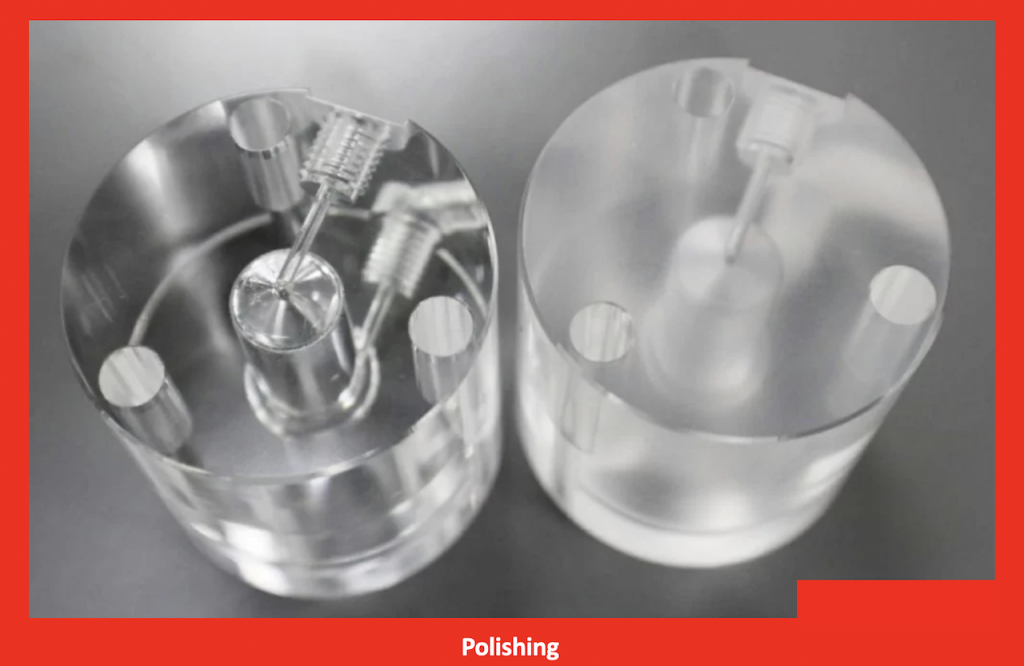
People base on how smooth, reflective, or cosmetic to define what polishing grades it is. In manufacturing industry, SPI is a commonly standard for the designers, engineers, and suppliers can communicate clearly. It represents a different level of smoothness and visual quality, achieved through specific polishing tools and abrasives.
| Polishing Grade | Typical SPI Grade | Roughness (Ra) | Appearance | How It’s Achieved | Common Applications |
|---|---|---|---|---|---|
| Matte Finish (Low Gloss) | SPI D1 – D3 | ~0.8 – 3.2 μm | • Low reflectivity• Slight texture remains• Hides minor defects | Dry blasting or coarse abrasive stones remove machining marks without creating shine | Hidden areas, functional parts, mechanical components |
| Semi-Gloss Finish (Medium Polish) | SPI C1 – C3SPI B3 | ~0.4 – 0.8 μm | • Light reflection• Smoother than matte• Good general appearance | Finer abrasive papers or stones followed by light buffing | Consumer electronics housings, general-purpose molded parts |
| Gloss Finish (High Polish) | SPI B1 – B2SPI A3 | ~0.2 – 0.4 μm | • Shiny, smooth surface• Minimal visible marks• Higher cosmetic quality | Polishing with fine abrasive papers then diamond compounds | Visible injection molded parts, cosmetic prototypes, industrial enclosures |
| Mirror Finish (Optical Grade) | SPI A1 – A2 | ~0.05 – 0.2 μm | • Highly reflective• No machining marks• Optical clarity possible | Multi-stage polishing using ultra-fine diamond paste and precision hand-polishing | Clear lenses, light guides, transparent PC/PMMA parts, high-end cosmetic parts |
Benefits of Polished Surface Finish for Custom Parts
Surface finishing is always optional for your manufacturing production, but the extra finishing steps can bring you many benefits for the custom parts you are producing. Here are some benefits of polished surface finish for custom parts:
Removing material defects
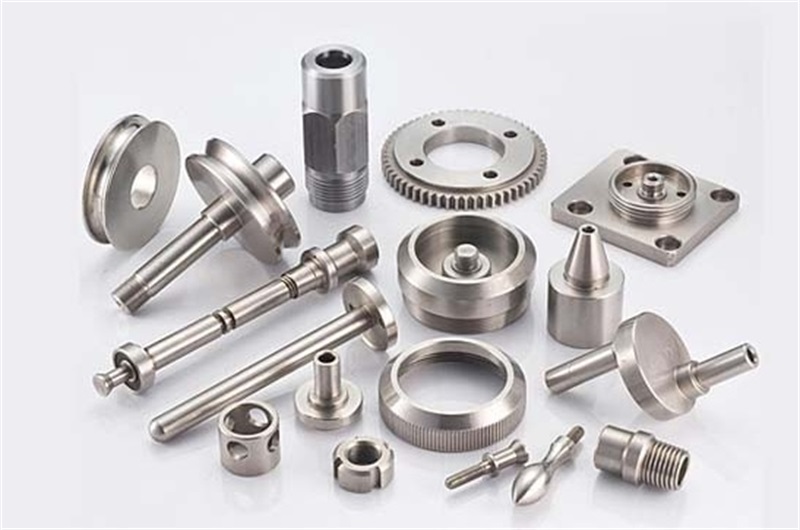
Polishing the surface of your custom parts will help remove various material defects and imperfections caused by the previous manufacturing process. For instance, welding can cause a kind of bad look on the surface of your custom parts. By polishing it, you will be able to eliminate these imperfections on the surface of the custom parts and make it look aesthetically better.
Enhancing the custom part aesthetics
Polished surface finish for custom parts can help enhance the aesthetics of the custom parts you are manufacturing. These improved aesthetics will make the final products look their best and much more presentable to your clients or customers.
Ensuring the best function for the custom parts
The custom parts you produce might not function well with the rough edges and bad surface condition. By polishing the custom parts or rapid prototypes surface, you can get the full functionality of the custom parts, and you don’t need to deal with any malfunctions or any other problems with it.
Easier assembly process
If the custom parts are a part of a bigger assembly component, polishing your custom parts surface will help you in the assembly process for the parts or die casting components. Skipping this process might make it difficult for you to assemble or disassemble the custom parts in your next production stage.
Creating variations for the custom parts
With polishing, you can also create various iterations of the custom parts, with different colors and finishes. There are plenty of polishing options you can choose, so there will be a lot of flexibility that you can get from each polished custom part.
Are There Any Disadvantages of Polished Surface Finish for Custom Parts
Despite the various benefits of creating polished surface finish for custom parts, it’s not always a smooth sailing for the manufacturers to perform this process. There are certain disadvantages of polished surface finish that might also make it to be unpreferable for your clients or customers. Here are some disadvantages of polished surface finish for custom parts:
Expensive finishing costs
Surface finishing can be a costly addition to your production process, which can inflate the price of the custom parts you are making. It might not be preferable for clients or customers with a limited budget.
Adding more time to the production process
Applying the surface finishing process for your custom parts can also add more time in your manufacturing production. Again, the time addition might turn off the clients or customers from ordering custom parts from your manufacturing service, especially if they are on a tight deadline.
A complex process to go through
Surface finishing for custom parts can sometimes be a complex process to go through, especially if your custom parts feature complex geometries and intricate designs.
Conclusion of polished surface finish
Polishing the surface of your custom parts can not only improve the aesthetics of the custom parts you are producing, but this process can also help deal with surface imperfections of the custom parts. It might put additional manufacturing time and expenses for you, but it will certainly change various aspects of the custom parts for the better. Getting a polished surface finish for custom parts is your best bet to ensure the highest quality of the custom parts you are making. Not only that, it can also help increase the value of your manufacturing products significantly.
Contact Us
Have a question, need a quote, or want to learn more about our polishing & manufacturing services? We’re here to help. Besides from polished surface finish, TEAM RAPID also offer anodizing, powder coating, painting etc post finish to meet your projects needs. Contact our team today to request a free quote now!
📞 Phone: +86 760 8850 8730
📧 Email: [email protected]
Or fill out the form below and one of our team members will get back to you — usually within 24–48 hours.
Frequently Asked Questions (FAQs)
1. What materials can be polished?
Most of metals (aluminum, steel, zinc), plastics (ABS, PC, PMMA), and other materials used in injection molding or CNC machining can be polishing.
2. How long does polishing take?
Time varies by grade and part complexity:
- Low gloss: Quick surface treatment
- Mirror finish: Multi-stage process requiring precision and care
3. Can I get polished surfaces by polishing the mold surfaces?
Yes. Polished molds produce high-quality injection-molded parts with minimal visible defects, improved aesthetics, and better surface performance.
4. Why choose TEAM RAPID for polishing services?
We offer:
- Expertise in all polishing grades
- Precision finishing for prototyping and production
- Advice on material selection and surface performance
- Fast turnaround and reliable delivery