
CNC Machining vs Injection Molding for Low-Volume Production: How to Choose the Right Process (and When to Use Both)
Most articles comparing CNC machining and injection molding give you a simplistic answer: "CNC is better for low volume, injection molding is better for high volume." But that's not how real engineering decisions work. Actually, the right answer depends on your part geometry, material requirements, tolerance needs, design maturity, and — most critically — your total cost calculation including tooling amortization. For low-volume production, use CNC machining when your design is still evolving, you need metal parts, or your quantity is under 100–300 pieces; switch to injection molding (via rapid tooling) once your design is frozen and your quantity exceeds your calculated break-even point — or strategically use both across your product lifecycle from prototype to mass production.
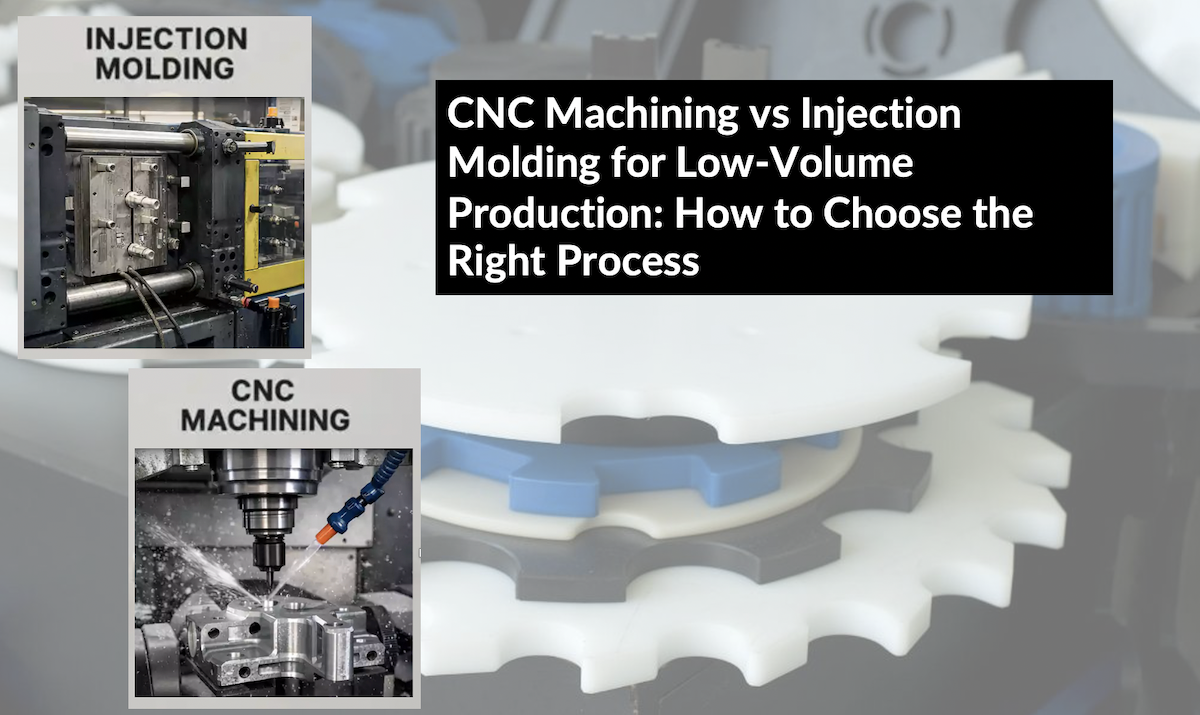
This guide breaks down exactly how to make that decision, with real numbers, a practical formula, and a development path that lets you use both processes strategically across your product lifecycle.
How CNC Machining Works for Low-Volume Production
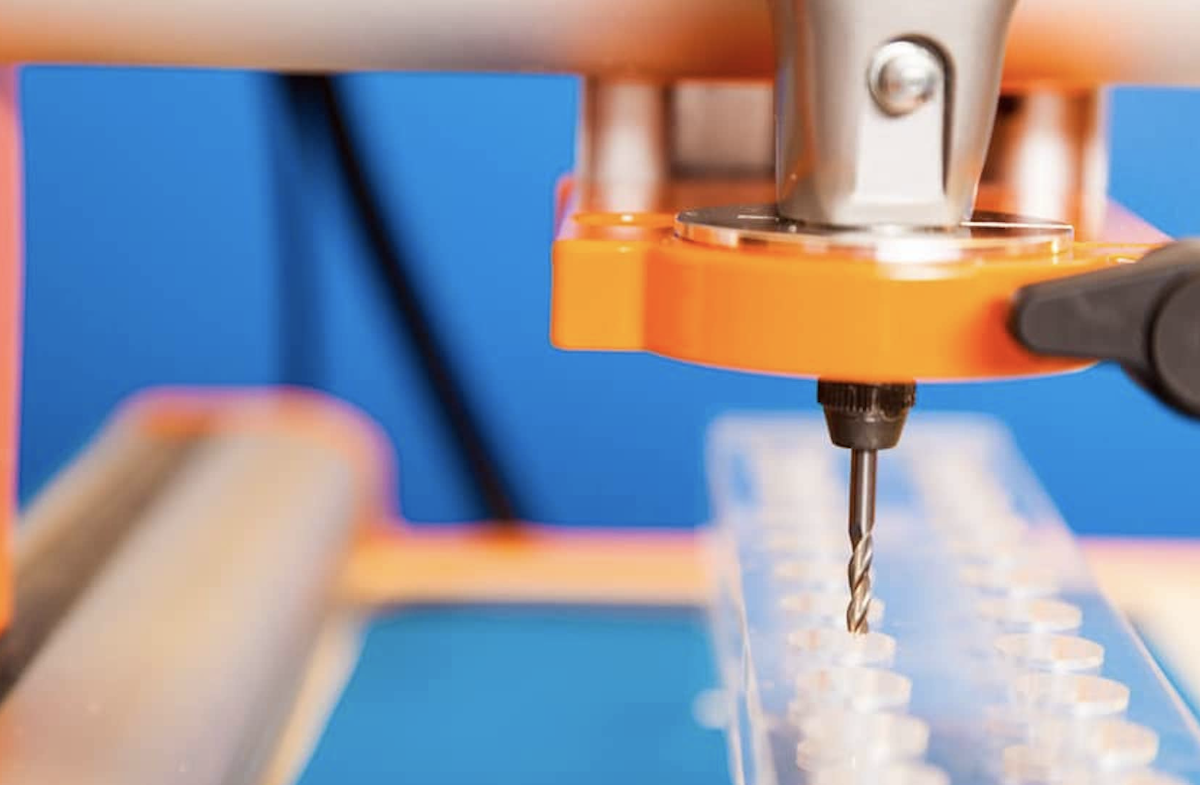
CNC machining removes material from a solid block (or billet) using computer-controlled cutting tools. For low-volume production, this means you can go from a CAD file to finished parts without any dedicated tooling.
CNC Milling and Turning for Small-Batch Production
CNC milling handles complex 3D geometries, pockets, slots, and contours. CNC turning is ideal for rotational parts like shafts, bushings, and housings. Many low-volume parts require both operations in a single workflow.
Why CNC Does Not Require Dedicated Molds
This is the single biggest advantage for low-volume work. There is no mold to design, manufacture, test, and debug. You load your CAD file, program the toolpaths, fix the raw material in the machine, and start cutting. This eliminates weeks of lead time and thousands of dollars in upfront tooling cost.
Typical Materials for CNC Low-Volume Production
CNC machining supports an exceptionally broad material range:
- Metals: Aluminum (6061, 7075), steel (4140, 4340), stainless steel (303, 304, 316), brass, titanium, copper
- Plastics: ABS, polycarbonate, POM (Delrin), nylon, PEEK, PTFE, HDPE
- Specialty materials: Inconel, Hastelloy, and other superalloys for aerospace and medical applications
This material breadth is a significant advantage when your application demands mechanical properties that injection-molded resins simply cannot provide.
When CNC Is Particularly Attractive
CNC machining becomes the clear choice when your project involves:
- Tight tolerances (±0.01 mm or better)
- Complex internal features that would be difficult or impossible to mold
- Frequent design changes during development
- Metal components that cannot be injection molded
- Functional prototypes and pilot production where you need production-grade material properties immediately
At TEAM Rapid, our small-batch CNC capabilities are specifically positioned for pilot runs, bridge production, market launches, and quantities ranging from a few parts to several hundred. We treat low-volume CNC not as a compromise, but as a strategic manufacturing choice.
How Low-Volume Injection Molding Works
Low-volume injection molding is not simply "mass-production injection molding with fewer parts." The tooling strategy, mold life, cavity configuration, and cost structure can be fundamentally different.
What Low-Volume Injection Molding Actually Means
Low-volume injection molding typically refers to production runs of 100 to 10,000 parts — far below the hundreds of thousands or millions associated with traditional injection molding. To make this economically viable, the entire approach to tooling changes.
Aluminum vs. Soft-Steel vs. Hardened-Steel Molds
|
Mold Type |
Typical Life |
Cost Range |
Best For |
|
Aluminum (7075) |
5,000–50,000 shots |
2,000–
8,000 |
Prototyping, bridge production, 100–5,000 parts |
|
Soft steel (P20, NAK80) |
50,000–200,000 shots |
5,000–
15,000 |
Low to mid-volume, 1,000–50,000 parts |
|
Hardened steel (H13, S136) |
500,000–1,000,000+ shots |
10,000–
50,000+ |
High-volume production |
For low-volume work, aluminum molds are the game-changer. They can be machined faster (reducing lead time by 30–50%), cost significantly less, and provide perfectly adequate surface finish and dimensional accuracy for most applications.
How Rapid Tooling Reduces the Initial Tooling Barrier
Rapid tooling — which is exactly what TEAM Rapid specializes in — uses streamlined mold design, aluminum or soft-steel construction, and efficient manufacturing processes to deliver production-ready molds in 2–4 weeks at a fraction of traditional tooling cost. This dramatically lowers the break-even point and makes injection molding viable at quantities that would have previously been CNC-only territory.
Typical Production Quantities
With rapid tooling, plastic injection molding becomes cost-effective starting at approximately 100–500 parts, depending on part complexity and mold cost. For many projects, the sweet spot is 500–5,000 parts.
Why Injection Molding Can Still Make Sense at Relatively Low Quantities
- Per-part cost drops dramatically once the mold exists
- Material waste is minimal compared to CNC (no chips, no swarf)
- Cycle times of 15–60 seconds per part enable fast throughput
- Consistent part-to-part repeatability without operator intervention
- Production-quality materials with excellent mechanical properties
Production-Quality Materials and Repeatability
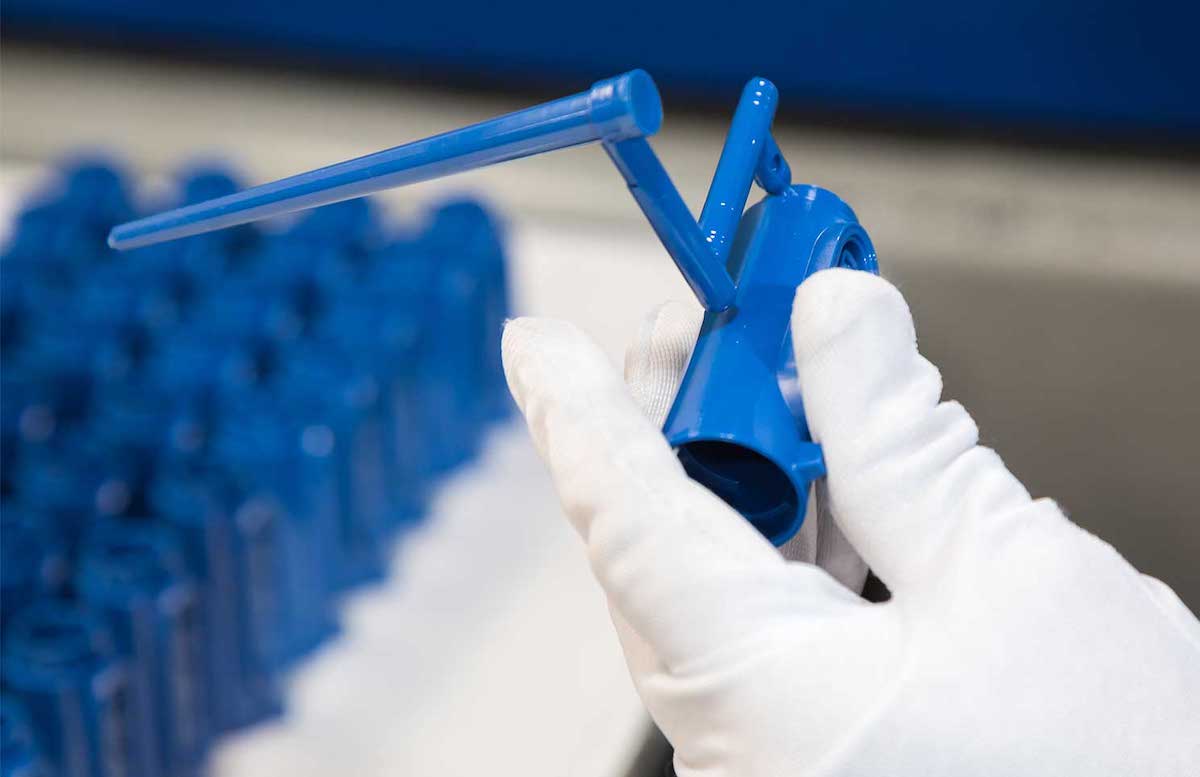
Injection molded parts use the same engineering-grade resins as mass-production parts: ABS, polycarbonate, nylon, POM, PBT, PP, TPE, and many more. The material properties are identical to high-volume production because the process is fundamentally the same — only the tooling strategy differs.
CNC Machining vs Injection Molding: Head-to-Head Comparison
Here is a comprehensive comparison to help you evaluate both processes side by side:
|
Factor |
CNC Machining |
Injection Molding |
|
Typical low-volume quantity |
1–500+ |
100–10,000+ |
|
Initial tooling cost |
Very low (fixtures only) |
Moderate to high (2,000–
50,000+) |
|
Unit cost |
Higher per part |
Lower after tooling investment |
|
Design changes |
Easy (update CAD, reprogram) |
More difficult (modify or remake mold) |
|
Initial lead time |
Short (days to 1–2 weeks) |
Longer (2–6 weeks for tooling) |
|
Material selection |
Very broad (metals + plastics) |
Resin-dependent (thermoplastics, some thermosets) |
|
Tolerance |
Excellent (±0.01 mm achievable) |
Good (±0.05–0.1 mm typical) |
|
Complex internal features |
Excellent (undercuts, threads, deep pockets) |
Design-dependent (draft angles, parting lines required) |
|
Surface finishes |
Highly flexible (anodizing, plating, painting, polishing) |
Mold-dependent (SPI finishes, texture, gloss) |
|
Scalability |
Moderate (linear cost increase) |
Excellent (marginal cost per additional part is very low) |
|
Best application |
Low volume, evolving design, metal parts |
Stable plastic production, 500+ parts |
Key takeaway: Neither process is universally "better." The right choice depends on your specific combination of quantity, material, geometry, timeline, and budget.
Cost Analysis: Understanding the Real Economics
Why Injection Molding Has a High Upfront Cost but Lower Unit Cost
Injection molding follows a classic fixed-cost/variable-cost model:
- Fixed cost: The mold (tooling) — this is a one-time investment regardless of how many parts you produce.
- Variable cost: Material + machine time per part — this is relatively low once the mold exists.
CNC machining is the opposite:
- Fixed cost: Minimal (programming, fixturing)
- Variable cost: Machine time + material per part — this is relatively high because each part requires individual machining cycles.
This means CNC cost scales linearly with quantity, while injection molding cost follows a curve that flattens dramatically after the tooling investment is amortized.
The Real Break-Even Point
There is no universal CNC-to-molding break-even quantity. Published estimates range from "100 parts" to "10,000 parts" because the actual break-even depends heavily on:
- Tooling cost (which depends on part size, complexity, number of cavities, and mold material)
- CNC cost per part (which depends on machining time, material cost, and part complexity)
- Molded cost per part (which depends on cycle time, material cost, and part weight)
Example calculation:
- Mold cost: $8,000 (aluminum, single cavity)
- CNC cost per part: $30
- Molded cost per part: $3
Break-even quantity = 8,000÷( 30 − $3) = 296 parts
In this scenario, if you need fewer than 296 parts, CNC is cheaper. If you need more than 296 parts, injection molding delivers lower total cost.
A Useful Formula
Break-even quantity = Mold cost ÷ (CNC cost per part − Molded cost per part)This is one of the most valuable tools for making your decision. Apply it to your specific project with real quotes from your manufacturing partner, and you'll have a clear, data-driven answer.
How Part Complexity Changes the Calculation
- Simple parts (flat plates, brackets, housings): CNC cost per part is moderate, so break-even might be 200–500 parts.
- Complex parts (multi-axis features, thin walls, tight tolerances): CNC cost per part is high, so break-even might drop to 100–200 parts.
- Very simple molded parts (small, thin, fast cycle time): Molded cost per part is very low, pushing break-even even lower.
- Large parts with long cycle times: Molded cost per part increases, pushing break-even higher.
This is why you should never rely on a generic "rule of thumb" number. Always calculate for your specific part.
When You Should Use Both CNC and Injection Molding
This is where TEAM Rapid's approach truly shines. In practice, the smartest product development teams don't choose one process for the entire product lifecycle. They use both — strategically, at different stages.
The Practical Development Path
Here's how a typical product moves from concept to mass production using both processes:
Stage 1: Prototype → CNC Machining
You have a new design. You need 5–20 parts to test form, fit, and function. CNC machining delivers these in days with production-grade materials. No tooling investment required. If the design changes, you simply update the CAD and machine new parts.
Stage 2: Design Validation → Low-Volume CNC
Your design is stabilizing. You need 50–200 parts for testing, certification, or initial customer samples. CNC still makes sense here because the design may still require adjustments, and you don't want to commit to a mold that might need modification.
Stage 3: Rapid Tooling → Injection Molding
Your design is frozen. You need 500–5,000 parts for a market launch, pilot production, or initial sales. Now you invest in an aluminum or soft-steel mold through rapid tooling. The per-part cost drops dramatically, and you get injection-molded quality at low volume.
Stage 4: Mass Production → Hardened Steel Tooling
Demand is proven. You need 50,000+ parts. You invest in hardened steel tooling for maximum mold life and lowest possible per-part cost.
Why Companies Don't Have to Choose One Process
The traditional mindset forces a binary choice: "Are we a CNC shop or a molding shop?" But product development is not binary. It's a progression from uncertainty to certainty, from low volume to high volume, from iteration to optimization.
TEAM Rapid already positions low-volume manufacturing as a bridge between prototyping and full-scale production. This philosophy naturally supports a combined approach:
- Use CNC when speed and flexibility matter most
- Transition to injection molding when cost-per-part and scalability matter most
- Use both in parallel when different components have different requirements (e.g., CNC-machined metal inserts + injection-molded plastic housing)
Real-World Example
Consider a medical device startup:
- Month 1–2: CNC machine 20 aluminum prototypes for usability testing
- Month 3: CNC machine 100 parts for design verification testing (DVT)
- Month 4–5: Build aluminum rapid tooling, injection mold 2,000 parts for clinical trials
- Month 6+: Transition to hardened steel tooling for commercial production
At each stage, the process matches the project's needs. No single process could have served all stages efficiently.
Making Your Decision: A Quick Checklist
Use this checklist to determine your starting point:
|
Question |
If Yes → |
If No → |
|
Is your design still changing? |
CNC |
Consider molding |
|
Do you need metal parts? |
CNC |
Either process |
|
Do you need fewer than 100 parts? |
CNC |
Calculate break-even |
|
Is your quantity above 500 and design is stable? |
Injection molding |
CNC may still work |
|
Do you need the lowest possible per-part cost? |
Injection molding |
CNC for simplicity |
|
Do you need parts in under 2 weeks? |
CNC |
Rapid tooling (3–4 weeks) |
Final Thoughts
The question is never simply "CNC or injection molding?" The question is: "For my specific part, at my specific quantity, with my specific timeline and budget — which process delivers the lowest total cost and the lowest production risk?"
Sometimes the answer is CNC. Sometimes it's injection molding. Very often, the best answer is both — used strategically at different stages of your product's journey from prototype to production.
At TEAM Rapid, we offer both CNC machining and rapid tooling / low-volume injection molding under one roof. This means you can move seamlessly between processes without switching suppliers, requalifying parts, or losing project momentum.
Ready to calculate your break-even point? Send us your part file and target quantity, and we'll provide a detailed cost comparison for both processes — so you can make a data-driven decision with confidence.



 Contact