
Recycled Plastic Injection Molding: Process, Benefits, Challenges & Solutions in 2026
Global plastic pollution and carbon reduction targets are reshaping modern manufacturing. Governments, brands, and consumers are pushing for more sustainable production methods, making recycled plastic injection molding no longer optional-but essential. From the European Union’s packaging regulations to ESG commitments in the United States and China, the demand for recycled materials is accelerating rapidly.
Compared to virgin plastics, recycled resins offer both environmental and economic advantages. The market for post-consumer and post-industrial plastics continues to grow as supply chains evolve toward circular models. However, integrating recycled materials into injection molding is not without challenges.
This guide explores everything you need to know-from material types and processing steps to real-world challenges and proven solutions. It also highlights how rapid tooling technologies can help manufacturers efficiently adopt recycled plastic injection molding for prototyping and low-volume production.
If you’re looking to implement sustainable manufacturing, working with an experienced partner like TEAM Rapid can significantly reduce risk while improving part quality and production efficiency.
What Are Cycle Plastics
Cycle plastics refers to plastics that are continuously reused, recycled, and reintegrated into production systems as part of a circular lifecycle, rather than being discarded after a single use. The term is closely tied to the concept of the circular economy, where materials are kept in use for as long as possible.
Core Concept: From Linear to Circular Plastics
Traditional plastic use follows a linear model
Raw material → Production → Use → Disposal
Cycle plastics operate within a circular model
Raw material → Production → Use → Collection → Recycling → Reprocessing → Reuse
What Is Recycled Plastic Injection Molding
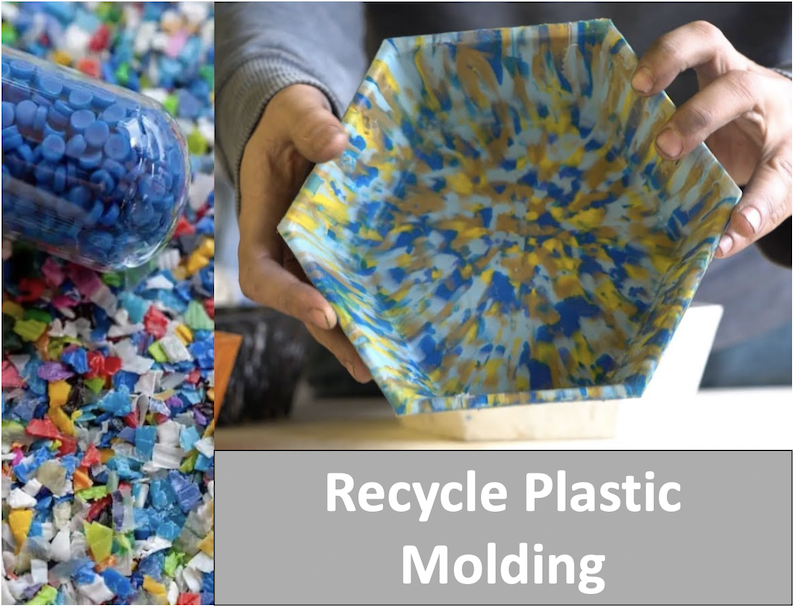
Recycled plastic injection molding refers to the process of using recycled plastic materials-either fully or blended with virgin resins-to produce molded parts. These recycled materials, often called r-resins, are processed into pellets before being fed into standard injection molding machines.
There are three main categories of recycled plastics:
- Post-Consumer Recycled (PCR)
- Post-Industrial Recycled (PIR)
- Closed-loop recycled materials
Common materials include PP, PE, ABS, PET, PS, and PC, making recycled injection molding applicable across multiple industries.
Types of Recycled Plastics Used in Injection Molding
Recycled plastics vary significantly in quality, consistency, and performance depending on their source and processing.
Post-Consumer Recycled (PCR) Materials
Post-Consumer Recycled (PCR) materials come from everyday products like packaging, electronics, and household goods. While environmentally impactful, PCR materials often contain contaminants and require extensive sorting and cleaning.
Post-Industrial Recycled (PIR) plastics
Post-Industrial Recycled (PIR) plastics are derived from manufacturing waste such as sprues, runners, and rejected parts. These materials are typically cleaner, more consistent, and easier to process, making them ideal for high-performance applications.
Blended Resins
Blended Resins are the most widely used solution in injection molding. By mixing recycled materials with virgin plastics-typically in ratios from 10% to 50%-manufacturers can balance cost savings with mechanical performance.
Specialty Recycled Resins
Specialty Recycled Resins are engineered for specific applications, including flame-retardant, food-grade, or medical-grade materials. These require strict processing and certification but are gaining popularity as recycling technologies improve.
The Complete Recycled Plastic Injection Molding Process
Material Collection & Sorting
The process begins with collecting plastic waste from various sources. Advanced sorting technologies, including AI-based systems, are used to separate materials by type, color, and quality while removing contaminants such as metals and foreign particles.Shredding & Washing
Collected plastics are shredded into smaller flakes and thoroughly washed to remove labels, adhesives, oils, and dirt. This step is critical to ensuring material purity and preventing defects in the final product.Melting & Pelletizing
The cleaned flakes are melted and filtered to remove remaining impurities. The molten plastic is then extruded and cut into uniform pellets, creating usable recycled resin.Drying
Recycled plastics often contain higher moisture levels than virgin materials. Proper drying is essential to prevent defects such as bubbles, voids, and poor surface finish during molding.Injection Molding
The dried pellets are fed into an injection molding machine. Compared to virgin plastics, processing parameters must be carefully adjusted, including barrel temperature, screw speed, holding pressure, and cooling time.Quality Inspection & Finishing
Finished parts undergo rigorous inspection, including dimensional checks, mechanical testing, and visual inspection for defects like black spots or flow marks. Secondary processes such as painting or assembly may follow.Key Benefits of Recycled Plastic Injection Molding
Using recycled plastics in injection molding offers multiple advantages.
- Cost reduction is one of the most direct benefits, as recycled materials are generally less expensive than virgin resins.
- Lower carbon footprint is another major advantage. Recycled plastics significantly reduce energy consumption and greenhouse gas emissions, helping companies meet ESG and sustainability goals.
- Regulatory compliance is increasingly important, especially in Europe and North America, where minimum recycled content requirements are becoming mandatory.
- Recycled injection molding also supports circular economy strategies, reducing waste and enhancing brand reputation.
Additionally, recycled materials are highly compatible with rapid tooling, enabling fast prototyping and low-volume production without large upfront investments.
Top Challenges in Recycled Plastic Injection Molding
- Material inconsistency is one of the biggest issues. Variations in recycled feedstock can lead to unstable viscosity, shrinkage, and moisture content.
- Mechanical properties may decline due to polymer degradation, resulting in reduced strength, toughness, and heat resistance.
- Aesthetic challenges are common, including color variation, black specks, flow marks, and inconsistent surface finish.
- Processing recycled plastics requires tighter control over temperature, pressure, and machine settings to avoid defects.
- Mold wear and contamination can increase due to residual impurities, leading to higher maintenance costs.
- Finally, regulatory barriers can limit the use of recycled materials in food-grade, medical, or flame-retardant applications.
Practical Solutions to Overcome Challenges
- Material optimization is essential. Using high-quality PIR materials, blending recycled with virgin resins, and adding stabilizers can significantly improve performance.
- Process parameter tuning helps maintain consistency. Proper drying, optimized screw speed, and controlled cooling are critical.
- Mold design should be adapted for recycled materials. Larger gates, better venting, and wear-resistant mold steels improve results. Rapid tooling allows flexible and cost-effective adjustments.
- Quality control must be strengthened with incoming material inspection, simulation tools, and real-time monitoring.
- Partnering with reliable suppliers ensures consistent material quality and traceability.
Industry Applications of Recycled Plastic Injection Molding
Recycled plastics are widely used in automotive interiors, electronic housings, consumer goods, packaging, and non-contact medical components. These applications demonstrate that recycled materials can meet both performance and sustainability requirements when properly managed.
Parts Suitable for Recycle Plastics
| Industry | Typical Parts | Common Materials (Recycled) | Suitability Level (1-5) | Key Notes |
|---|---|---|---|---|
| Consumer Products | Electronic housings, appliance covers, storage bins, tool casings | rABS, rPP, rHIPS | 4 | Good balance of cost and performance; minor color variation acceptable |
| Automotive (Non-Safety) | Interior trim, wheel liners, battery covers, seat backs | rPP, rPET blends | 4 | Widely used; must meet OEM specs but not safety-critical |
| Packaging | Bottles, caps, containers, crates | rPET, rHDPE, rPP | 5 | High-volume use; food-grade requires certification |
| Furniture & Household | Chairs, tables, laundry baskets, garden furniture | rPP, rPE | 4 | Thick parts tolerate material variation well |
| Electrical Components | Junction boxes, switch housings, cable systems | rABS, rPC blends | 3 | Requires stable properties and flame-retardant grades |
| Construction | Pipes (non-pressure), panels, decking, ducts | rPVC, rHDPE | 4 | Ideal for large, non-precision applications |
| Logistics & Industrial | Pallets, crates, bins, totes | rHDPE, rPP | 5 | Highly suitable; durability more important than appearance |
Parts That Typically DO NOT Use Recycle Plastics (or require caution)
Recycle plastics are less suitable for:
Safety-critical components
- Airbag housings
- Brake system parts
- Structural automotive components
High-precision / tight tolerance parts
- Medical devices
- Aerospace components
Transparent or high-aesthetic parts
- Optical lenses
- Premium cosmetic surfaces
Food-contact parts (unless certified)
- Must meet strict compliance standards
Future Trends of Recycled Injection Molding
- AI-driven sorting technologies are improving material purity and consistency.
- Chemical recycling is emerging as a powerful method to restore polymer quality.
- Hybrid materials combining bio-based and recycled plastics are gaining traction.
- Governments are introducing stricter regulations requiring higher recycled content across industries.
Conclusion
Recycled plastic injection molding is becoming a standard in modern manufacturing. While challenges exist, they can be effectively addressed through material selection, process optimization, and tooling strategies.
Rapid tooling enables flexible and efficient production, especially for low-volume and sustainable projects. Choosing the right manufacturing partner is key to success.
Contact Us
Looking for reliable, high-quality injection molding solutions? We’re here to help. At Team Rapid, we specialize in rapid tooling, prototype molding, and mass production using both virgin and recycled (cycle) plastics. Whether you need a small batch or full-scale production, our experienced engineering team will support you from design to delivery.
Our Injection Molding Capabilities
- Rapid tooling and bridge tooling
- Low-volume to high-volume production
- Wide range of materials (ABS, PP, PC, PET, recycled plastics)
- Tight tolerances and high-quality surface finishes
- DFM (Design for Manufacturability) support
Get a Quote Today
Have a project in mind? Send us your CAD files or requirements, and we’ll get back to you with a fast and accurate quotation.
Visit our website
Contact our team
Or email us directly: sales@teamrapidtooling.com
We look forward to supporting your next injection molding project!


 Contact