
Where Should I Draft on My Injection Molded Part
Draft is necessary to include in your injection model to avoid drag issue during injection molding. What is draft? How should we set a proper draft on myInjection Molded Part? Here, we are talk about it in the following article.
What Is Draft
Draft(people also call it draft angle), which refers to the slight taper added to the vertical walls of a part in design, to ensure the part can be easily removed from a mold or die without damage. It is most commonly used in injection molding, die casting, blow molding, and other molding processes.
Why Draft is Important in Manufacturing
Draft is critical in molding and casting processes because it directly affects part quality, tooling life, and production efficiency. Without proper draft, parts can stick in the mold, causing defects and increasing manufacturing costs.
Benefits of Draft:
- Ensures Smooth Part Ejection
- Improves Surface Finish
- Extends Mold Life
- Reduces Production Costs
- Prevents Warping and Stress
How to Create Draft on My Parts
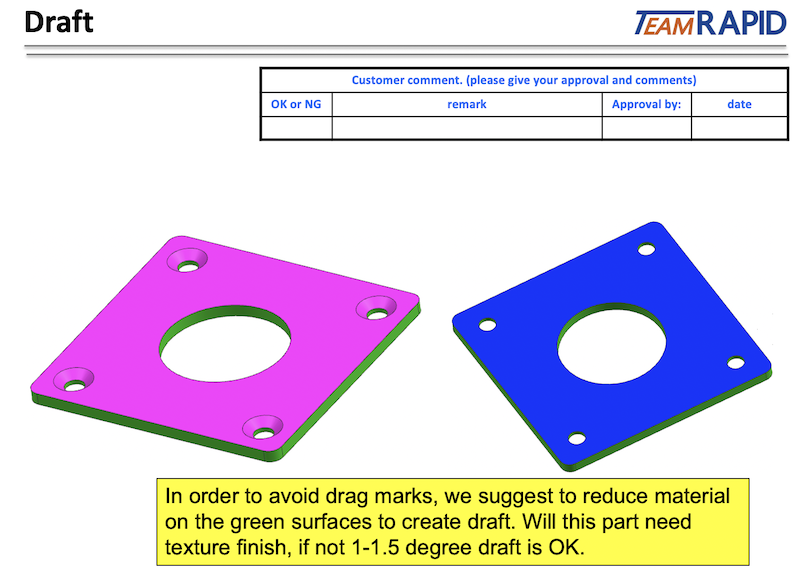
Draft: creating angles or tapers on features such as ribs, posts, walls and bosses that lie parallel to the ejection direction. How a specific feature is, it always determines the type and degree of draft needed. Features such as holes or pockets should taper thinner as they extend into the mold. There may not need draft for surfaces that steel separates before ejection. Also, the other guides for designing draft include:
1. Draft should be considered for all surfaces parallel to the mold separate directions.
2. Angle walls and others attribute in both mold halves to assist ejection and retain uniform wall thickness.
3. Using the standard one degree of draft plus one additional degree of draft for every 0.001 inch of texture depth to avoid any potential risk of drag issue.
4. If design permitted, use a draft angle of at least one-half degree for most materials, and set the draft as bigger as possible for easy part ejection. SAN resins typically require one to two degrees of draft.
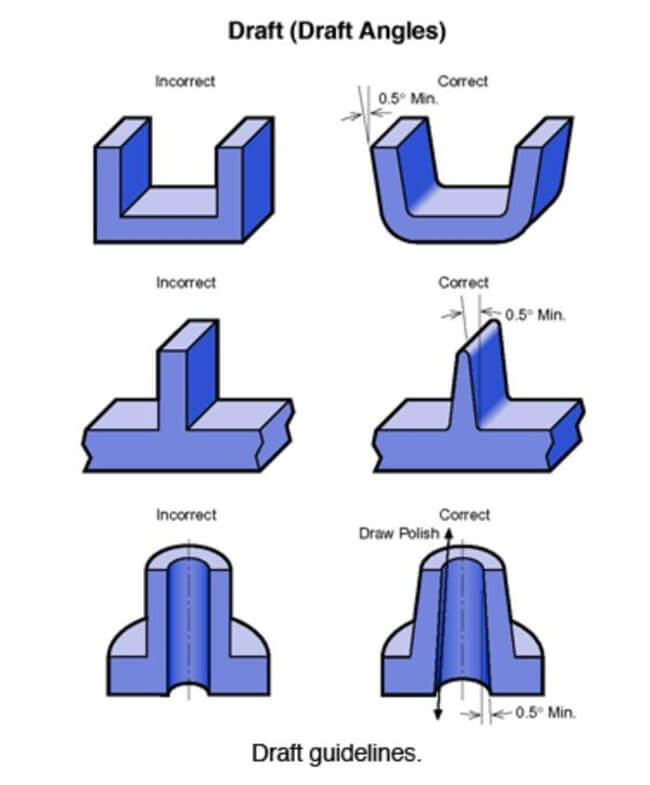
Typical Draft Angle Guidelines
| Surface Type | Recommended Draft |
|---|---|
| Smooth surface | 1° per side |
| Light texture | 2° per side |
| Heavy texture | 3°-5° per side |
| Deep ribs | 0.5°-1° minimum |
Draft vs. No Draft (Simple Comparison)
| Feature | With Draft | Without Draft |
|---|---|---|
| Part Release | Easy | Difficult |
| Surface Quality | Better | Risk of scratches |
| Mold Wear | Lower | Higher |
| Production Efficiency | Faster | Slower |
Contact TEAM RAPID
TEAM RAPID offers professional Injection Molding Service. Our engineers will offer strong DFM support to help for shooting down potential manufacturing issues. Make sure you can get your final parts in a short time. Want to know more about us? Contact our team at sales@teamrapidtooling.com today to request a rapid manufacturing quote.


 Contact