
2026 NEV Injection Molding Trends: Rapid Tooling Solutions for Lightweight, Integrated Automotive Parts
Global NEV (New Energy Vehicle) production is accelerating at a compound annual growth rate exceeding 28% through 2026 (BloombergNEF, IEA). Platform architectures are iterating on 18-24 month cycles, compressing validation timelines and demanding unprecedented supply chain agility. In this environment, injection molded polymers now account for over 40% of total vehicle mass, making NEV injection molding a primary lever for lightweighting and structural integration. However, traditional hardened steel (H13/S136) tooling, with typical lead times of 12-16 weeks, severely misaligns with the industry’s “fast iteration, low-volume validation” paradigm. Compounding this bottleneck are advanced lightweight automotive plastics like LGF-reinforced PAs and halogen-free FR grades, which introduce complex molding variables: anisotropic shrinkage, fiber orientation-induced warpage, and weld-line sensitivity.
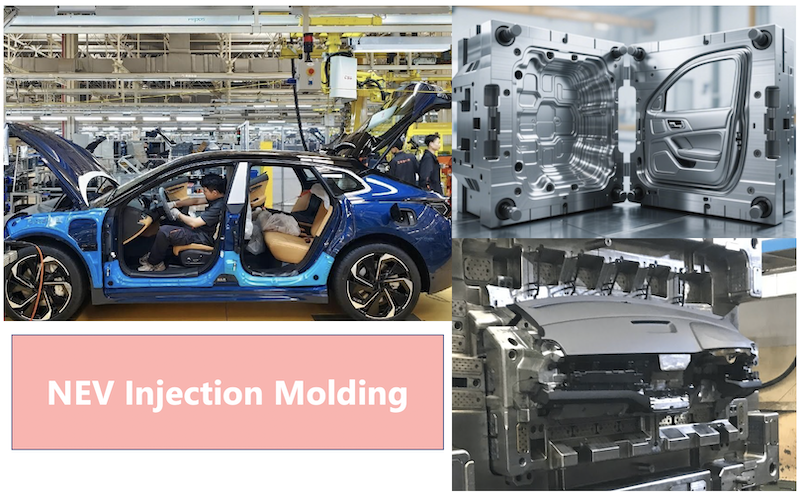
Rapid tooling for automotive applications has evolved from a prototyping compromise into a core engineering strategy. At TEAM Rapid, we specialize in a closed-loop workflow spanning DFM analysis, Al-7075/pre-hardened steel rapid molds, precision injection molding, and bridge production. This approach effectively bridges the critical gap between DV/PV validation and early SOP, enabling engineering teams to iterate physically, not just digitally.
Key NEV Components Driven by Injection Molding
Successful part integration hinges on aligning component architecture with process capabilities. Below is a breakdown of high-impact NEV subsystems, their engineering constraints, and proven process countermeasures.
2.1 Battery Pack & Enclosure Components
Typical Parts: Upper/lower housings, module brackets, thermal management flow plates, sealing flanges.
Engineering Challenges: UL94 V-0 compliance at 3.0mm, EMI shielding integration, flatness tolerance (<0.5mm/1000mm for gasket sealing), and 10G random vibration fatigue resistance.
Material Trends: High-flow, low-warp PPA/PPS/LCP for thermal zones; PC/ABS or GF-PA66 for structural carriers.
Process Execution: battery enclosure molding requires sequential valve gating to balance fill fronts and suppress knit lines on large surfaces. Zoned cooling channels (±2℃ control) combined with conformal drilling on 3-axis/5-axis CNC machined blocks are essential to manage differential cooling. For high-aspect-ratio covers, dynamic pressure control during packing compensates for fiber-reinforced shrinkage anisotropy.
2.2 Interior & Exterior Integrated Parts
Typical Parts: IP cross-car beams, center console integrated carriers, door trim substrates, charge port doors.
Engineering Challenges: Class A surface aesthetics (zero sink/flow lines), precise IMD/IML film registration, and 2K soft-touch overmolding adhesion.
Design Trend: Aggressive part consolidation to eliminate mechanical fasteners and reduce secondary assembly labor by 25-35%.
Process Execution: Achieving optical-grade surfaces demands rapid-cycle mold temperature control (up to 140℃ with steam or electrical heating, then rapid water quench). Gas-assisted injection molding reduces sink marks on thick ribs while lowering clamp force. For multi-material assemblies, rotary 2K platen molding with hot-runner synchronization ensures interface bonding strength >15 MPa without visible gate scars.
2.3 Electrical & Connector Components
Typical Parts: HV connector housings, sensor mounting brackets, wire harness clips, dielectric isolation barriers.
Engineering Challenges: Tight geometric tolerancing (±0.02mm for terminal alignment), CTI >400V insulation resistance, and stress-crack prevention during metal terminal overmolding.
Material Trends: Liquid Crystal Polymers (LCP) and PPS for ultra-low moisture absorption and minimal post-mold shrinkage (<0.15%). Halogen-free phosphorous/nitrogen FR systems replace Sb?O?-based chemistries.
Process Execution: Precision locating fixtures and servo-controlled insert placement are mandatory. Vacuum-assisted mold venting (-0.8 bar) eliminates air entrapment around complex terminal geometries. Gate placement is strategically positioned away from sealing ribs to prevent flow hesitation-induced micro-cracking.
Why Rapid Tooling is the Strategic Choice for NEV Development
Rapid tooling is frequently misunderstood as a short-term prototype substitute. In modern NEV development, it functions as a strategic bridge tooling asset that de-risks hard tool investment while accelerating physical validation.
Metallurgical & Economic Comparison
| Parameter | Al-7075 Rapid Tooling | Pre-Hardened Steel (P20/NAK80) | Production Hardened Steel (H13/S136) |
|---|---|---|---|
| Machining Lead Time | 2-4 weeks | 8-10 weeks | 12-16+ weeks |
| Thermal Conductivity | ~130-150 W/m.K | ~30 W/m.K | ~28 W/m.K |
| Typical Shot Life | 10,000-50,000 cycles | 50,000-150,000 cycles | 250,000+ cycles |
| Design Change Flexibility | High (CNC re-machining, TIG welding) | Moderate (weld & re-polish) | Low (costly EDM & heat treatment rework) |
| Initial Tooling Cost | Baseline (1.0×) | ~1.3-1.5× | ~1.8-2.2× |
The 2-4 weeks delivery window aligns perfectly with DV/PV phase gates, allowing engineering teams to capture physical data (thermal performance, assembly fitment, EMI shielding) before locking SOP specifications. Financially, upfront mold investment drops by 30-50%, preserving capital for parallel component testing or software validation. From a risk-management standpoint, rapid molds validate actual material shrinkage rates, cooling efficiency, and clamp-force requirements-data that prevents costly re-cuts during final H13 hardening. For bridge tooling volumes (500-10,000 units), Al-7075 provides production-grade dimensional stability with the flexibility to absorb late-stage ECNs via localized welding or feature re-machining.
Material Innovations Enabling Lightweight & High Performance
Achieving target curb weight without compromising crash safety or NVH requires advanced polymer formulations paired with optimized processing windows.
Long Glass Fiber (LGF) Reinforced Thermoplastics
Replacing stamped steel brackets with 30-40% LGF-PPA or LGF-PPS achieves 20-30% part-level weight reduction while maintaining flexural moduli >5.0 GPa. Critical design rule: gate placement must align with principal load paths to control fiber orientation.Microcellular Foaming (MuCell?)
Physical foaming with N or CO2 reduces density by 10-15% while simultaneously lowering injection viscosity. This cuts required clamp force by ~25% and virtually eliminates sink marks on thick-section transitions. Warpage is mitigated through uniform cell pressure distribution during packing.Flame Retardant Engineering Systems
Battery enclosure compliance with GB 38031 and UN 38.3 demands materials that withstand thermal runaway exposure (800-1000℃ for 5 min without ignition propagation). Modern halogen-free FR grades achieve UL94 5VA at 1.5mm while maintaining >120℃ HDT and high tracking resistance (CTI 600V).PCR & Sustainable Resins
OEM ESG mandates are driving 15-25% Post-Consumer Recycled (PCR) content into interior trim and non-structural underbody components. Advanced compatibilizer packages restore impact strength and melt flow index consistency, ensuring processability on standard screw geometries.
Material Selection Guide: Structural brackets → LGF-PPA/PPS; Thermal interfaces → PPS/LFP; Interiors (Class B/C) → PC/ABS with 20% PCR. (Note: Actual performance depends on design, wall geometry, and processing parameters. Consult resin supplier datasheets for specific grade validation.)
Critical DFM Guidelines for NEV Injection Molding
Physical validation begins at the CAD stage. Implementing these DFM rules reduces trial-and-error cycles and ensures rapid molds hit dimensional targets on the first T1 shot.
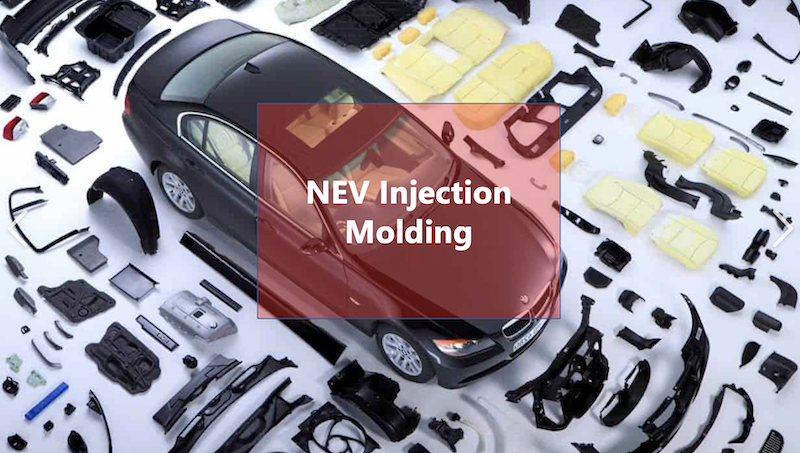
- Uniform Wall Thickness: Maintain 2.5-3.5 mm nominal thickness for structural housings. Avoid transitions >20% thickness differential. Use 2-3 mm fillet radii at ribs/wall intersections to prevent localized shear heating and fiber breakage.
- Draft & Texture Correlation: Minimum draft: ≥1.5° for textured surfaces, ≥2.0° for polished/deep cavities. Texture depth (VDI 21 to 3400) requires an additional 1° draft per 0.02 mm depth increase to guarantee clean ejection.
- Gate Strategy for Large Parts: Avoid edge gating on flat battery covers. Utilize multi-valve hot runner systems with cascaded opening sequences to balance melt fronts and push weld lines to non-critical flanges or hidden ribs.
- Rib & Boss Geometry: Rib thickness ≤ 60% of nominal wall. Add 0.5-1.0 mm draft to ribs. Hollow boss cores with 1.5 mm minimum wall thickness to prevent sink. Position ejector pins on thick features or under structural ribs.
- Insert & Overmold CTE Matching: When overmolding onto brass or aluminum inserts, account for thermal expansion mismatch. Design mechanical undercuts (diamond knurling or axial grooves >0.15 mm depth) instead of relying solely on adhesive bonding to prevent interfacial delamination during thermal cycling.
At TEAM Rapid, we deliver a comprehensive DFM report within 24 hours of 3D submission. The report includes Moldflow simulation results, tolerance stack-up analysis, sink/warp predictions, and cost-optimized manufacturing feedback.
Real-World Application: From Prototype to Low-Volume Launch
Client Background: A Tier 1 NEV supplier required 2,000 units of a high-voltage battery module mounting bracket for pre-production road testing. Original steel mold specifications called for a 14-week lead time and exceeded budget, while mounting hole locations were still undergoing ECR revisions.
Engineering Solution: We transitioned to Al-7075 rapid tooling with direct-conformal cooling channels and implemented a post-mold stress-relief annealing cycle (100℃ for 2 hours). Material: PC/ABS blend with 15% GF for vibration damping and dimensional stability. Process parameters were optimized using DoE (Design of Experiments) to control warpage within ±0.3 mm/m.
Quantified Results:
- Lead Time: 3 weeks from 3D release to first approved parts (79% reduction)
- Cost: Mold investment reduced by 42% vs. traditional P20 baseline
- Validation: Passed 85℃/85%RH humidity cycling, 15G random vibration, and 2-meter drop impact per customer spec
- Compliance: Full IATF 16949 documentation control, supporting PPAP Level 3 submission without process deviation
Conclusion & Next Steps
NEV platform development has shifted from a linear “design-freeze-then-validate” model to a concurrent engineering workflow where speed, flexibility, and lightweighting compete as equal priorities. Bridge tooling via aluminum or pre-hardened steel molds is no longer a temporary stopgap; it is a validated engineering pathway that captures real-world material behavior, absorbs late-stage design changes, and preserves capital until SOP volumes are confirmed.
TEAM Rapid delivers an integrated pipeline: 24-hour DFM feedback → CNC-machined rapid molds → precision injection molding → secondary operations & surface finishing. We align directly with DV/PV milestones to keep your program on schedule and within budget.
Upload your 3D CAD file for a free DFM analysis & cost estimate within 24 hours.


 Contact