
Plastic Trays: The Complete Guide to Custom Manufacturing
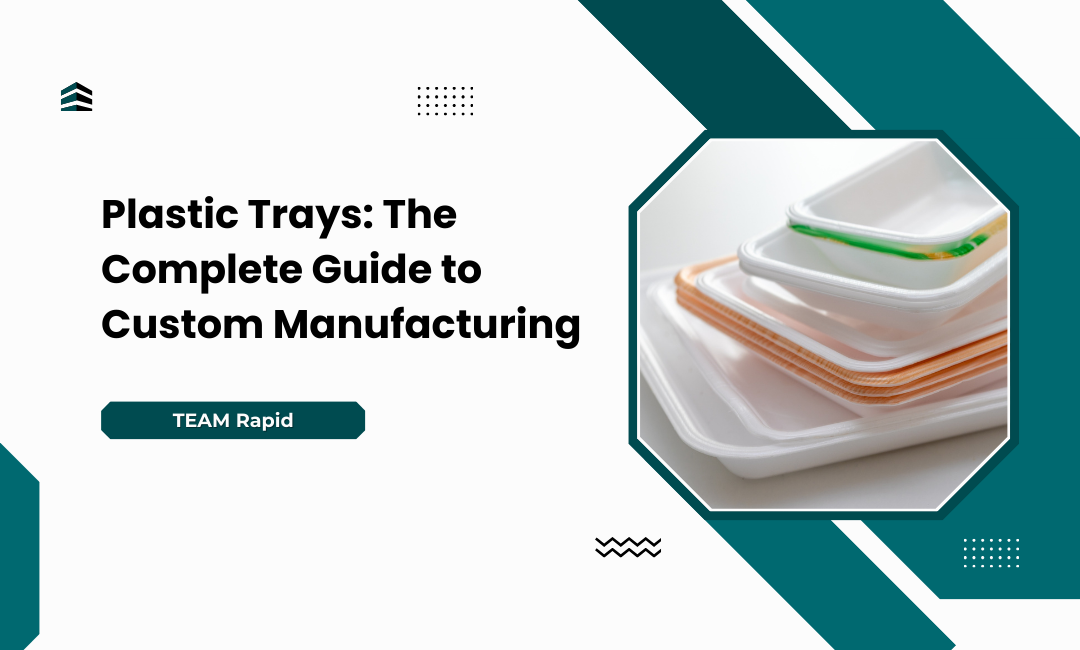
Most plastic trays fail before they even reach production. Why? Poor material choices, bad design decisions, and manufacturers who cut corners. Whether you're developing custom plastic trays for packaging, electronics, or food service, getting it wrong means wasted time and money.
This guide covers everything you need to get it right:
● Types of plastic trays and their best applications
● Materials, manufacturing methods, and prototyping
● Custom molded plastic trays for specific industries
● Battery case holders and specialty tray designs
● How to find reliable plastic tray suppliers
● Pricing factors and cost-saving strategies
At TEAM Rapid, we help businesses go from tray concept to finished product using injection molding, CNC machining, and rapid prototyping. Thousands of projects delivered, 10+ years in the game.
Types of Plastic Trays and Their Applications
The type you choose depends entirely on what it needs to do, where it will be used, and how much abuse it needs to survive. Pick the wrong one, and you're looking at cracked trays, contaminated products, or wasted budget.
Let's break down the most common types of plastic trays and where they actually work best.
Plastic Food Trays
Food service is one of the biggest markets for plastic trays. Restaurants, catering companies, grocery chains, and meal prep businesses all rely on them daily. But material selection matters more here than in almost any other category.
The most common materials used in plastic food trays include:
● Polypropylene (PP) for microwave-safe meal packaging and hot food service
● PET (Polyethylene Terephthalate) for clear display trays that showcase bakery items and deli products
● Polystyrene (PS) for lightweight, low-cost disposable options
● ABS (Acrylonitrile Butadiene Styrene) for durable, reusable restaurant trays that handle daily dishwasher cycles
If your trays need to go from freezer to microwave, polypropylene is your best bet. It handles temperature swings from 32°F to 180°F without warping.
Plastic Serving Trays
A plastic serving tray needs to balance aesthetics with function. Nobody wants food presented on something that looks cheap. Melamine trays have been a go-to here for decades because they resist stains, survive dishwashers, and handle temperatures up to 212°F.
For upscale catering or event service, polycarbonate trays offer a near-glass clarity without the breakage risk. They're heavier than melamine, but the visual payoff is worth it.
Disposable Plastic Trays
Speed and cost drive this category.Disposable plastic trays are everywhere: fast food, airline meals, hospital food service, and event catering. PET and polystyrene dominate here because they're inexpensive to produce and lightweight to ship.
That said, sustainability pressure is reshaping this space. PLA (Polylactic Acid), a biodegradable plastic made from cornstarch, is gaining traction as a greener alternative. It won't replace PET overnight, but it's worth watching.
Plastic Fruit Trays
Plastic fruit trays serve a dual purpose: protection during transport and attractive display at retail. Thermoformed PET trays with ventilation slots are the standard for fruits and vegetables because they prevent moisture buildup and bruising.
Farms and distributors rely heavily on custom-molded tray designs that fit specific produce shapes. A tray built for strawberries won't work for apples. That level of customization is where manufacturers with rapid prototyping capabilities really shine.
TEAM Rapid's rapid prototyping services let you test custom tray designs in as little as 2-8 days before committing to full production tooling. That means less guesswork and fewer costly revisions.
Plastic Ice Trays
Simple in concept, but plastic ice trays have evolved well beyond the basic cube mold. Silicone rubber molding now produces flexible trays in almost any shape: spheres, diamonds, even branded logo molds for cocktail bars and events.
For high-volume commercial ice tray production, injection molding remains the most efficient method. It delivers consistent wall thickness, clean release edges, and repeatability across thousands of units.
Plastic Drip Trays
Plastic drip trays are the unsung heroes of labs, workshops, and industrial equipment setups. They catch leaks, contain spills, and protect expensive machinery from chemical corrosion.
HDPE and polypropylene are the standard materials here because they resist a wide range of chemicals. In scientific and medical settings, custom thermoformed drip trays with specific cavity dimensions prevent cross-contamination between samples.
Battery Case Holders and Trays
This is a niche but growing category. A battery case holder or battery tray needs to be non-corrosive, vibration-resistant, and dimensionally precise. Automotive, marine, RV, and increasingly EV applications all require custom battery holders designed to exact specifications.
Materials like ABS and polypropylene are standard because they resist battery acid exposure and hold up under constant vibration. For EV battery modules, tighter tolerances and flame-retardant materials become critical.
With TEAM Rapid's injection molding and CNC machining services, you can produce custom battery holders with tolerances as tight as 0.01mm. That precision matters when you're dealing with battery safety and fit.
Plastic Tray for Dog Crates
The pet industry is a surprisingly large consumer of plastic trays for dog crates. These trays need to be chew-resistant, leak-proof, odor-resistant, and easy to clean. Most are injection molded from polypropylene or ABS plastic in a single-piece construction for durability.
Custom sizing matters here. Crate trays must match specific crate dimensions exactly, and pet product brands often need multiple SKUs across a range of sizes from extra small to giant.
Quick-Reference Comparison Table
|
Tray Type |
Best Material(s) |
Key Feature |
Common Industry |
|
Food trays |
PP, PET, ABS |
Heat/cold resistance |
Food service, retail |
|
Serving trays |
Melamine, polycarbonate |
Stain resistance, clarity |
Catering, hospitality |
|
Disposable trays |
PET, PS, PLA |
Low cost, lightweight |
Fast food, airlines |
|
Fruit trays |
PET (thermoformed) |
Ventilation, display |
Agriculture, grocery |
|
Ice trays |
Silicone, PP |
Flexible release |
Consumer, hospitality |
|
Drip trays |
HDPE, PP |
Chemical resistance |
Lab, industrial |
|
Battery holders |
ABS, PP |
Vibration/acid resistance |
Automotive, marine, EV |
|
Dog crate trays |
PP, ABS |
Chew/leak-proof |
Pet products |
Why Tray Type Drives Manufacturing Method
Here's something many buyers overlook: the type of plastic tray you need directly determines how it should be manufactured. Thermoforming works well for thin-gauge trays like food packaging. Injection molding is better for thicker, more durable trays like battery holders and dog crate pans. And for low-volume prototyping or complex geometries, CNC machining and vacuum casting fill the gap.
Understanding this connection saves you from choosing the wrong supplier or paying for a process that doesn't match your product.
How to Make Plastic Trays
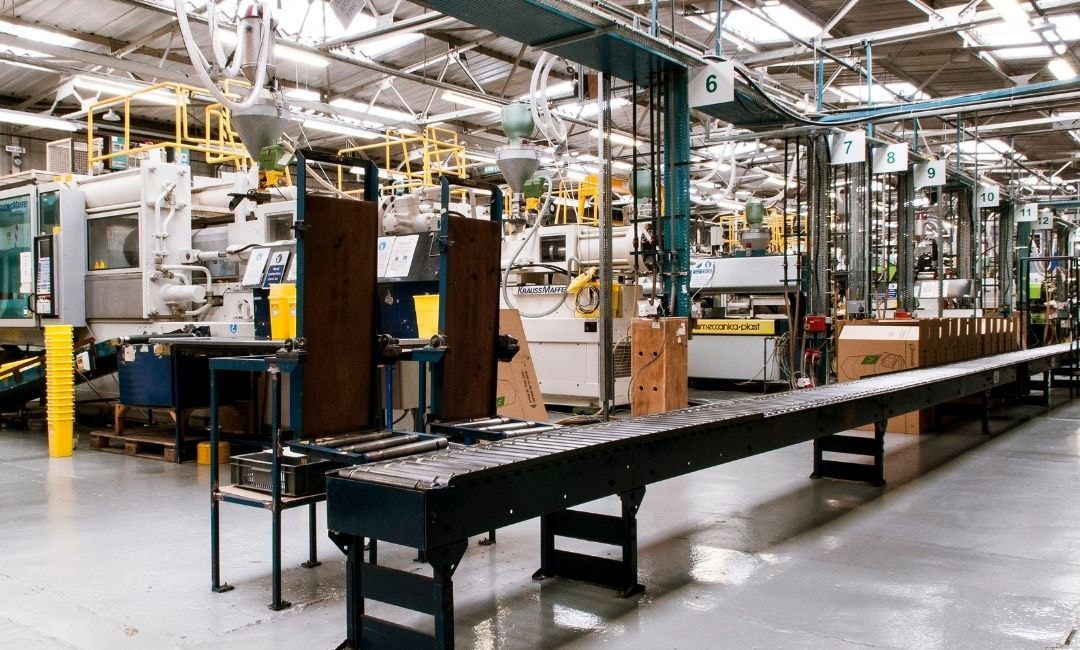
Knowing the type of tray you need is only half the equation. The other half is understanding how plastic trays are actually manufactured. The method you choose affects everything: cost per unit, lead time, minimum order quantity, dimensional accuracy, and surface finish.
Get this decision wrong and you'll either overpay for production or end up with trays that don't perform. Here are the four primary methods for making plastic trays.
Thermoforming (Vacuum and Pressure)
Thermoforming is the workhorse of the plastic tray world. A flat plastic sheet gets heated until it's soft and pliable, then it's shaped over a single-sided mold using either vacuum suction or applied pressure.
Why it works for trays:
● Lower tooling costs compared to injection molding
● Faster production startup (weeks, not months)
● Great for thin-walled trays like food packaging and shipping inserts
● Scales well from a few hundred to thousands of units
The tradeoff? Thermoformed trays need post-forming trimming, and they can't achieve the same level of dimensional precision as injection-molded parts. For simple, shallow tray designs at moderate volumes, though, thermoforming is tough to beat.
Pro tip: Always add 1-3 degrees of draft angle to your tray walls. Without it, parts stick to the mold and warp during removal.
Injection Molding
When you need precision, durability, and high-volume consistency, injection molding is the gold standard. Molten plastic pellets are injected into a two-sided steel or aluminum mold under high pressure. Once cooled, the tray pops out ready to go.
This is the method behind custom molded plastic trays used in medical devices, electronics, automotive battery holders, and reusable industrial trays. The tolerances are tight, the surface finishes are clean, and every single tray comes out identical.
The catch? Tooling costs are significantly higher, and mold production takes longer. But once that mold is built, per-unit costs drop fast at scale.
|
Factor |
Thermoforming |
Injection Molding |
|
Tooling cost |
Lower |
Higher |
|
Lead time (tooling) |
2-4 weeks |
4-8+ weeks |
|
Best for |
Thin, shallow trays |
Thick, complex trays |
|
Volume sweet spot |
100-10,000 units |
1,000-100,000+ units |
|
Tolerance |
Moderate |
Very tight (down to 0.01mm) |
TEAM Rapid offers injection molding services with tooling lead times as short as 5-25 days, and DFM analysis is included with every quote. That's a meaningful speed advantage over traditional mold shops.
CNC Machining for Prototypes
Before committing to expensive molds, smart manufacturers prototype first. CNC machining carves a tray directly from a solid plastic block using computer-controlled cutting tools. No mold needed.
You won't use CNC for production runs because the per-unit cost is too high. But for validating dimensions, testing fit, and getting stakeholder approval before tooling investment, it's invaluable. Typical turnaround for a CNC prototype tray is 2-5 days.
3D Printing and Vacuum Casting
For early-stage plastic tray prototypes, 3D printing (SLA or SLS) lets you test a design concept in hours, not days. The finish won't match production quality, but the speed is unmatched for rapid design iteration.
When you need a step between 3D-printed prototypes and full injection molding, vacuum casting bridges the gap. A silicone mold is made from a master part, then liquid plastic is poured in under vacuum to produce small batches of 10-50 trays. It's faster and cheaper than cutting a steel mold, and the parts closely replicate injection-molded quality.
Our rapid prototyping capabilities at TEAM Rapid cover all three methods: 3D printing (SLA and SLS), CNC prototyping, and vacuum casting, so you can move from concept to testable parts in as little as 2-8 days.
Materials for Custom Plastic Trays
Material selection can make or break your tray. Choose the wrong plastic, and you'll deal with warping, cracking, chemical degradation, or regulatory issues. Choose the right one and your tray performs exactly as intended for years.
Here's what you need to know about the most commonly used materials for custom plastic trays.
Polypropylene (PP)
PP is one of the most versatile plastics for tray manufacturing. It's lightweight, chemical-resistant, microwave-safe, and handles temperatures up to 180°F. That makes it a popular pick for food trays, medical trays that require autoclave sterilization, and chemical-resistant drip trays.
The downside? PP gets brittle in cold environments. If your tray needs to perform in freezer conditions, look elsewhere.
PET and PETG
● PET (Polyethylene Terephthalate) delivers excellent clarity, which is why you see it everywhere in retail food packaging and display trays. It's strong, recyclable, and holds its shape well.
● PETG adds glycol to the mix, making it tougher and easier to thermoform. It's become a go-to material for medical packaging trays because of its chemical resistance, low outgassing, and compatibility with multiple sterilization methods.
ABS (Acrylonitrile Butadiene Styrene)
If your tray needs to take a beating, ABS is worth considering. It offers strong impact resistance, scratch resistance, and dimensional stability. You'll find ABS in reusable industrial trays, custom battery holders, pet crate trays, and electronics packaging.
ABS also machines well, making it a solid choice for CNC-machined prototypes before moving to injection-molded production.
HDPE (High-Density Polyethylene)
HDPE stands out for its chemical resistance and flexibility. It's commonly used in shipping trays, automotive dunnage trays, and industrial drip trays where exposure to oils, solvents, or acids is a concern. The material is softer than ABS or PP, so it absorbs impact well.
One thing to watch: HDPE has a tendency to warp during thermoforming. If your tray needs to stay perfectly flat for automation applications, HDPE might not be ideal.
ESD and Anti-Static Materials
For electronics packaging, standard plastics aren't enough. You need materials that dissipate static electricity to protect sensitive components like circuit boards and semiconductors.
Common ESD-safe options include conductive HIPS (black), anti-static coated PETG (clear), and conductive polypropylene. The right choice depends on your surface resistivity requirements and whether the trays are for shipping, storage, or production line use.
How to Choose the Right Material
Picking a material isn't about finding the "best" plastic. It's about matching properties to your specific application.
● Need heat resistance? Go with PP or polycarbonate
● Need clarity for product display? PET or PETG
● Need impact durability? ABS or polycarbonate
● Need chemical resistance? HDPE or PP
● Need ESD protection? Conductive HIPS or anti-static PETG
● Need FDA compliance for food contact? PP, PET, or HDPE
When you work with TEAM Rapid's engineering team, you get material guidance as part of the DFM (Design for Manufacturability) analysis. We'll help you match the right material to your tray's functional requirements, budget, and production method before a single part is made.
Battery Case Holders and Specialty Trays
A battery case holder might look simple, but it's one of the most precision-critical plastic components you can manufacture. Get the dimensions wrong by even a fraction of a millimeter, and you risk poor electrical contact, vibration damage, or worse.
Custom battery holders show up in more places than most people realize: automotive under-hood compartments, marine vessels, RVs, EV battery modules, consumer electronics, and medical devices. Each application brings its own set of demands.
Here's what separates a well-designed battery tray from a bad one:
● Dimensional accuracy to ensure a snug, secure fit
● Chemical resistance to withstand battery acid and electrolyte exposure
● Vibration dampening for automotive and marine environments
● Flame-retardant properties for EV and industrial applications
● Proper ventilation to prevent heat buildup
ABS and polypropylene remain the standard materials, but specialty applications like EV battery packs increasingly call for flame-retardant grades or even composite blends engineered for crash safety and thermal management.
Pro tip: Always prototype your battery holder before investing in production tooling. A minor fit issue at the prototype stage is a quick fix. The same issue discovered after tooling is an expensive one.
TEAM Rapid's engineering team supports the full cycle here, from CNC-machined prototypes to injection-molded production runs with tolerances down to 0.01mm. If your project involves insert molding for embedded metal contacts or overmolding for vibration isolation, those capabilities are in-house, too.
How to Find Reliable Plastic Tray Suppliers
Finding a manufacturer that can actually deliver is harder than it sounds. The plastic tray suppliers landscape is crowded, and not every shop can handle custom work with consistent quality.
Here's what to evaluate before you commit:
● Certifications matter. ISO 9001:2015 should be the baseline. For food-contact trays, look for FDA or EFSA compliance. For medical trays, verify cleanroom capabilities.
● In-house tooling vs. outsourced. Suppliers who build their own molds have more control over lead times and quality. Those who outsource tooling introduce extra risk and delays.
● DFM support. The best suppliers don't just take your CAD file and run with it. They analyze your design for manufacturability before production starts, catching issues early.
● Prototyping capabilities. If a supplier can't offer rapid prototyping, you're flying blind until the production mold is cut.
● Communication speed. This is underrated. A supplier that takes a week to respond to a quote request will take even longer when problems arise during production.
Working with a China-based manufacturer like TEAM Rapid can cut costs by up to 40% compared to European or American suppliers, without sacrificing quality. The key is choosing a partner with proven engineering support, full inspection protocols, and a track record of on-time global delivery.
Plastic Tray Pricing and Cost-Saving Tips
Plastic tray price varies wildly depending on a few key factors. Understanding what drives cost helps you make smarter decisions and avoid overpaying.
The biggest pricing levers:
● Material type. Standard PP and HIPS are budget-friendly. Specialty materials like polycarbonate, ESD-safe plastics, or flame-retardant blends cost more.
● Tooling investment. Thermoforming molds can run a few hundred to a few thousand dollars. Injection molds start higher but pay off at volume.
● Order quantity. Per-unit cost drops significantly as volume increases. A run of 10,000 injection-molded trays costs a fraction per piece compared to 500.
● Tray complexity. More cavities, tighter tolerances, textured surfaces, or multi-material construction all add cost.
● Finishing requirements. Painting, plating, polishing, or adding anti-static coatings increases the price per unit.
Ways to reduce your tray costs without cutting corners:
1. Simplify the design. Eliminate unnecessary features and reduce wall thickness where strength allows
2. Choose the right process for your volume. Don't use injection molding for 200 trays when thermoforming would cost half
3. Use a MUD (Master Unit Die) mold. This shared mold base system from TEAM Rapid's rapid tooling services lowers tooling costs significantly for small-to-mid production runs
4. Consolidate orders. Combining multiple tray SKUs into a single production run reduces setup costs
5. Get DFM feedback early. Design changes are free on paper. They're expensive after the mold is built
The global plastic tray market is projected to reach over $12 billion by 2034. That growth means more suppliers competing for your business, which works in your favor if you know what to negotiate on.
Build Better Plastic Trays With TEAM Rapid
Custom plastic trays touch nearly every industry, and getting the design, material, and manufacturing method right from the start saves you time, money, and a lot of headaches down the road.
Here's what to remember:
● Match your tray type to its actual application before choosing materials
● PP, PET, ABS, and HDPE each serve different performance needs
● Thermoforming suits thin, high-volume trays; injection molding wins on precision
● Always prototype before committing to production tooling
● Evaluate suppliers on certifications, DFM support, and communication speed
● Design simplicity and volume planning are your biggest cost-saving levers
Whether you need custom molded plastic trays, specialty battery case holders, or high-volume production runs,TEAM Rapid brings 10+ years of manufacturing expertise, ISO 9001:2015 certification, and pricing up to 40% lower than Western suppliers.Upload your CAD file at teamrapidtooling.com and get a quote with full DFM analysis within 24 hours.


 Contact