
Sink Marks in Injection Molding: Causes, Prevention, Inspection & Troubleshooting Guide
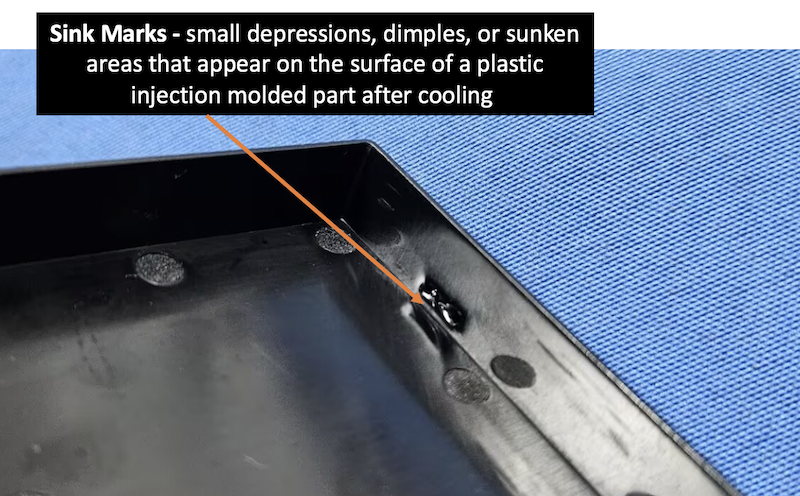
Sink marks are one of the most common and persistent defects in plastic injection molding, it is a small depressions, dimples, or sunken areas that appear on the surface of a plastic injection molded part after cooling. Whether you are producing automotive interiors, medical device housings, or consumer electronics enclosures, even minor surface depressions can compromise aesthetics, dimensional accuracy, and structural performance. At TEAM Rapid, we specialize in precision mold design and injection molding optimization to eliminate sink defects before they impact your production line. This comprehensive guide covers everything engineers, quality managers, and procurement teams need to know about sink marks: what causes them, how to inspect them, and proven strategies to prevent and troubleshoot them.
Introduction to Sink Marks in Injection Molding
What Are Sink Marks
Sink marks are localized depressions or dimples that form on the surface of an injection-molded plastic part. They typically appear directly over thick sections, ribs, bosses, or behind cosmetic walls where material shrinkage during cooling cannot be adequately compensated by the injection process.
Why Sink Marks Matter in Plastic Manufacturing
In modern manufacturing, surface quality directly impacts brand perception and functional reliability. Sink marks are not just cosmetic flaws; they indicate underlying material distribution, cooling, or pressure imbalances. Left unaddressed, they can trigger quality rejections, delay time-to-market, and increase per-unit costs.
Common Industries Affected by Sink Marks
- Automotive: Interior trims, dashboards, connector housings
- Consumer Electronics: Smartphone casings, appliance panels, battery covers
- Medical Devices: Diagnostic housings, surgical tool handles, fluid connectors
- Industrial & Packaging: Valve components, pump housings, protective enclosures
How Sink Marks Affect Product Appearance and Performance
Visually, sink marks create shadow lines and uneven gloss that fail cosmetic standards. Structurally, they indicate localized density variations that can reduce impact resistance, fatigue life, and long-term reliability in load-bearing applications.
How Sink Marks Affect Dimensions and Flatness
Because sink marks result from differential shrinkage, the surrounding plastic pulls inward as it cools. This creates localized stress concentrations, alters nominal wall thickness, and distorts part flatness. Over multiple features, cumulative sink can push parts outside engineered tolerances.
The Cost Impact of Sink Defects in Production
Sink-related scrap, secondary machining, cosmetic rework, and customer returns typically add 5-15% to total manufacturing costs. In high-volume production, even a 2% sink defect rate can translate to thousands of dollars in lost margin annually.
What Causes Sink Marks in Injection Molding
Plastic Shrinkage During Cooling
All thermoplastics contract as they transition from molten to solid state. Semi-crystalline materials shrink more (1.5-3.5%) than amorphous resins (0.4-0.7%). If shrinkage isn't uniformly compensated, surface depressions form.
Uneven Wall Thickness
Thick sections cool slower than thin ones. As the outer skin solidifies, the inner core continues to contract, pulling the surface inward and creating a sink mark.
Improper Rib and Boss Design
Ribs and bosses that exceed 60% of nominal wall thickness act as heat sinks. Without adequate material compensation, they become primary sink initiation points.
Insufficient Packing Pressure
Packing pressure forces additional molten plastic into the cavity to offset volumetric shrinkage. Too little pressure leaves voids that manifest as surface sinks.
Inadequate Holding Time
If the gate freezes before shrinkage compensation is complete, the part loses pressure support prematurely, increasing sink risk.
High Melt Temperature
Excessive melt temps increase volumetric shrinkage and extend cooling time, both of which amplify sink formation.
Improper Mold Temperature
Mold surfaces that are too hot delay skin solidification, reducing packing effectiveness. Too cold, and premature freezing blocks material flow into thick zones.
Poor Gate Location and Gate Size
Gates placed far from thick sections or sized too small restrict material flow and pressure transfer, leaving high-shrink zones under-packed.
Slow Cooling Rates
Inefficient cooling extends cycle time and allows prolonged shrinkage without pressure compensation, worsening sink depth.
Material Shrinkage Characteristics
Resin formulation, filler content, and crystallinity dictate baseline shrinkage. Engineers must design around the material's published shrinkage range.
Understanding the Formation of Sink Marks
Injection Molding Cooling and Solidification Process
As molten plastic contacts the mold wall, a frozen skin forms instantly. The core remains molten and continues to shrink. Packing pressure must push additional material into this shrinking core until the gate solidifies.
Why Thick Plastic Sections Sink
Thick zones retain heat longer. When the outer shell hardens, the still-contracting core pulls the surface inward, creating a visible depression.
Relationship Between Internal Voids and Surface Sinks
If the gate freezes too early or packing pressure is insufficient, internal voids form. Surface sinks are essentially the visible expression of these internal volumetric deficits.
Typical Areas Where Sink Marks Appear
- Behind cosmetic walls over ribs or bosses
- At wall thickness transitions
- Around screw inserts or metal molded-in components
- Near thick mounting flanges
Why Sink Marks Cause Dimensional Deviation
Localized shrinkage alters nominal thickness and shifts geometric centers. This affects bore alignment, snap-fit engagement, and mating surface contact.
Relationship Between Sink Marks and Part Flatness
Uneven shrinkage creates differential internal stresses. As these stresses relax post-ejection, the part warps, and flatness tolerances are compromised.
How Sink Marks Affect Dimensions and Flatness
Dimensional Shrinkage Caused by Sink Marks
Sink marks represent non-uniform material density. This causes localized shrinkage variation, making it difficult to hold tight ±0.1mm or ±0.05mm tolerances.
Flatness Problems in Injection Molded Parts
When sink occurs asymmetrically, one side of the injection molded part contracts more than the other. The resulting stress imbalance bends the part out of plane.
How Sink Marks Influence Assembly Accuracy
Misaligned mounting holes, uneven sealing surfaces, and inconsistent snap-fit engagement are direct consequences of sink-induced dimensional drift.
Effects on Sealing Surfaces and Mating Parts
Even 0.05mm of surface depression can break O-ring compression, compromise gasket contact, or cause fluid leaks in pressurized assemblies.
Sink Marks and Tolerance Control
Traditional tolerance stacks assume uniform shrinkage. Sink defects break this assumption, requiring statistical process control (SPC) and post-mold compensation.
Warpage and Surface Deformation Related to Sink Defects
Sink and warpage share the same root cause: uneven cooling and shrinkage. Reducing sink often improves flatness by default.
Measuring Flatness in Plastic Parts
Flatness is measured using CMM probe mapping, laser profilometers, or optical flatness gauges against a reference datum plane.
Common Flatness Tolerance Standards
- General industrial: ±0.5mm/m
- Precision electronics: ±0.2mm/m
- Medical & automotive sealing: ±0.1mm/m
Industries Requiring Tight Flatness Control
Automotive Components
Dashboard panels, sensor housings, and light bezels require tight flatness to ensure proper fit, acoustic sealing, and aesthetic continuity.
Consumer Electronics Housings
Smartphone backs, tablet frames, and wearable casings demand sub-0.2mm flatness for seamless assembly and premium surface finish.
Medical Plastic Parts
Diagnostic devices, fluid connectors, and sterile housings require flat, defect-free surfaces to meet ISO 13485 and FDA validation standards.
Industrial Equipment Covers
Control panels, pump housings, and protective enclosures rely on flat mating surfaces for environmental sealing (IP65/IP67) and structural rigidity.
Types of Sink Marks in Plastic Parts
Cosmetic Sink Marks
Visible on Class-A surfaces under standard lighting. Primarily affect appearance but rarely compromise structural integrity.
Structural Sink Defects
Deep depressions over load-bearing features like mounting bosses. Can reduce cross-sectional area and weaken mechanical performance.
Micro Sink Marks
Barely visible to the naked eye but detectable under magnification or angled lighting. Common in high-gloss or transparent parts.
Deep Sink Marks
Severe depressions exceeding 0.3mm. Often indicate fundamental design or process flaws and usually result in part rejection.
Sink Marks vs. Internal Voids
Sink marks are surface expressions of volumetric shrinkage. Internal voids are trapped air or shrink cavities that don't reach the surface but still weaken the part.
Sink Marks vs. Warpage
Sink is localized surface depression. Warpage is global part deformation. Both stem from uneven cooling but manifest differently.
Materials Most Susceptible to Sink Marks
ABS
Amorphous, low shrinkage (~0.4-0.7%). Moderate sink resistance. Easy to polish for cosmetic applications.
Polypropylene (PP)
Semi-crystalline, high shrinkage (1.5-2.5%). Highly prone to sink. Often requires rib optimization and extended packing.
Polycarbonate (PC)
Amorphous, moderate shrinkage (~0.5-0.7%). Good dimensional stability but sensitive to high melt temps that increase sink risk.
Nylon (PA)
Semi-crystalline, high shrinkage (1.0-2.0%). Hygroscopic nature requires strict drying. Unfilled grades show significant sink.
POM/Acetal
Semi-crystalline, high shrinkage (1.8-2.5%). Excellent mechanical properties but requires precise cooling and packing control.
Glass-Filled Materials
Fillers reduce shrinkage (often to 0.2-0.8%) and improve sink resistance. However, improper orientation can cause anisotropic warpage.
Comparing Shrinkage Rates of Common Plastics
|
Material |
Typical Shrinkage Range |
Sink Resistance |
|
ABS |
0.4-0.7% |
High |
|
PC |
0.5-0.7% |
High |
|
PP |
1.5-2.5% |
Low |
|
PA6 |
1.0-1.8% |
Low-Medium |
|
POM |
1.8-2.5% |
Low |
|
GF-PA |
0.2-0.6% |
Very High |
Sink Mark Inspection in Injection Molding
Why Sink Mark Inspection Is Important
Early detection prevents defective parts from reaching assembly lines, reduces scrap rates, and ensures compliance with customer specifications.
Inspecting Sink Marks That Affect Dimensions and Flatness
Dimensional inspection verifies whether sink has pushed critical features outside tolerance bands, especially on mating and sealing surfaces.
Visual Inspection Methods
Surface Reflection Inspection
Using a uniform light source to observe shadow lines and gloss discontinuities that indicate surface depression.
Angle Lighting Inspection Techniques
45° oblique lighting reveals micro-sinks invisible under direct illumination. Industry standard for Class-A surfaces.
Manual Inspection Standards
Trained inspectors use visual gauges, depth comparators, and standardized lighting booths per ISO 2813 or customer-specific cosmetic criteria.
Dimensional Inspection Methods
Using Calipers and Micrometers
Quick checks for nominal thickness variation over sink-prone zones. Limited for complex geometries.
Coordinate Measuring Machine (CMM) Inspection
High-accuracy 3D probing maps surface topology, identifies sink depth, and verifies flatness against GD&T callouts.
Flatness Measurement Techniques
Plane fitting algorithms compare surface points to a reference plane. Deviations beyond tolerance trigger corrective action.
Tolerance Verification
Statistical sampling validates whether sink-induced shrinkage remains within approved process capability indices (Cp/Cpk ≥ 1.33).
Surface Quality Inspection Technologies
3D Surface Scanning
Structured light or laser scanning generates point clouds to quantify sink depth, area, and distribution across the part.
Laser Surface Measurement
High-resolution profilometers measure micron-level surface deviations for medical and optical components.
Optical Inspection Systems
Machine vision cameras with controlled lighting automate sink detection on high-speed production lines.
Internal Defect Inspection
CT Scanning for Internal Voids
X-ray CT reveals internal shrink cavities, correlates them with surface sinks, and validates core density.
Ultrasonic Inspection Methods
Sound wave attenuation identifies density variations and subsurface voids without part destruction.
Cross-Section Analysis
Metallographic polishing and microscopy verify internal structure, filler orientation, and shrink zones.
Automated Sink Mark Detection Systems
AI Vision Inspection Systems
Deep learning models trained on defect libraries classify sink severity in real-time with >98% accuracy.
Inline Quality Monitoring
Sensors integrated into molding machines track cavity pressure, temperature, and cycle data to predict sink formation.
Smart Factory Inspection Solutions
IoT-connected inspection stations feed data to MES/ERP systems for traceability, SPC, and continuous process improvement.
Inspection Standards and Acceptance Criteria
Cosmetic Surface Standards
Class-A (visible), Class-B (semi-visible), Class-C (hidden). Each defines allowable sink depth, frequency, and lighting conditions.
Flatness and Dimensional Tolerance Standards
GD&T per ASME Y14.5 or ISO 1101. Flatness, parallelism, and profile tolerances dictate acceptable sink-induced deformation.
Automotive Industry Inspection Standards
IATF 16949, VDA 6.3, and OEM-specific cosmetic grids (e.g., Ford WSS, GM GMW). Require strict sink control on interior panels.
Consumer Electronics Appearance Standards
Apple MFI, Samsung QCS, and internal brand guidelines demand zero visible sink on visible surfaces under controlled lighting.
Medical Device Inspection Requirements
ISO 13485, FDA 21 CFR Part 820, and risk-based validation. Sink defects affecting fluid pathways or sterilization compatibility are critical failures.
Common Inspection Challenges
Detecting Micro Sink Marks
Sub-0.05mm depressions require magnification and standardized lighting. Human vision fatigue increases false negatives.
Glossy vs. Textured Surface Inspection
Textured surfaces mask sinks visually but not dimensionally. Different inspection protocols apply.
Human Inspection Errors
Subjectivity, lighting inconsistency, and fatigue lead to inconsistent pass/fail decisions. Automation reduces variability.
Quick Comparison Table: Sink Marks Causes and Solutions
Cause vs. Solution Matrix
|
Cause |
Engineering Solution |
|
Uneven wall thickness |
Core-out design, uniform 2.0-3.0mm walls |
|
Low packing pressure |
Increase to 60-80% of injection pressure |
|
Short holding time |
Extend until gate freeze + 0.5s buffer |
|
High melt temperature |
Reduce by 10-20°C per material datasheet |
|
Poor cooling efficiency |
Conformal channels, optimized circuit layout |
|
Thick ribs/bosses |
Limit to 50-60% of nominal wall thickness |
Material Shrinkage Comparison Table
These ranges are commonly published in:
- BASF Ultramid Design Guide
- SABIC Injection Molding Guide
- DuPont Zytel Design Handbook
- Covestro Makrolon Processing Guide
Recommended Wall Thickness by Material
|
Material |
Nominal Wall (mm) |
Max Recommended (mm) |
|
ABS |
2.0-3.0 |
4.0 |
|
PP |
1.5-2.5 |
3.5 |
|
PC |
2.0-3.5 |
4.5 |
|
PA6 |
1.5-2.5 |
3.0 |
|
POM |
1.5-2.5 |
3.0 |
Flatness Tolerance Comparison Table
|
Application Tier |
Typical Flatness Tolerance |
|
General Industrial |
±0.5 mm / 100 mm |
|
Consumer Electronics |
±0.2 mm / 100 mm |
|
Automotive Interiors |
±0.15 mm / 100 mm |
|
Medical/Sealing Components |
±0.1 mm / 100 mm |
How to Prevent Sink Marks in Injection Molding
Optimize Wall Thickness Design
-
Recommended Uniform Wall Thickness Guidelines
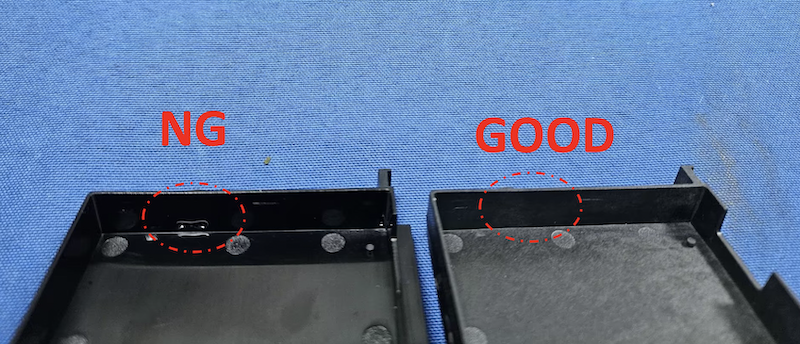
Maintain nominal thickness within 1.5-3.0mm depending on material flow length. Avoid sudden jumps >25% between adjacent sections.
-
Avoiding Thick-to-Thin Transitions
Use gradual tapers (≤1:3 slope) or core-out cavities to eliminate heat traps. Transition zones act as shrink amplifiers if abrupt.
-
Designing for Better Flatness Control
Symmetrical feature placement, balanced wall distribution, and neutral axis alignment reduce differential shrinkage stress.
Improve Rib and Boss Design
-
Recommended Rib Thickness Ratios
Ribs should not exceed 50-60% of the adjoining wall thickness. Thicker ribs guarantee sink formation.
-
Best Practices for Structural Features
Use multiple thin ribs instead of one thick rib. Add fillets (0.5-1.0mm radius) to reduce stress concentration and improve flow.
Optimize Gate Design and Placement
-
Choosing the Right Gate Type
Fan, tab, or diaphragm gates provide broader flow fronts and better packing distribution than small edge gates.
-
Gate Positioning for Better Packing
Place gates closest to thickest sections to maintain pressure longer. Multi-gate layouts balance fill and packing.
Optimize Injection Molding Parameters
-
Increase Packing Pressure
Raise packing to 60-80% of injection pressure. Monitor cavity pressure to avoid overpacking or flash.
-
Extend Holding Time
Hold until gate freeze + safety margin. Use short shots and pressure decay curves to determine optimal time.
-
Reduce Melt Temperature
Lower melt temp by 10-20°C to reduce volumetric shrinkage and cooling time. Verify viscosity remains within process window.
-
Optimize Injection Speed
Use medium-fast fill to prevent jetting but maintain shear heating for uniform viscosity.
-
Optimize Cooling Time
Balance cycle time with complete solidification. Premature ejection causes post-mold sink and warpage.
Improve Cooling Efficiency
-
Uniform Cooling Channel Design
Maintain 1.5-2.0x channel diameter from cavity surface. Use parallel circuits for even heat extraction.
-
Mold Temperature Control
Use independent zones for thick/thin areas. Typical range: 40-80°C for amorphous, 60-100°C for semi-crystalline.
-
Conformal Cooling Technology
3D-printed mold inserts follow part contour, reducing cooling time by 30-50% and dramatically cutting sink formation.
Material Selection Strategies
-
Low-Shrinkage Materials
Choose amorphous resins (ABS, PC, PMMA) or filled grades when flatness and cosmetic quality are critical.
-
Reinforced Engineering Plastics
Glass or mineral-filled compounds reduce shrinkage by 40-60%, improving sink resistance and dimensional stability.
-
Material Drying and Conditioning
Moisture causes hydrolysis and erratic shrinkage. Follow manufacturer drying specs (typically 80-120°C for 2-4 hours).
Mold Design Solutions for Sink Mark Reduction
Core-Out Design Techniques
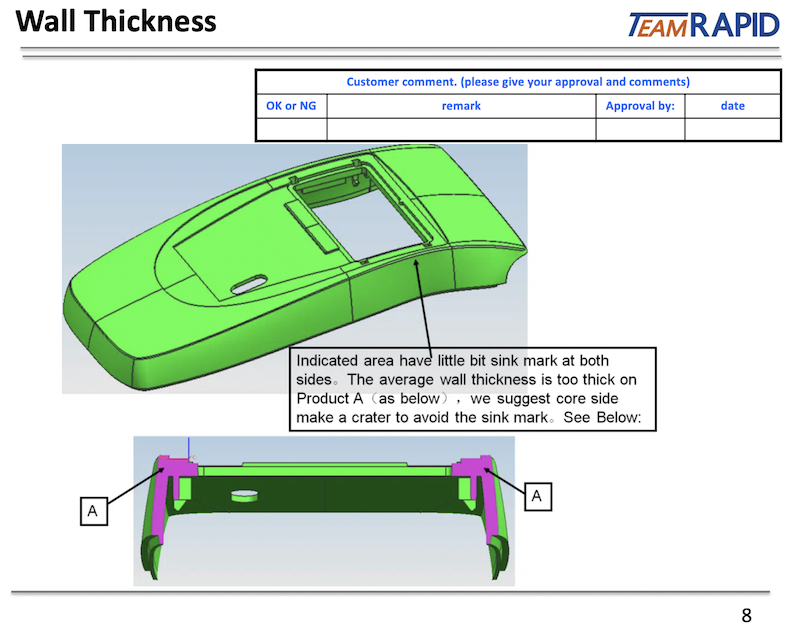
Hollow out thick sections while maintaining external geometry. Reduces material mass, cooling time, and shrinkage volume.
Proper Rib and Boss Engineering
Taper ribs, add draft, and limit base thickness. Use knock-out pins instead of solid bosses where possible.
Balanced Runner Design
Cold runner systems must balance flow length and pressure drop. Hot runners with individual nozzle control optimize packing per cavity.
Venting Optimization
Trapped air causes incomplete packing and localized sink. Place vents at end-of-fill and thick zones (0.02-0.03mm depth).
Multi-Gate Design Strategies
Multiple gates reduce fill distance, maintain pressure longer, and distribute shrinkage more evenly across large parts.
Gas-Assisted Injection Molding
Nitrogen channels hollow thick sections, reduce material usage, and eliminate sink by maintaining internal pressure during cooling.
Mold Design Strategies to Improve Flatness
Symmetrical cooling, balanced ejection, and neutral axis tooling ensure uniform stress release post-ejection.
Injection Molding Process Optimization
Scientific Molding Techniques
Decoupled molding separates fill, pack, and hold phases. Enables precise pressure profiling and repeatable sink control.
Cavity Pressure Monitoring
In-cavity sensors track real-time pressure curves. Deviations indicate packing inefficiency or gate freeze timing issues.
Mold Flow Analysis for Sink Prediction
Software like Moldflow analysis simulates cooling, shrinkage, and packing. Identifies sink-prone zones before steel is cut.
Process Window Optimization
Design of Experiments (DOE) maps optimal temperature, pressure, and time combinations. Maximizes robustness against material lot variation.
Real-Time Production Monitoring
IoT sensors feed cavity pressure, mold temp, and cycle data to cloud dashboards. Early warnings prevent sink drift.
Controlling Shrinkage for Better Dimensional Accuracy
Compensate mold dimensions using predicted shrinkage factors. Validate with first-article CMM and adjust tooling if needed.
Troubleshooting Sink Marks: Practical Solutions
Step-by-Step Sink Mark Troubleshooting Guide
- Verify Material & Drying: Confirm resin grade, moisture content, and drying parameters match datasheet.
- Check Wall Thickness: Use 3D CAD to identify thick zones, ribs, and transitions exceeding 60% ratio.
- Review Mold Flow Report: Locate predicted sink areas. Compare with actual defect locations.
- Optimize Packing & Hold: Increase packing pressure by 5-10% increments. Extend hold time until gate freeze.
- Adjust Temperatures: Reduce melt temp by 10°C. Verify mold temp uniformity with infrared thermography.
- Improve Cooling: Clean cooling lines, balance flow rates, and verify channel proximity to cavity.
- Validate Gate Design: Ensure gate size/location supports pressure transfer to thick zones.
- Run DOE Validation: Test parameter combinations, measure sink depth with profilometer, and lock optimal window.
- Implement SPC: Track cavity pressure, part weight, and flatness. Set control limits for early deviation detection.
- Engage Tooling Partner: If sink persists, collaborate with your mold builder for core-out redesign, conformal cooling, or multi-gate retrofit.
When to Redesign vs. Optimize Process
If sink depth exceeds 0.3mm or flatness fails ±0.15mm/100mm, process tweaks alone rarely suffice. Mold redesign (core-out, rib reduction, conformal cooling) becomes necessary.
Partnering with Experts for Zero-Defect Production
At TEAM Rapid, we integrate DFM analysis, advanced mold flow simulation, and precision cooling design into every project. Our engineering team collaborates with clients to eliminate sink marks at the design stage, not on the production floor.
Conclusion: Achieving Sink-Free Injection Molding
Sink marks are preventable when design, material science, and process control work in harmony. By optimizing wall thickness, refining rib and boss geometry, implementing scientific molding practices, and leveraging advanced inspection technologies, manufacturers can consistently produce flat, dimensionally accurate, and cosmetically flawless plastic parts.
Whether you are developing a new product or troubleshooting an existing mold, early collaboration with an experienced tooling partner saves time, reduces scrap, and ensures your parts meet the strictest industry standards.
Ready to eliminate sink marks from your production line?
Contact TEAM Rapid today for expert DFM review, precision mold design, and end-to-end injection molding support. Let our engineering team help you achieve zero-defect, high-yield manufacturing from rapid prototyping to mass production.
Quick Answers About Sink Marks in Injection Molding
What causes sink marks in injection molding?
Uneven wall thickness, insufficient packing pressure, high melt temperatures, poor cooling design, and improper rib/boss geometry.
How can sink marks be prevented?
Optimize wall thickness uniformity, increase packing pressure and holding time, lower melt temperature, improve mold cooling efficiency, and use mold flow analysis during design.
Which plastics are most prone to sink marks?
High-shrinkage materials like polypropylene (PP), polyethylene (PE), and unfilled nylons. Semi-crystalline polymers generally show more sink than amorphous resins.
Can sink marks affect part dimensions?
Yes. Localized shrinkage changes nominal thickness, shifts critical datums, and reduces flatness, directly impacting assembly fit and sealing performance.


 Contact