
Injection Molding Warpage Explained: Causes, Defects & Solutions
Injection molding warpage is one of the most persistent and costly defects in plastic manufacturing. Even when a part looks perfect straight out of the mold, subtle internal stresses can cause it to twist, bend, or distort hours, days, or weeks after ejection. For product designers, engineers, and procurement teams, understanding why warpage happens-and how to stop it before production begins-is the difference between a successful launch and a costly recall.
At TEAM Rapid, we’ve spent years helping hardware startups, automotive suppliers, and medical device manufacturers navigate the complexities of plastic part production. This guide breaks down the root causes of warpage, explains how to predict and prevent it, and provides actionable solutions backed by real-world engineering experience. Whether you’re designing a consumer electronics enclosure, an automotive bracket, or a precision medical component, this article will give you the technical clarity needed to eliminate deformation at the source.
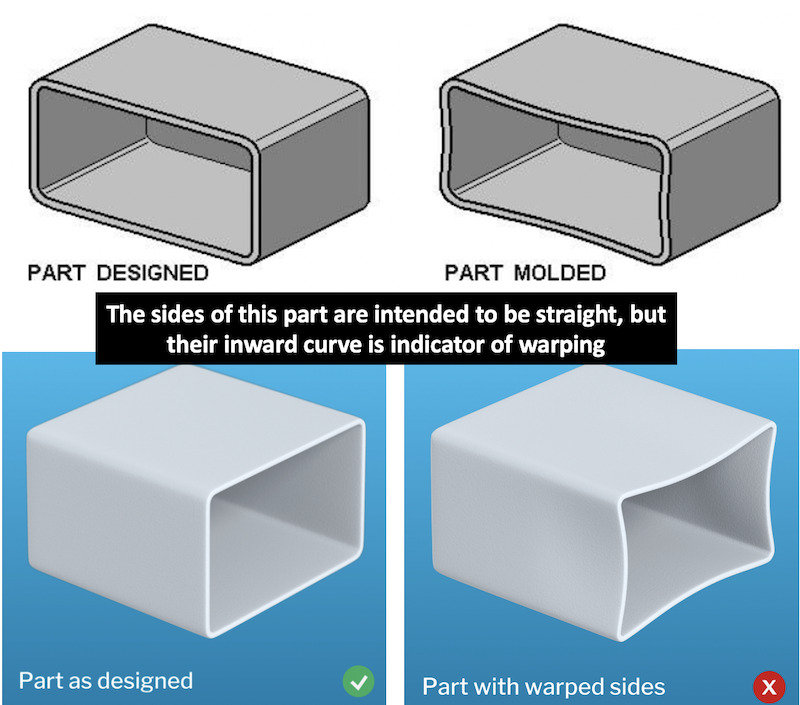
Why Warpage Is a Critical Issue in Injection Molding
Part warpage isn’t just an aesthetic flaw. It directly compromises assembly fit, mechanical performance, sealing integrity, and long-term durability. When a component doesn’t meet flatness or dimensional tolerance specifications, it can cause misalignment in snap-fits, uneven stress distribution in load-bearing applications, or complete failure in automated assembly lines.
The financial impact is equally severe. Warped parts increase scrap rates, trigger costly post-molding straightening or rework, delay time-to-market, and damage supplier credibility. Industries with tight regulatory or functional requirements-such as automotive, medical devices, aerospace, and precision consumer electronics-are especially vulnerable. A 0.2 mm deviation in a medical housing or an automotive sensor bracket can mean the difference between certification and rejection.
That’s why proactive risk mitigation is non-negotiable. TEAM Rapid integrates early-stage Design for Manufacturability (DFM) reviews, advanced simulation, and precision tooling strategies to catch warpage triggers before steel is cut. By addressing thermal, geometric, and material variables upfront, we help clients achieve first-shot success and predictable production scaling.
What Is Warpage in Injection Molded Parts
Warpage refers to the uneven distortion or bending of a molded plastic part after it cools and is ejected from the mold. Unlike uniform shrinkage, which reduces overall dimensions predictably, warpage creates internal stress imbalances that pull the part out of its intended shape. The result is twisting, bowing, cupping, or localized deformation that violates critical tolerance zones.
Warpage vs. Shrinkage: Key Differences
- Shrinkage is a volumetric reduction that occurs uniformly as molten plastic cools and solidifies. It’s predictable and can be compensated for during mold design.
- Warpage is directional and non-uniform. It happens when different sections of the part cool at different rates, shrink unevenly, or experience residual stress from flow orientation.
How Warpage Is Measured
Engineers typically quantify warpage using:
- Flatness tolerance (e.g., ≤0.15 mm over 100 mm span)
- 3D optical scanning or CMM (Coordinate Measuring Machine) deviation mapping
- Go/no-go gauge testing for assembly-critical interfaces
- Warpage index calculation in CAE software, comparing simulated vs. nominal geometry
Understanding these metrics helps teams set realistic expectations and identify when a defect crosses from acceptable variation into functional failure. When analyzing injection molding defects warpage, precise measurement is the foundation of effective troubleshooting.
Main Causes of Injection Molding Warpage
Warpage rarely stems from a single factor. It’s usually the result of interacting variables across part design, tooling, material selection, and processing. Below are the primary drivers, explained from an engineering perspective.
1. Uneven Cooling (Primary Cause)
Cooling accounts for up to 70% of the injection molding cycle. When one area of the part cools faster than another, differential shrinkage occurs, creating internal tension that pulls the part out of shape.
- Mold temperature imbalance: Hot spots near thick sections or poorly placed cooling lines delay solidification, while thin areas cool rapidly.
- Cooling rate variation: Inconsistent water flow, fouled channels, or inadequate baffle placement creates thermal gradients across the cavity.
How optimized tooling from TEAM Rapid improves thermal balance: We design conformal or high-efficiency baffle cooling circuits that follow part contours, maintain uniform mold surface temperatures (±2°C), and reduce cycle time while minimizing stress buildup.
2. Non-Uniform Wall Thickness
Plastic shrinks as it transitions from melt to solid. Thick sections retain heat longer, shrink more, and pull on adjacent thin walls that have already solidified. This mismatch generates bending moments that warp large or complex geometries.
- Thick vs. thin sections: A sudden transition from 3 mm to 1 mm wall thickness can create localized stress concentrations.
- Stress accumulation during cooling: Without proper core-out features or gradual transitions, residual stress locks into the polymer matrix.
3. Material Shrinkage Variations
Different plastics shrink at different rates, and their molecular structure dictates how they respond to cooling and flow.
- Crystalline vs. amorphous plastics: Crystalline resins (PP, PA, POM, PBT) typically shrink 1.5-3.0% due to organized molecular packing during cooling. Amorphous resins (ABS, PC, PS) shrink 0.4-0.7% and are generally more dimensionally stable.
- Glass-filled materials & directional shrinkage: Reinforced plastics exhibit anisotropic shrinkage. Fibers align in the flow direction, causing less shrinkage along flow and more across it. This directional imbalance is a major contributor to causes of warpage in plastic parts, especially in long, narrow, or asymmetric geometries.
4. Mold Design Issues
Even a well-designed part will warp if the mold doesn’t manage flow, cooling, and ejection properly.
- Gate location problems: Poor gate placement creates uneven packing pressure and flow-induced orientation stresses.
- Poor cooling channel layout: Straight-drilled lines often leave dead zones near ribs, bosses, or thick sections.
- Venting limitations: Trapped air or gas causes short shots or burning, but inadequate venting also disrupts uniform pressure distribution during packing, indirectly promoting warpage.
Importance of expert mold design (TEAM Rapid approach): Our tooling engineers use 3D cavity modeling, balanced runner systems, and strategic gate placement (edge, submarine, or hot-tip) to ensure symmetrical fill and uniform pressure distribution. We also integrate venting at high-risk flow fronts and weld lines to maintain process stability.
5. Processing Parameters
Molding parameters act as the final control layer. Small adjustments can either mitigate or exacerbate warpage.
- Injection pressure & speed: High speed increases shear heating and molecular orientation; too low causes premature freezing and incomplete packing.
- Holding pressure & time: Insufficient packing leaves voids and uneven density; excessive packing over-compresses the gate area, creating stress differentials.
- Temperature control: Melt, mold, and ambient temperatures must be tightly regulated. Fluctuations disrupt cooling consistency and polymer relaxation.
6. Part Geometry & Design Flaws
Certain shapes are inherently prone to distortion.
- Large flat surfaces: Act like thermal plates; without breaks or ribs, they bow as internal stresses release.
- Lack of ribs or support features: Unreinforced panels lack structural rigidity to resist shrinkage forces during cooling.
Addressing these geometric vulnerabilities early is the most cost-effective way to implement how to prevent warpage in injection molding before tooling begins.
How to Predict Warpage Before Production
Guessing warpage behavior after steel is cut is expensive. Modern manufacturing relies on predictive engineering to simulate, validate, and optimize before the first shot.
- Mold flow analysis (CAE simulation): Tools like Autodesk Moldflow or Moldex3D simulate fill, pack, cool, and warp phases. They visualize temperature gradients, shrinkage vectors, and stress distribution across the part.
- Shrinkage and deformation prediction: CAE outputs provide warpage compensation data, allowing mold designers to pre-distort cavity geometry so the final part lands within tolerance.
- Prototyping & validation methods: Soft tooling (aluminum or 3D-printed molds), bridge tooling, and low-volume trial runs validate simulation results under real process conditions.
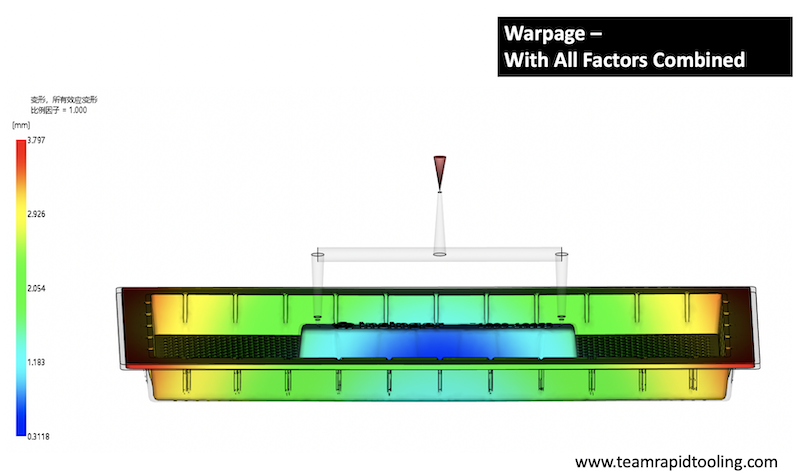
TEAM Rapid’s DFM feedback process: Before quoting or cutting steel, our engineering team reviews your 3D model, runs preliminary flow simulations, and delivers a detailed DFM report highlighting wall thickness transitions, gate recommendations, cooling feasibility, and warpage risk zones. This collaborative approach eliminates costly revisions mid-production and accelerates time-to-market.
Effective Solutions to Reduce Warpage
Once the root causes are identified, targeted interventions can dramatically reduce or eliminate deformation. Below are proven engineering strategies, categorized by design phase.
1. Optimize Part Design (DFM Best Practices)
Part geometry sets the baseline for dimensional stability.
- Uniform wall thickness: Maintain ±10-15% variation across the part. Use coring, pocketing, or gradual tapers to manage mass.
- Rib design guidelines: Keep rib thickness at 50-60% of nominal wall. Add draft (1-2° per side) and avoid sharp intersections to prevent sink marks and stress buildup.
- Smooth transitions: Use fillets and radii instead of sharp corners to distribute stress and improve flow.
Design support from TEAM Rapid engineers: We provide actionable DFM recommendations, including wall thickness mapping, rib/boss optimization, and draft analysis, ensuring your design is production-ready from day one.
2. Improve Mold Design
Tooling quality dictates repeatability and thermal control.
- Gate optimization: Position gates to promote balanced flow, minimize weld lines in critical zones, and allow even packing pressure distribution.
- Balanced cooling system: Use baffles, bubblers, or conformal channels near thick sections. Maintain consistent coolant temperature and flow rate (typically 10-25 L/min per circuit).
- Mold material selection: High-conductivity steels (e.g., P20, H13, or beryllium copper inserts) improve heat extraction in hot spots.
High-precision tooling capabilities at TEAM Rapid: We manufacture molds with CNC-machined cooling circuits, hardened cavity inserts, and precision-ground parting lines to ensure consistent thermal management and long-term dimensional stability.
3. Adjust Processing Parameters
Fine-tuning the machine can correct residual warpage tendencies.
- Cooling time optimization: Extend cooling until the part reaches ejection temperature (typically 60-80°C for engineering plastics) to prevent post-ejection distortion.
- Balanced pressure control: Use multi-stage packing to compensate for shrinkage without over-compressing the gate area. Monitor cavity pressure if available.
- Process stability: Implement closed-loop temperature control, consistent cycle times, and automated part handling to reduce environmental and operator-induced variation.
4. Select the Right Material
Material choice directly impacts shrinkage behavior and warpage susceptibility.
- Low-shrinkage plastics: Amorphous resins like PC, ABS, or PMMA offer better dimensional stability for precision parts.
- Reinforced materials trade-offs: Glass or carbon fiber improves stiffness but increases anisotropic shrinkage. Compensate with symmetric gating, balanced cooling, and flow-oriented rib placement.
When evaluating plastic part deformation solutions, material selection must align with part function, environmental exposure, and tolerance requirements-not just unit cost.
Case Study: How TEAM Rapid Fixed Warpage in a Plastic Part
Project Background: An automotive device manufacturer required a high-volume ABS housing with critical sealing interfaces. Initial aluminum prototype tooling produced parts with 0.4 mm bowing across the top panel, causing assembly misalignment and O-ring leakage.
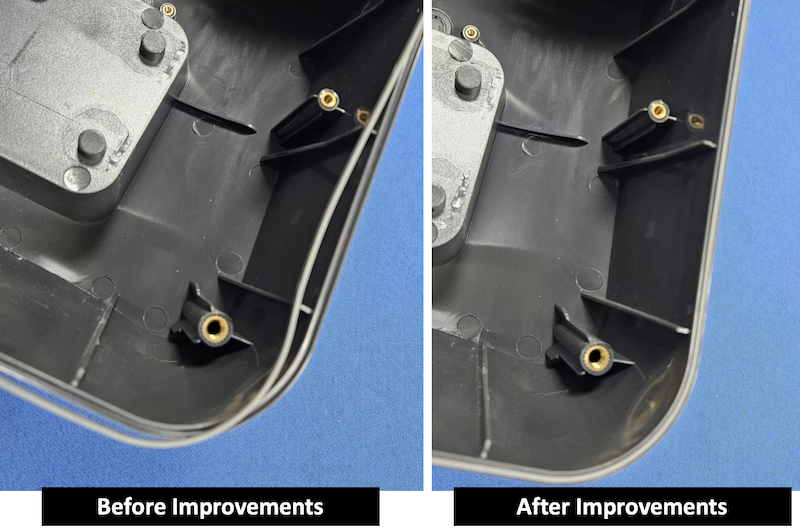
Root Cause Analysis:
CAE simulation and mold inspection revealed three compounding factors:
- Uneven cooling due to straight-drilled channels missing the 4 mm thick rib bases.
- Single edge gate created asymmetric flow and differential packing pressure.
- Holding pressure was set too high for ABS, causing over-packing near the gate and under-packing at the far end.
Tooling & Process Improvements:
- Redesigned cooling layout with conformal baffles around thick sections.
- Switched to dual submarine gates for balanced fill and symmetric pressure distribution.
- Optimized holding pressure profile (3-stage ramp-down) and increased cooling time by 8 seconds.
- Applied 0.12 mm warp compensation to cavity geometry based on Moldflow prediction.
Before vs. After Results:
- Flatness improved from 0.40 mm to 0.09 mm (within ±0.10 mm spec)
- Scrap rate dropped from 18% to 1.2%
- Cycle time reduced by 12% due to efficient cooling
- Zero assembly rework in 50,000-unit production run
This case demonstrates how integrated DFM, precision tooling, and process control work together to eliminate warpage at scale.
Common Mistakes to Avoid
Even experienced teams fall into predictable traps that guarantee warpage:
- Ignoring DFM feedback: Skipping early review leads to unfixable geometry locked into expensive steel tooling.
- Overly tight tolerances: Specifying ±0.02 mm on large plastic panels without accounting for material shrinkage and thermal expansion sets up production for failure.
- Poor supplier selection: Low-cost shops often lack CAE capabilities, process documentation, or thermal optimization expertise, resulting in trial-and-error molding and hidden costs.
Why working with an experienced partner like TEAM Rapid matters: We combine rapid prototyping agility with production-grade engineering rigor. Our rapid tooling injection molding services include full DFM analysis, simulation-backed tool design, and documented process windows-so you get predictable quality without sacrificing speed or budget.
Cost Impact of Warpage (Hidden Losses)
Warpage doesn’t just waste plastic. It drains budgets across multiple hidden cost centers:
- Scrap and rework costs: Failed inspections, manual straightening, or secondary machining add labor and material waste.
- Tool modification expenses: Welding, re-machining, or adding cooling lines to an existing mold can cost 3,000- 15,000+ and delay production by weeks.
- Delayed product launches: Engineering redesigns, re-validation, and supply chain disruptions impact revenue windows and market positioning.
How TEAM Rapid helps reduce total manufacturing cost: By catching warpage risks during DFM, optimizing tooling upfront, and stabilizing process parameters, we typically reduce trial-and-error cycles by 60-80%. Our transparent quoting and simulation-backed tool design ensure you pay for predictability, not post-production fixes.
Key Takeaways: Prevent Warpage from Day One
-
Align design, tooling, and process: Warpage is a system-level issue. Optimize geometry, balance cooling, and stabilize parameters together.
-
Early simulation reduces risk: CAE modeling identifies thermal gradients and shrinkage vectors before steel is cut, saving time and budget.
-
Choose the right manufacturing partner: Technical expertise, DFM integration, and rapid tooling capabilities separate reliable suppliers from costly guesswork.
When how to prevent warpage in injection molding is addressed proactively, you shift from reactive troubleshooting to predictable, scalable production.
About TEAM Rapid
TEAM Rapid specializes in end-to-end plastic part manufacturing, from prototype to high-volume production. Our core capabilities include:
- Rapid tooling & injection molding expertise: Aluminum and pre-hardened steel molds delivered in 10-20 days.
- Global support for prototyping to production: Engineering consultation, DFM review, CAE simulation, and certified manufacturing (ISO 9001, IATF 16949).
- Fast lead times + cost-effective solutions: Optimized tool design, balanced cooling, and process documentation ensure first-shot success and long-term repeatability.
Ready to eliminate warpage before it starts? Request a free DFM review and quote today. Our engineering team will analyze your 3D model, simulate flow and cooling behavior, and deliver a production-ready manufacturing plan within 24-48 hours.


 Contact