
Rapid Tooling vs Production Tooling: Cost, Speed, Quality, and How to Choose
Choosing between rapid tooling and production tooling is not simply a matter of picking the cheaper or the more durable option. Rapid tooling uses aluminum molds / soft tooling molds for fast, low-cost prototyping and low-volume production, while production tooling uses hardened steel for high-volume, long-term manufacturing—It is a strategic decision that depends on calculating your break-even quantity, design stability, and total lifecycle cost rather than simply comparing upfront tooling prices.
Rapid Tooling vs Production Tooling: A Quick Comparison
|
Factor |
Production Tooling |
|
|
Typical material |
Aluminum (7075, 6061) |
Hardened steel (P20, H13, S136) |
|
Tool life |
50–10,000 shots |
100,000–1,000,000+ shots |
|
Lead time |
1–4 weeks |
6–16 weeks |
|
Upfront cost |
Low to moderate |
High |
|
Cost per part |
Higher |
Lower |
|
Design change flexibility |
High |
Very low |
|
Best use case |
Prototyping, validation, low-volume, bridge production |
High-volume, stable-design mass production |
Important note: Planning ranges vary significantly with part size, complexity, resin type, cavitation, and mold construction. The figures above represent general industry benchmarks and should be validated against your specific project parameters.
The core insight of this article is this: the lowest tooling quote does not equal the lowest total manufacturing cost. You must evaluate tooling cost, part price, maintenance, modification risk, scrap rate, and schedule delays together.
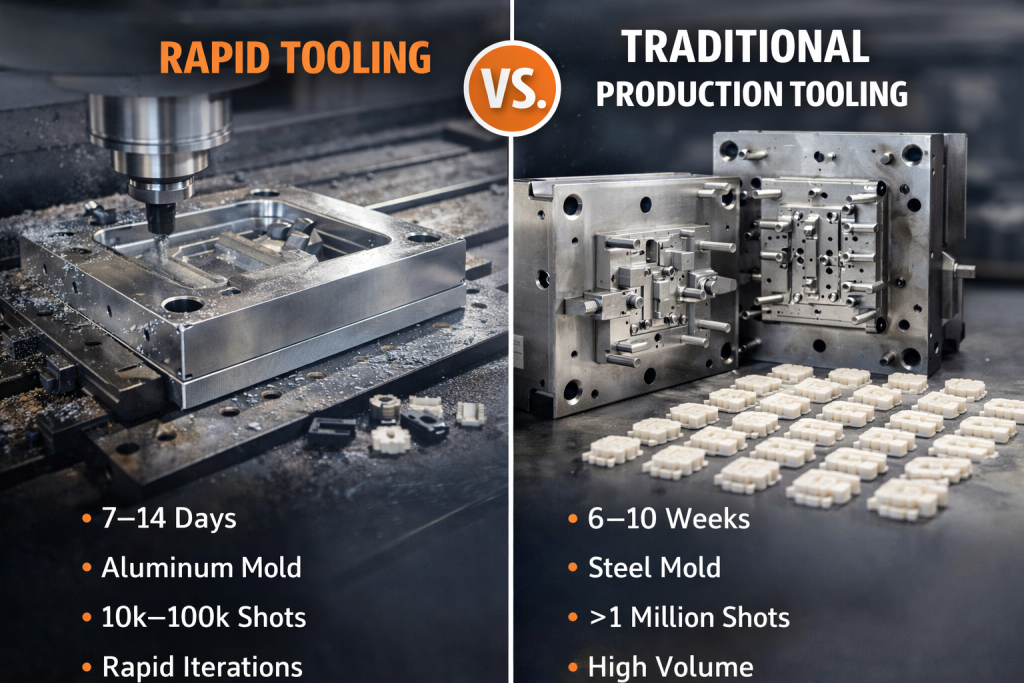
What Is Rapid Tooling
The Main Purpose of Rapid Tooling
Rapid tooling is designed to prioritize speed and flexibility over longevity. Its primary purposes include:
- Faster mold manufacturing – Aluminum molds can be machined in days rather than weeks.
- Lower initial investment – Reduced material and processing costs lower the barrier to entry.
- Functional testing – Engineers can evaluate real injection-molded parts under actual processing conditions.
- Engineering validation – Confirm fit, form, and function before committing to expensive production tooling.
- Low-volume production – Serve markets that need hundreds to a few thousand parts.
- Bridge production – Fill the gap between rapid prototyping and full-scale manufacturing while production tooling is being built.
Rapid tooling is not a "cheap shortcut." It is a deliberate engineering strategy that reduces risk during the uncertain phases of product development.
What Is Production Tooling
Production tooling (also called hard tooling or mass-production tooling) is engineered for longevity, consistency, and high throughput. Key characteristics include:
- Hardened steel construction (typically HRC 48–62)
- Multi-cavity designs for maximum output per cycle
- Conformal or optimized cooling channels for cycle-time reduction
- Wear-resistant inserts, slides, and lifters
- Designed for automated, lights-out manufacturing
- Tolerances held to ±0.01 mm or tighter over hundreds of thousands of cycles
Production tooling is the right choice when your design is frozen, your material is confirmed, and your volume justifies the investment.
Cost Comparison: Upfront Tooling Cost vs Total Manufacturing Cost
Why Rapid Tooling Costs Less Initially
Several factors contribute to the lower upfront cost of rapid tooling:
- Easier-to-machine materials – Aluminum cuts 3–5× faster than hardened steel, reducing CNC time.
- Simpler mold construction – Fewer sliders, lifters, and side-actions are typically incorporated.
- Fewer cavities – Single-cavity or 2-cavity layouts are common, reducing complexity.
- Less automation – Manual or semi-automatic ejection is acceptable for low volumes.
- Shorter expected tool life – No need for expensive surface treatments or wear-resistant coatings.
- Reduced engineering complexity – Cooling channels are simpler; hot runners are rarely used.
A typical rapid tool might cost 2,000– 15,000 depending on part size and complexity.
Why Production Tooling Requires a Higher Investment
Production tooling demands significantly more engineering and material investment:
- Hardened materials – Pre-hardened or through-hardened steels require slower, more precise machining and often EDM finishing.
- More cavities – 4, 8, 16, or even 64 cavities multiply machining and fitting effort.
- Better cooling – Conformal cooling or baffles/bubblers add design and manufacturing time.
- Longer tool life – Components must withstand hundreds of thousands of cycles without degradation.
- Wear-resistant components – Interlocks, guide pins, and insert surfaces are hardened or coated.
- Automated production – Robot-compatible ejection, sensors, and hot-runner systems add cost.
- Higher precision requirements – Tighter tolerances mean more finishing, polishing, and inspection.
A production tool can range from 10,000 to 200,000+ depending on complexity and cavitation.
The Hidden Cost Many Buyers Miss: Cost Per Part
This is where most procurement decisions go wrong. Buyers compare tooling quotes side by side and pick the lowest number—without calculating what each part actually costs over the full production run.
Consider this example:
|
Rapid Tool |
Production Tool |
|
|
Tooling cost |
$3,000 |
$30,000 |
|
Cost per part |
$2.50 |
$0.85 |
|
Quantity needed |
10,000 |
10,000 |
|
Total cost |
$28,000 |
$38,500 |
At 10,000 parts, rapid tooling is still cheaper overall. But at 50,000 parts:
|
Rapid Tool |
Production Tool |
|
|
Tooling cost |
$3,000 |
$30,000 |
|
Cost per part |
$1.50 |
$0.55 |
|
Quantity needed |
50,000 |
50,000 |
|
Total cost |
$78,000 |
$57,500 |
Now production tooling is dramatically cheaper. The crossover point is the break-even point, and finding it should be the foundation of your tooling decision.
Finding the Break-Even Point Between Rapid and Production Tooling
Use this formula:
Total Manufacturing Cost = Tooling Cost + (Part Cost × Production Quantity) + Maintenance + Modification + Scrap/Quality Risk
To find the break-even quantity:
Break-Even Quantity = (Production Tooling Cost − Rapid Tooling Cost) ÷ (Rapid Part Cost − Production Part Cost)
Using the numbers above:
(50,000− 8,000) ÷ (3.50− 0.85) = 42,000÷ 2.65 ≈ 15,849 parts
Below ~15,800 parts, rapid tooling is more economical. Above that threshold, production tooling wins.
However, volume alone should not be the only deciding factor. Even if your forecast exceeds the break-even point, you should still ask: Is my design final? Is my material confirmed? Am I willing to absorb the cost of a design change on a $50,000 mold?
Speed: Lead Time and Time-to-Market
Rapid tooling typically delivers molds in 1–4 weeks, while production tooling requires 6–16 weeks (sometimes longer for complex multi-cavity molds with hot runners).
If your product launch window is tight, or if you need to validate the market before committing to mass production, rapid tooling can save weeks or even months of schedule time. That time advantage often translates directly into revenue or competitive positioning.
Quality: Can Rapid Tooling Produce End-Use Parts?
Yes—rapid tooling can produce parts that meet functional and cosmetic requirements. However, there are important distinctions:
- Short-term quality – A fresh aluminum mold can produce parts with excellent surface finish and dimensional accuracy.
- Long-term consistency – Aluminum wears faster than steel. After several thousand shots, you may observe flash, dimensional drift, or surface degradation.
- Material limitations – Abrasive or corrosive resins (e.g., glass-filled nylon, PVC, POM) accelerate aluminum wear significantly.
For production tooling, hardened steel maintains dimensional stability over hundreds of thousands of cycles, providing the consistency that high-volume OEMs and regulated industries demand.
The Hidden Cost of Design Changes
This is one of the most overlooked factors in tooling decisions.
With rapid tooling:
- Aluminum is easy to weld, re-machine, or modify.
- A design change might cost a few hundred dollars and a few days.
With production tooling:
- Hardened steel requires EDM, re-hardening, or complete insert replacement.
- A design change can cost 5,000– 30,000 and add 2–6 weeks to your schedule.
- In worst cases, the mold is unusable and must be rebuilt from scratch.
Rule of thumb: Do not invest in production tooling until your design is frozen and validated. If there is even a 20% chance of a significant geometry change, use rapid or bridge tooling first.
The Missing Middle Ground: When Bridge Tooling Is the Best Option
Recent industry comparisons increasingly treat tooling as a lifecycle strategy that can include a bridge stage rather than a simple choice between only two extremes.
Bridge tooling sits between rapid and production tooling.
It typically uses:
- Pre-hardened steel (P20, NAK80) instead of aluminum
- 1–4 cavities
- Moderate lead time (3–6 weeks)
- Tool life of 50,000–200,000 shots
Bridge tooling is ideal when:
- Your design is 90% finalized but you want one more validation round.
- You need to start shipping while production tooling is being built.
- Your volume is in the "gray zone" between low and high.
- You want to reduce risk before committing to a full production mold.
Bridge tooling avoids the premature investment of production tooling while offering better longevity and consistency than aluminum rapid tooling.
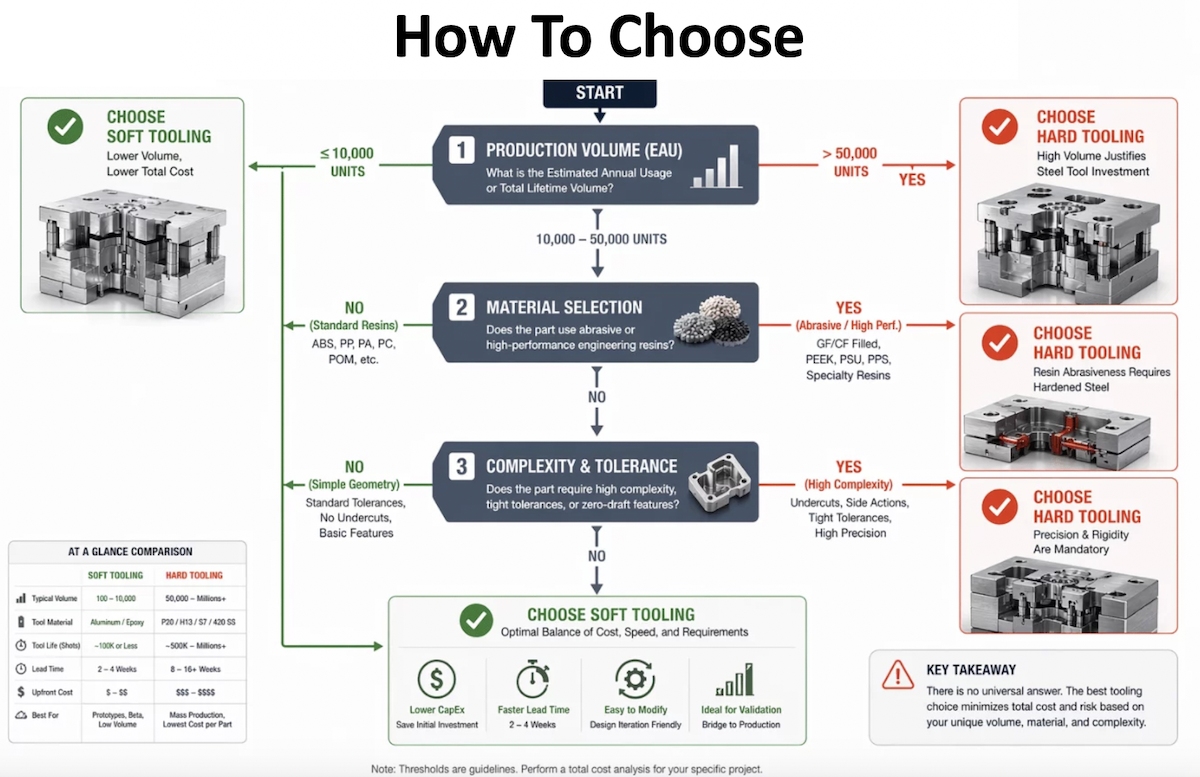
A Practical Decision Framework: Which Tooling Should You Choose
Answer these five questions to guide your decision:
Question 1: How Many Parts Do You Need?
Evaluate both current and expected future volume. If your total need is below the break-even point, rapid tooling is likely more economical. If it significantly exceeds the break-even point and other factors are stable, production tooling makes sense.
Question 2: Is Your Product Design Final?
If major changes are likely, avoid excessive early investment in production tooling. Use rapid or bridge tooling until the design is confirmed through testing and customer feedback.
Question 3: How Fast Do You Need Parts?
If your timeline is compressed—due to a trade show, customer commitment, or market window—rapid tooling can deliver parts in weeks, not months.
Question 4: What Material Are You Using?
Abrasive or corrosive materials (glass-filled resins, PVC, certain flame-retardant compounds) will rapidly degrade aluminum molds. In these cases, even for moderate volumes, consider bridge or production tooling in steel.
Question 5: What Are Your Quality and Consistency Requirements?
If you are supplying to automotive, medical, or aerospace customers who require CPK data over long production runs, production tooling in hardened steel is typically mandatory.
Decision Matrix Summary
|
Scenario |
Recommended Tooling |
|
Prototype / design validation |
Rapid tooling (aluminum) |
|
Low volume (< 5,000 parts) |
Rapid tooling |
|
Medium volume, design not final |
Bridge tooling (P20/NAK80) |
|
Medium volume, design frozen |
Bridge or production tooling |
|
High volume (> break-even), stable design |
Production tooling (hardened steel) |
|
Abrasive/corrosive material |
Bridge or production tooling |
|
Tight deadline |
Rapid or bridge tooling |
Common Mistakes to Avoid
-
Choosing based on tooling quote alone – Always calculate total cost per part over the full volume.
-
Investing in production tooling before design freeze – The cost of changes on hard steel is 10–50× higher than on aluminum.
-
Ignoring material compatibility – Aluminum molds fail quickly with abrasive resins.
-
Underestimating future volume – If demand grows, you may outgrow a rapid tool faster than expected.
-
Skipping bridge tooling – Many teams jump from prototype to production tooling, missing the risk-reduction benefits of a bridge stage.
Final Recommendation
- Rapid tooling for validation, agile development, and low-volume injection molding.
- Bridge tooling for transition, risk reduction, and medium-volume needs.
- Production tooling for long-term, stable, high-volume manufacturing.
The best tooling strategy is not a single choice—it is a phased approach that matches your investment to your level of certainty. At TEAM Rapid, we help customers evaluate the full lifecycle cost and select the right tooling strategy for each stage of their product journey.
Ready to discuss your project? Contact us for a free tooling strategy consultation.



 Contact