
Rapid Tooling Explained: Bridging Prototyping and Production at Scale
In modern product development, the gap between a functional prototype and full-scale manufacturing is often where projects stall. Long lead times, high upfront mold costs, and design lock-in can kill momentum. This is exactly where rapid tooling steps in. By combining accelerated fabrication methods with conventional manufacturing processes, rapid tooling enables engineers to produce real parts, validate designs, and even fulfill initial market demand in a fraction of the time and budget required for traditional steel tooling.
What is Rapid Tooling
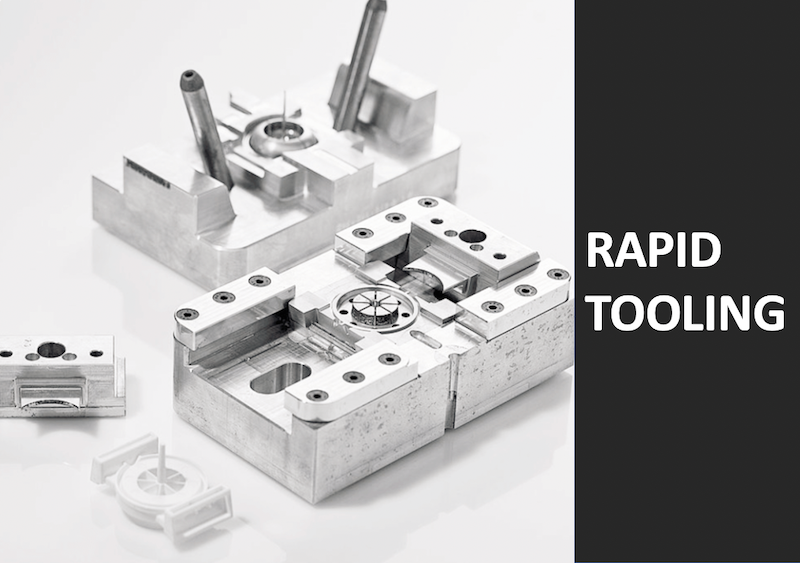
Rapid tooling is the process of quickly manufacturing molds-typically using aluminum or soft/pre-hardened steel-for injection molding and other production processes. It allows manufacturers to produce functional parts within 5-15 days, making it ideal for prototyping and low-volume production.
Rapid Tooling Materials
-
CNC-machined aluminum (6061, 7075): Most popular for injection molding and pressure die casting due to excellent thermal conductivity and machinability.
-
Soft steel (P20, NAK80): Used when higher durability is needed without the full hardening cycle.
-
Epoxy resins & cast metals: Ideal for vacuum casting or low-pressure forming.
-
Silicone & 3D printed tooling inserts: Frequently used for indirect or conformal cooling applications.
Available Finishes
As-machined, bead-blasted, polished (SPI A3 to A1), textured (VDI, EDM finish), and coated (Teflon, DLC, or nickel plating for wear/corrosion resistance).
Rapid Tooling vs. Traditional Tooling
Aspect
Rapid Tooling
Traditional Tooling
Definition
Fast mold manufacturing using additive manufacturing or soft tooling methods
Conventional mold making using hardened steel and full CNC machining processes
Lead Time
Short: ~2-6 weeks
Long: ~8-16+ weeks
Cost (Initial)
Lower setup cost
High upfront investment
Materials
Aluminum, soft steel, epoxy, 3D-printed inserts
Hardened tool steels (H13, P20, S136, etc.)
Tool Life
Short to medium (hundreds to tens of thousands of cycles)
Very high (hundreds of thousands to millions of cycles)
Precision
Good, but slightly lower than production tooling
Very high precision and repeatability
Best For
Prototypes, low-volume production, market testing
Mass production and long-term manufacturing
Design Flexibility
High (easy and fast to modify)
Low (modifications are costly and time-consuming)
Production Volume
Low to medium volume
High volume production
Time-to-Market
Very fast
Slower due to longer tooling phase
Risk Level
Lower financial risk for early-stage products
Higher initial risk but better long-term efficiency
Key Takeaways
-
Rapid tooling is ideal when you need speed, flexibility, and lower upfront cost, especially for prototyping or small batches.
-
Traditional tooling is best for high-volume, stable production, where durability and precision matter most.
-
Many companies use a hybrid strategy: rapid tooling for validation → traditional tooling for mass production.
Design Considerations: Rapid Tooling vs. Traditional Tooling
Design Factor
Rapid Tooling
Traditional Tooling
Design Flexibility
High flexibility; CAD changes can be implemented quickly between iterations
Very low flexibility; design changes require costly steel modification or new mold
Design Stage Suitability
Best for early-stage design (concept, prototype, EVT, DVT)
Best for finalized production-ready design (PVT, mass production)
Iteration Speed
Fast iteration cycles (days-weeks), ideal for design validation
Slow iteration cycles (weeks-months) due to steel machining and mold refinement
Design Change Cost
Low cost; updates often involve minor tooling adjustments or inserts
Very high cost; changes may require re-cutting hardened steel or rebuilding mold
Design Risk Level
Low risk; supports experimentation and fast validation
High risk; design errors are expensive and difficult to correct
Complexity Handling
Moderate complexity; limited by aluminum, resin, or soft steel tooling
High complexity; supports deep undercuts, thin walls, and multi-action mechanisms
Undercuts & Geometries
Limited or simplified undercut solutions depending on tooling method
Fully supported using sliders, lifters, unscrewing systems, and complex mechanisms
Wall Thickness Sensitivity
Requires more uniform wall thickness to reduce warpage and cooling issues
More tolerant; optimized for thin-wall, high-volume production
Draft Angle Design
Requires larger draft angles (typically 2°-5°+) due to softer tooling and wear sensitivity
Allows tighter draft angles (0.5°-2° or lower) due to hardened steel durability
Thermal Design Constraints
Lower thermal conductivity (especially aluminum molds); simplified cooling design
High thermal stability; supports optimized cooling and high-efficiency cycle design
Cooling Channel Design
Simple cooling layouts; limited use of advanced conformal cooling
Advanced cooling systems possible, including conformal cooling for cycle optimization
Material Selection Impact
Tooling materials (aluminum/soft steel/resin) limit pressure and tool life
Hardened steel (H13, P20, S136) enables high-pressure injection and long life
Tolerance Capability
Moderate precision; suitable for functional prototypes and low-volume parts
High precision; tight tolerances and full GD&T compliance achievable
Surface Finish Quality
Good to moderate finish depending on CNC/3D printing and polishing
Excellent finish; supports SPI-level cosmetic requirements
DFM Focus
Focus on manufacturability, speed, and simplified tooling structure
Focus on durability, cycle efficiency, and long-term production optimization
Gate & Runner Design
Simplified gating systems for fast build and cost efficiency
Fully optimized runner systems (hot runner/cold runner) for cycle and quality control
Mold Base System
Often uses standard or simplified mold bases, sometimes modular or soft tooling frames to reduce cost and lead time
Uses standardized or custom high-precision mold base systems (e.g., LKM, DME, HASCO), designed for durability and interchangeability
Mold Base Complexity
Reduced mold base complexity; fewer components and simplified ejector systems
Full mold base architecture with ejector systems, alignment systems, guide pillars, wear plates, etc.
Ejection System Design
Basic ejector systems (simple pins or manual-assisted structures in some cases)
Fully engineered ejection systems (ejector pins, sleeves, stripper plates, air ejection, etc.)
Production Intent Influence
Designed for validation, testing, and bridge production
Designed for long-term, high-volume manufacturing
Lifecycle Expectation
Short lifecycle (prototype to low-volume runs)
Long lifecycle (hundreds of thousands to millions of cycles)
Engineering Optimization Level
Functional optimization (“good enough” for validation)
Full production optimization (cost, cycle time, durability, repeatability)
Typical Use Case
Prototyping, design validation, bridge tooling, low-volume production
Mass production for automotive, electronics, medical, consumer goods
How Does Rapid Tooling Work
Rapid tooling operates through two primary pathways: Direct and Indirect approaches, each with distinct workflows and use cases.
Direct Tooling
Direct tooling involves machining or printing the mold cavity and core directly into the final tooling material. Typically, a 5-axis CNC mill cuts an aluminum block to produce a ready-to-use injection or casting mold. Direct Metal Laser Sintering (DMLS) or binder jetting can also print conformal cooling channels into tool steel inserts before final machining. The result is a production-ready mold with minimal intermediate steps.
Indirect Tooling
Indirect tooling starts with a master pattern (often 3D printed or CNC machined) that serves as the positive. A mold is then cast around it using materials like room-temperature vulcanizing (RTV) silicone, polyurethane, or epoxy. Once cured, the master is removed, leaving a negative cavity that replicates the original geometry. This method is highly accessible for complex undercuts or multi-part assemblies that would be difficult or costly to machine directly.
Direct vs Indirect: Which to Choose
-
Direct offers better dimensional accuracy, higher temperature/pressure tolerance, and longer mold life. It’s ideal for engineering thermoplastics, overmolding, and bridge production.
-
Indirect is faster and cheaper for highly complex geometries, low-temperature casting, or ultra-low volume runs. However, mold materials wear quickly, limiting it to ~20-50 shots before degradation.
Advantages and Disadvantages of Rapid Tooling
Advantages:
-
Speed to Market: T1 samples in 10-20 days versus 2-3 months for steel.
-
Cost Efficiency: Drastically reduces upfront capital expenditure.
-
Design Flexibility: Easy to modify, iterate, or add inserts before committing to permanent tooling.
-
Functional Validation: Produces end-use materials, not just prototype simulants.
-
Bridge Production: Enables early market entry, pilot runs, and supply chain ramp-up.
Disadvantages:
-
Limited Lifespan: Not economical for multi-million part runs.
-
Material Restrictions: Some highly abrasive or glass-filled resins can degrade aluminum molds prematurely.
-
Tight Tolerance Trade-offs: While excellent for most applications, aluminum expands more thermally than hardened steel, requiring careful process tuning.
-
Not for High-Volume Automation: May lack the durability required for lights-out, fully automated production cells.
Applications of Rapid Tooling
Rapid tooling thrives where speed, cost, and functional accuracy intersect:
-
Consumer electronics housings & enclosures
-
Automotive interior trim, brackets, and lighting components
-
Medical devices (surgical tools, diagnostic housings)
-
Aerospace ducts, clips, and UAV components
-
Industrial jigs, fixtures, and custom machinery guards
-
Pre-production validation for crowdfunding or investor demos
Case Study of Our Rapid Tooling Project
Challenge: A German med tech startup developed a portable insulin delivery device requiring clinical trials with 800 functional units within 21 days. Traditional steel tooling quoted 9 weeks at 17,000 EUR, jeopardizing their FDA submission timeline.
Solution: Our team opted for direct soft-steel rapid tooling (P20) with conformal cooling channels designed via simulation. The mold was CNC machined, EDM, bead-blasted to make pretty finish.
Result:
-
T1 parts delivered in 15 days at 60% lower cost
-
100% dimensional compliance with engineering thermoplastic (PC/ABS)
-
Allowed one minor gate redesign before committing to production steel tooling
-
Accelerated clinical trial initiation by 6 weeks, securing Series B funding ahead of schedule
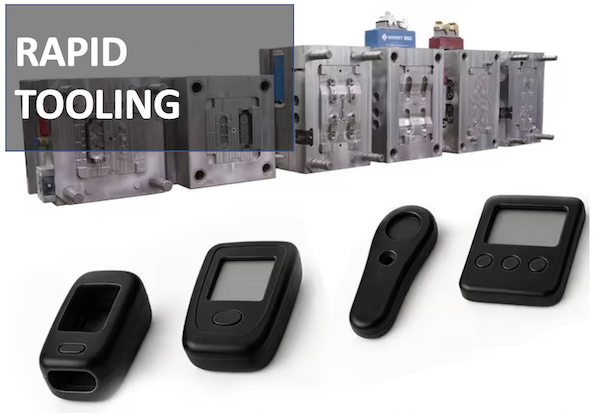
Customer Feedbacks: customer was happy with our lead-time and quality, they ordered other series cases in the following week.
Processes That Use Rapid Tooling
Rapid tooling isn’t a standalone process; it’s a mold-making strategy that enables several conventional manufacturing methods to run faster.
Injection Molding
The most common application. Aluminum molds handle most amorphous and semi-crystalline resins. Fast cycle times are achieved thanks to aluminum’s superior heat dissipation.
Overmolding & Insert Molding
Quick-turn tools are used to bond soft TPE/TPU over rigid substrates or encapsulate metal inserts. Multi-material designs benefit from aluminum’s machinability for precise core alignment.
Pressure Die Casting
Pre-harden steel molds are used to cast aluminum or zinc parts rapidly. While not suited for millions of parts, they’re excellent for functional metal prototypes and small volume production, thermal testing, and structural validation before hard tooling investment.
Rapid Tooling vs Other Manufacturing Processes
Rapid Tooling vs Rapid Prototyping
Rapid prototyping focuses on creating one-off or small batches of parts to verify form/fit/function. Rapid tooling creates molds to produce those parts using actual production-grade processes. Prototyping answers “Does the design work?” Rapid tooling answers “Can we manufacture it at volume?”
Rapid Tooling vs 3D Printing
3D printing builds parts layer-by-layer without tooling. It’s unmatched for geometric freedom and zero-tooling lead time but struggles with production-grade surface finish, isotropic strength, and per-part economics at scale. Rapid tooling uses molds, yielding consistent mechanical properties and lower per-unit cost after ~50 parts.
Rapid Tooling vs Vacuum Casting
Vacuum casting uses silicone molds and polyurethane resins under vacuum to produce 10-20 visually and mechanically similar parts. It’s ideal for marketing samples or ergonomic testing. Rapid tooling supports engineering resins, higher temperatures, and longer production runs, bridging the gap to true manufacturing.
Rapid Tooling vs CNC Machining
CNC machining cuts parts directly from solid blocks. It’s perfect for 1-100 pieces, complex metals, and rapid custom components. However, material waste is high, and per-part cost doesn’t scale well. Rapid tooling becomes more economical beyond ~150 units and offers better repeatability for plastic/composite assemblies.
How to Choose the Right Suppliers in China
China remains a global hub for rapid tooling due to mature manufacturing ecosystems and competitive pricing. However, not all shops deliver equal quality. Use this checklist:
-
Certifications: Look for ISO 9001, IATF 16949 (auto), or ISO 13485 (medical).
-
DFM Capabilities: The best suppliers provide free, thorough Design for Manufacturing reports with gate, vent, shrinkage, and draft recommendations before cutting metal.
-
Equipment & Metrology: Verify 5-axis CNC, EDM, wire-cutting, and CMM inspection. Ask about their process control and first-article inspection (FAI) protocols.
-
Communication & IP Protection: Clear English-speaking project managers and signed NDAs are non-negotiable for proprietary designs.
-
Transparent Pricing & Lead Times: Avoid quotes that seem too good to be true. Hidden costs (mold revisions, texture charges, express shipping) often appear later.
-
Sample & Trial Run Policy: Reputable suppliers offer T0/T1 sample evaluation with dimensional reports and allow mold tweaks before full batch approval.
Ready to Accelerate Your Next Project
Don’t let long tooling lead times or inflated costs slow your product launch. Whether you need aluminum injection molds for bridge production, soft-tool inserts for overmolding, or DFM-optimized die casting dies, TEAM Rapid deliver precision, speed, and engineering expertise from design to delivery. Upload your CAD files today at www.teamrapidtooling.com for a free, no-obligation DFM analysis and rapid quote within 24 hours.
FAQ
-
What is rapid tooling used for?
It’s used for design validation, functional testing, market launch batches, clinical/regulatory trials, and bridge production between prototyping and full-scale steel tooling.
-
How many shots can an aluminum mold last?
Typically 10,000 to 50,000 shots, depending on resin type (unfilled vs. glass-filled), mold design, cooling, and maintenance. Properly engineered aluminum molds can exceed 50,000 cycles with routine care.
-
Is rapid tooling suitable for mass production?
Not for multi-million unit runs. It’s optimized for low to medium volumes (up to ~50,000-100,000 parts). Beyond that, hardened steel molds offer better durability, tighter long-term tolerances, and lower per-part cost amortization.
-
How fast can I get parts from China?
With approved DFM, aluminum tooling takes 7-14 days. First samples (T1) typically ship within 10-20 days total from order. Express machining and air freight options can reduce lead times to under 10 days for urgent projects.
Key Takeaways
- Rapid tooling is ideal when you need speed, flexibility, and lower upfront cost, especially for prototyping or small batches.
- Traditional tooling is best for high-volume, stable production, where durability and precision matter most.
- Many companies use a hybrid strategy: rapid tooling for validation → traditional tooling for mass production.
- What is rapid tooling used for?
- How many shots can an aluminum mold last?
- Is rapid tooling suitable for mass production?
- How fast can I get parts from China?



 Contact