
Cycles of Injection Molding Process | 4 Stages & Low-Volume Production
TEAM Rapid is a plastic injection molding manufacturer in China, we produce thousands of plastic injection molded parts each day in various sizes and geometries.
The Injection Molding Process involves a high-pressure injection of a polymer into a mould where it is shaped. Clamping, injection, cooling and ejections are the main four stages in the cycle. Depending on how large the mold is and the efficiency of the injection machine, the injection cycle usually lasts on 2 seconds to 2 minutes.
We outline this rapid manufacturing process here, so you can have a better idea of how TEAM Rapid produces your plastic injection molded parts.
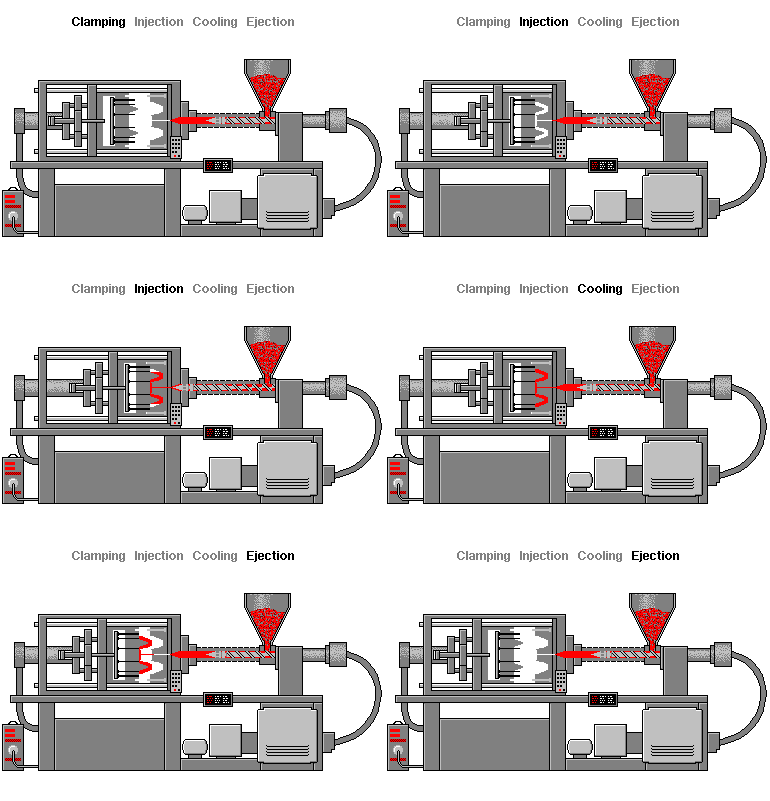
Cycle of Injection Molding Process
1. Clamping
Injection Mold is designed to 2 halves, both halves are attached to Injection Molding machine and pressed together using a hydraulic clamp during the injection and cooling, the mold will be opened once the plastic workpiece has been filled fully.
2. Injection
This is the stage when raw plastic pellets are fed from a funnel-shaped hopper into the injection molding machine. Once in the machine, an auger screw pushes the pellets through a barrel where the plastic is heated and injected from the nozzle into the mold quickly and with high pressure. Under the pressure caused by barrel, as much as plastic will be packed into the mold in a short time.
3. Cooling
The cooling stage starts once the molten plastic hits the mold. The plastic cools and harden into the desired shape of the cavity. The mold will be closed during the cooling stage, and part takes amount of time for fully cool vary from the part’s size and layout of cooling channels.
4. Ejection
The mold opens again after cooling, and the part is ejected out. Force must be used because the part shrinks and sticks to the mould. The mould can be shut again after ejection and another shot can be injected for the process to begin again.
What about the Cycle Time In Low-Volume Injection Molding
Low-volume injection molding uses the same basic cycle stages as high-volume production: mold closing, injection, packing and holding, cooling, and part ejection. However, the cycle time per part is not necessarily shorter just because the production volume is low. It depends on part geometry, wall thickness, plastic material, mold design, cooling requirements, and processing conditions.
For many conventional plastic parts, a typical cycle may take approximately 15–60 seconds. Thin-walled parts may run faster, while thick or complex parts can require significantly longer.
How Do Removal Manual Inserts Affect Cycle Time
When rapid tooling uses manual inserts to form undercuts, internal features, or other complex geometries, the operator must typically remove and reposition the inserts between molding cycles. This approach can simplify the mold design and reduce initial tooling costs compared with automated side actions, making it attractive for low-volume production.
However, manual insert handling adds time to each cycle. The following estimates can help with preliminary production planning:
|
Injection Molding Setup |
Estimated Cycle Time per Shot |
|
Standard injection molding with simple rapid tooling |
15–40 seconds |
|
Rapid tooling with manual inserts |
30–90 seconds |
|
Complex parts requiring multiple manual inserts |
60–180+ seconds |
|
|
|
|
|
|
|
|
|
These are indicative planning estimates, not fixed industry standards. Actual cycle times depend on the part design, material, cooling requirements, number of inserts, and operator handling time.
For example, if injection, packing, cooling, and ejection take 20 seconds, and removing and repositioning the manual inserts takes another 20 seconds, the total cycle time is approximately 40 seconds.
What Else Affects Total Production Time
When planning a low-volume injection molding project, it is important to distinguish among three time factors:
- Cycle time per shot: The time needed to complete one molding cycle, including manual insert handling where applicable.
- Setup and changeover time: The time required for mold installation, machine setup, material preparation, and process adjustment.
- Total production time: The combined time for setup, molding, inspection, and any required post-processing.
For example, an order of 100 parts with a 40-second cycle time and one part produced per shot requires approximately 67 minutes of actual molding time, excluding setup, downtime, and inspection. If the mold produces four parts per shot, the theoretical molding time drops to approximately 17 minutes.
Is Rapid Tooling with Manual Inserts Suitable for Low-Volume Production
The answer is Yes. Manual inserts can be a cost-effective solution when production quantities are limited and the additional handling time is acceptable. Compared with automated side actions, they can reduce mold complexity and initial tooling investment.
However, manufacturers should also consider operator labor, insert wear, handling consistency, and the required production schedule. For low-volume projects, optimizing the overall manufacturing process is often more valuable than minimizing cycle time alone.
For low-volume injection molding, rapid tooling with manual inserts can reduce upfront tooling costs, simplify mold construction, and accommodate complex part features. The key is to balance tooling investment against cycle time and labor costs to determine the most economical solution for the project.
Contact TEAM Rapid for Rapid Injection Molding
If you would like to know more about Rapid Injection Molding or your company are looking for rapid prototyping services China and injection molding services, give us a call at +86 760 8850 8730 or email sales@teamrapidtooling.com .



 Contact