
What Is the Different between Molding and Casting
Molding and casting are 2 different manufacturing processes. They have differences, but both of them are closely related, we can say they are some how and the same thing, here we are going to talk about the different between Molding And Casting.
The Molding and Casting Differences
Materials Different
They are related pouring molten liquid into a mold/die which will solidify the shape of cavity mold and die after cooling down. The differences is at pouring material, plastic is for molding, metal is for casting.
Machines and Parameters Different
The equipment or the method by pouring molten liquid is different for molding and casting. The injection pressure and clamping force for high die casting is much more than injection molding. Also, the working temperature for pressure die casting is far more than Injection Molding.
Post Finish and Costs Different
Molding can give you a final product but in case of casting, you may need to do post machining or post finishing to remove some features or deburred. Typically, the cost for molding is less expensive than casting, not only for the product but also for the tooling.
Differences Between Molding and Casting - The More Details
Aspect
Molding
Casting
Definition
Shapes material by injecting or pressing it into a mold under pressure
Forms parts by pouring liquid material into a mold and allowing it to solidify
Material State
Softened or molten material
Fully liquid material
Common Materials
Plastics, rubber, silicone
Metals (aluminum, steel, zinc), resins
Pressure Used
Medium to high pressure
Low pressure or gravity (some processes use pressure)
Mold Type
Typically rigid, precision steel or aluminum molds
Sand, metal, ceramic, or silicone molds
Tooling Cost
Higher initial mold cost
Lower initial mold cost (varies by process)
Production Volume
Best for medium to high volumes
Suitable for low to medium volumes
Dimensional Accuracy
Very high, tight tolerances
Good, often requires post-machining
Surface Finish
Excellent, near-net shape
Good to excellent, process-dependent
Post-Processing
Minimal
Often required (machining, polishing)
Typical Applications
Plastic housings, consumer products, connectors
Engine parts, structural components, metal housings
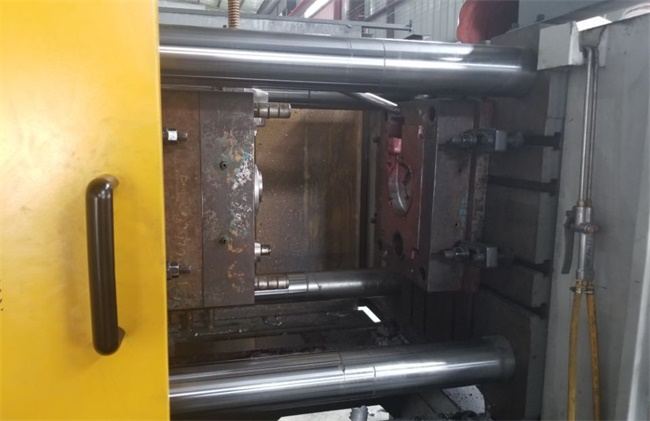
Molding or Casting - How to Choose the Process for My Product
Nowadays, the product usually made combine plastic and metal, it is essential for a high-quality final build to choose the right molding and casting - or using them together to make product. At TEAM RAPID, we provide integrated solutions for both, ensuring your plastic and metal components fit and function perfectly together.
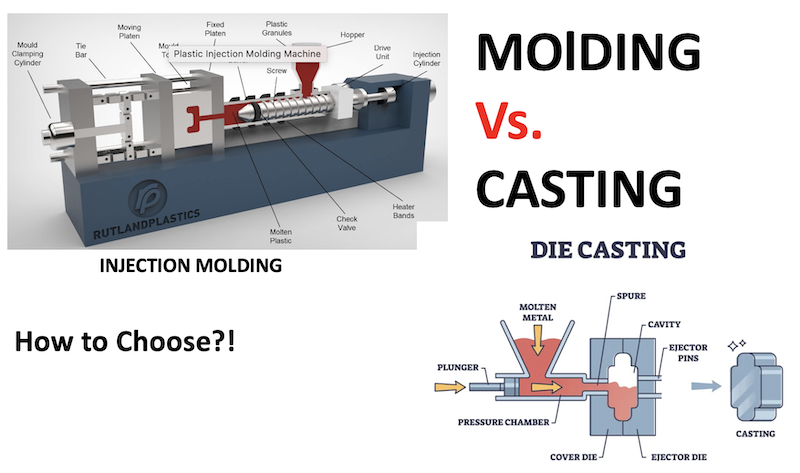
Choosing the Right Process for Your Material
While the terms are sometimes used interchangeably, the industry generally separates them by material type:
Plastic Parts: Injection Molding
For plastic components,Injection Molding is the standard. It involves injecting molten resin into a steel or aluminum mold at high pressure.
- Best for:Enclosures, buttons, internal brackets, and high-volume consumer goods.
- Key Advantage:Exceptional speed and the ability to produce millions of identical parts with tight tolerances.
Metal Parts: Die Casting
For metal components,Die Casting is the most efficient counterpart to injection molding. It forces molten metal (like aluminum or zinc) into a steel die.
- Best for:Structural frames, heat sinks, engine components, and heavy-duty housings.
- Key Advantage:High strength, excellent thermal conductivity, and a premium "metallic" feel.
Contact TEAM RAPID for Molding and Casting
TEAM RAPID provides both rapid injection molding and Pressure Die Casting Service. We specialize not only for the mass production but also for low volume manufacturing. Want to know more about our capability and see if we can help for your next project? Contact our team at sales@teamrapidtooling.com today to request a rapid manufacturing quote.


 Contact