
Packing Pressure vs Holding Pressure in Injection Molding: What's the Difference
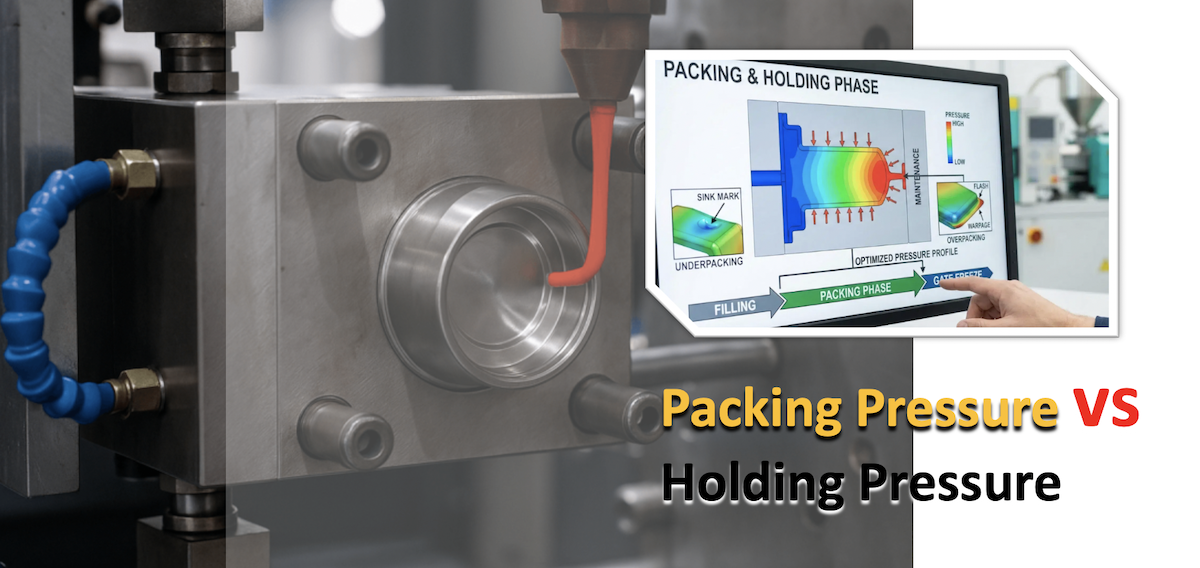
Packing pressure and holding pressure are two important parameters in the plastic injection molding process. Both help compensate for material shrinkage, improve part density, and maintain dimensional accuracy. However, they serve different purposes depending on the stage of the molding cycle. Packing pressure helps fill the mold completely and compensate for initial shrinkage, while holding pressure keeps the plastic under pressure until the gate freezes.
In this article, we explain the differences between packing pressure and holding pressure, how each works, how to determine suitable pressure settings, and how to troubleshoot common injection molding problems.
What Is Packing Pressure in Injection Molding
Packing pressure is the pressure applied to molten plastic after the mold cavity has been substantially filled. Its primary purpose is to force additional material into the cavity to compensate for volumetric shrinkage as the plastic begins to cool.
During injection molding, molten plastic enters the mold cavity under injection pressure. Once the cavity is filled, the material starts cooling and shrinking. If no additional material enters the cavity, the finished part may have insufficient weight, sink marks, or internal voids.
Packing pressure helps prevent these problems by pushing more molten plastic through the gate into the cavity before the gate freezes.
How Packing Pressure Works During the Packing Stage
After the initial filling stage, the injection molding machine switches from velocity control to pressure control, usually at a programmed transfer point.
The machine then applies packing pressure to push additional molten plastic into the cavity. This additional material compensates for the shrinkage that occurs as the plastic cools.
The amount of packing pressure required depends on several factors:
- Plastic material and its viscosity
- Part wall thickness and geometry
- Mold design and cavity layout
- Gate size and location
- Melt temperature and mold temperature
- Injection molding machine capacity
For example, a thick plastic component generally requires more effective packing to compensate for its greater volumetric shrinkage than a thin-walled component. However, the actual pressure setting must also account for material characteristics and gate restrictions.
Why Packing Pressure Is Important for Plastic Part Quality
Packing pressure directly influences the weight, density, and dimensional stability of injection molded parts.
Proper packing pressure helps:
- Compensate for plastic material shrinkage.
- Reduce sink marks on thick sections.
- Minimize internal voids.
- Maintain consistent part weight.
- Improve dimensional accuracy.
- Reduce variations between production batches.
If packing pressure is too low: insufficient material may enter the cavity, resulting in shrinkage-related defects.
If packing pressure is too high: it may cause flash, excessive part weight, residual stress, or difficulty with part ejection.
Therefore, manufacturers need to establish a suitable packing pressure based on the material, mold design, and part requirements.
What Is Holding Pressure in Injection Molding
Holding pressure is the pressure maintained inside the mold cavity after the initial packing stage to compensate for material shrinkage while the plastic continues cooling. As molten plastic cools, its volume decreases. Before the gate freezes, additional molten plastic can still enter the cavity. Holding pressure maintains this material supply and helps prevent excessive shrinkage.
In many injection molding processes, holding pressure is lower than the initial packing pressure. However, the actual pressure profile depends on the material, part geometry, mold design, and machine settings.
How Holding Pressure Works During the Holding Stage
After the initial packing stage, the machine maintains a controlled pressure for a specified holding time.
During this period, the plastic continues cooling and shrinking. Holding pressure helps push additional material through the gate to compensate for this volume reduction.
The holding stage continues until the gate freezes.
Once the gate freezes, additional plastic can no longer enter the cavity. Increasing holding pressure or extending holding time beyond this point generally provides little or no additional benefit to part weight or shrinkage.
The holding stage is therefore important for achieving consistent part dimensions and reducing shrinkage-related defects.
Why Holding Pressure Is Important for Dimensional Stability
Holding pressure helps maintain the correct amount of plastic material inside the mold cavity while the part cools.
Suitable holding pressure can:
- Reduce excessive volumetric shrinkage.
- Minimize sink marks.
- Reduce internal void formation.
- Improve dimensional consistency.
- Maintain stable part weight.
- Improve repeatability during production.
For precision plastic components, holding pressure is particularly important because even small variations in shrinkage can affect assembly dimensions, fitting accuracy, and product performance.
Packing Pressure vs Holding Pressure: Key Differences
Packing pressure and holding pressure are closely related, but they have different roles in a multi-stage injection molding pressure profile.
Packing pressure is generally used during the initial stage after cavity filling to add material and compensate for shrinkage. Holding pressure maintains pressure during the subsequent cooling period until the gate freezes.
Packing Pressure vs Holding Pressure: Comparison Table
|
Comparison |
Packing Pressure |
Holding Pressure |
|
Main purpose |
Add material to compensate for shrinkage |
Maintain material supply as the plastic continues shrinking |
|
Process stage |
Initial packing stage |
Subsequent holding stage |
|
Timing |
Immediately after cavity filling |
After initial packing |
|
Pressure profile |
Often higher initially |
Often lower or maintained at a controlled level |
|
Main effect |
Controls initial part weight and density |
Helps stabilize part weight and dimensions |
|
Duration |
Depends on the programmed pressure profile |
Continues until gate freeze |
|
Main defects when insufficient |
Sink marks, voids, excessive shrinkage |
Sink marks, voids, dimensional variation |
The pressure levels and stage boundaries are not universal. Some machines and process documentation use the terms packing pressure and holding pressure interchangeably. Others distinguish them as separate stages within a multi-stage pressure profile.
Are Packing Pressure and Holding Pressure the Same
Not necessarily.
In general injection molding discussions, packing pressure and holding pressure are sometimes treated as the same parameter because both occur after the filling stage and help compensate for material shrinkage.
However, in a multi-stage molding process, they can describe different parts of the pressure profile.
Packing pressure usually refers to the initial pressure applied after cavity filling. Holding pressure refers to the pressure maintained afterward while the plastic continues cooling and shrinking.
For this reason, it is important to understand how an injection molding machine defines and controls these parameters rather than relying only on their names.
How Packing Pressure and Holding Pressure Work Together
Packing pressure and holding pressure work together to achieve the required part weight, density, and dimensional accuracy.
The packing stage initially adds material to the cavity. The holding stage then maintains pressure to compensate for further shrinkage before the gate freezes.
If the initial packing pressure is insufficient, the cavity may not receive enough additional material. If the holding pressure is too low or the holding time is too short, the part may continue shrinking excessively.
Both stages need to be optimized to achieve consistent molded part quality.
How to Set Packing Pressure and Holding Pressure in Injection Molding
There is no single packing pressure or holding pressure suitable for every injection molding project.
The correct settings depend on the plastic material, part geometry, mold design, machine capacity, and required dimensional tolerances. Manufacturers typically establish suitable pressure settings through mold trials and process optimization.
Factors That Affect Packing Pressure Settings
Several factors influence the packing pressure required for an injection molding project.
Plastic material
Different plastic materials have different viscosity, compressibility, and shrinkage characteristics.
For example:
- ABS generally has moderate shrinkage and requires suitable packing to maintain dimensions.
- PP has relatively high shrinkage and often requires careful packing and holding pressure control.
- PC requires appropriate processing conditions to maintain dimensional stability and avoid excessive residual stress.
- PA materials can have significant shrinkage and moisture-related dimensional changes.
- POM requires careful control of processing conditions because of its crystallization and shrinkage behavior.
The appropriate packing pressure should be established for the specific material grade rather than relying on a general material category.
Part wall thickness
Thick sections generally take longer to cool and may experience greater volumetric shrinkage. They often require sufficient packing to compensate for this shrinkage.
Thin-walled parts, on the other hand, may have higher flow resistance and shorter effective packing windows because their gates and flow paths can freeze relatively quickly.
Gate size and location
Gate design directly affects how efficiently pressure is transmitted into the cavity.
A small gate may freeze earlier, limiting the amount of additional material that can enter the mold. Gate location also influences pressure distribution throughout the cavity.
Mold and melt temperatures
Mold temperature and melt temperature affect plastic flow, cooling behavior, and gate freeze time.
Higher temperatures may keep the material flowing for longer, while lower temperatures can accelerate freezing. The correct temperatures depend on the resin manufacturer's processing recommendations and the part design.
Factors That Affect Holding Pressure Settings
Holding pressure is influenced by the conditions inside the mold during the cooling stage.
Important factors include:
- Material shrinkage characteristics.
- Gate thickness and gate freeze time.
- Part wall thickness and geometry.
- Mold temperature.
- Melt temperature.
- Required part weight and dimensional tolerances.
For example, a thick-walled plastic component may require a longer holding time because the gate and surrounding material need sufficient time to cool and seal.
However, holding pressure cannot compensate for every mold design problem. If the gate freezes too early, the cavity may not receive enough additional material regardless of how long the holding time is programmed.
How to Optimize Packing and Holding Pressure
A practical approach is to optimize pressure settings through controlled mold trials.
Step 1: Establish stable filling conditions
First, optimize the filling stage. Check the injection speed, transfer position, melt temperature, and mold temperature. The cavity should be filled consistently before packing and holding pressure are optimized.
Step 2: Establish a suitable initial packing pressure
Start with a conservative pressure setting based on the material and mold design. Gradually adjust the pressure while monitoring part weight, appearance, and dimensions.
Step 3: Optimize holding pressure
Adjust the holding pressure to compensate for shrinkage without causing flash, excessive part weight, or unnecessary residual stress.
Step 4: Determine the correct holding time
Use a gate seal study to identify when additional holding time no longer increases part weight. One practical method is to produce parts using progressively longer holding times, then weigh the parts after consistent cooling. When part weight reaches a stable plateau, the gate is generally sealed.
Step 5: Inspect the finished parts
Check the following:
- Part weight consistency.
- Critical dimensions.
- Sink marks and surface appearance.
- Internal voids where relevant.
- Flash and parting line quality.
- Assembly fit and functional requirements.
Once suitable settings are established, record the process parameters and verify their repeatability during production.
Packing Pressure and Holding Pressure for Insert Molding and Overmolding
Packing and holding pressure are important in both insert molding and overmolding. Besides compensating for plastic shrinkage, manufacturers must ensure that the insert or existing molded component stays in the correct position during injection.
Packing and Holding Pressure in Insert Molding
In insert molding, molten plastic is injected around pre-positioned components such as brass inserts, metal bushings, and electrical terminals. Packing and holding pressure must be sufficient to fill the areas around the insert and compensate for shrinkage without causing insert movement or misalignment.
Packing and Holding Pressure in Overmolding
In overmolding, a second material is injected over an existing plastic or metal substrate. For example, TPE can be overmolded onto an ABS or PC component. Packing and holding pressure must provide sufficient material to fill the cavity and compensate for shrinkage without deforming or displacing the first-shot component.
Key Considerations for Both Processes
- Ensure the insert or substrate is properly positioned and secured.
- Optimize packing and holding pressure to prevent shrinkage and incomplete filling.
- Avoid excessive pressure that may cause insert movement, substrate deformation, or flash.
- Consider material compatibility, gate location, and mold design to achieve consistent part quality.
Common Injection Molding Defects Caused by Incorrect Packing and Holding Pressure
Incorrect packing and holding pressure settings can cause several common injection molding defects. However, these defects can also result from mold design, material selection, cooling conditions, and other processing parameters. Understanding the possible causes helps manufacturers troubleshoot problems more efficiently.
Sink Marks and Internal Voids
Sink marks are small depressions on the surface of an injection molded part. They commonly occur in thick sections where the material shrinks during cooling.
Internal voids are cavities that form inside the molded component when the material shrinks and cannot receive sufficient additional material to compensate.
Possible causes include:
- Insufficient packing pressure.
- Insufficient holding pressure.
- Holding time that is too short.
- Premature gate freeze.
- Excessive wall thickness.
- Inadequate cooling conditions.
Possible solutions:
Increase packing or holding pressure within the acceptable process window, optimize holding time, and review gate size and location.
For parts with thick sections, improving wall thickness uniformity or modifying the mold design may be more effective than simply increasing pressure.
Flash and Excessive Part Weight
Flash occurs when molten plastic escapes through the parting line, ejector pin clearances, or other mold gaps.
- Excessive packing or holding pressure can contribute to flash, particularly when the clamping force is insufficient or the mold has a sealing problem.
- Excessive pressure may also increase part weight beyond the target.
Possible solutions:
- Reduce packing or holding pressure if the pressure profile is excessive.
- Check mold clamping force.
- Inspect the parting line and mold sealing surfaces.
- Verify that the mold is properly maintained.
- Check the injection-to-packing transfer point.
It is important to identify the actual cause of flash before changing pressure settings.
Warpage and Dimensional Variations
Warpage occurs when different areas of a plastic part shrink at different rates, causing the finished component to bend or twist. Uneven packing pressure, inconsistent cooling, and nonuniform wall thickness can all contribute to warpage.
Possible solutions:
- Optimize the packing and holding pressure profile.
- Improve cooling channel design and temperature consistency.
- Review gate location and flow balance.
- Maintain uniform wall thickness where possible.
- Verify material drying and processing conditions when required.
For precision components, dimensional measurements should be performed under consistent conditioning and measurement conditions.
Short Shots and Inconsistent Part Quality
A short shot occurs when the mold cavity is not completely filled. Although short shots are often associated with insufficient injection speed or injection pressure, an incorrect transfer point or insufficient packing can also affect the final part.
Possible solutions:
- Optimize injection speed and filling pressure.
- Review the velocity-to-pressure transfer point.
- Check for blocked gates or runners.
- Verify melt temperature and material flow characteristics.
- Confirm that the machine has sufficient injection capacity.
Packing and holding pressure should not be used to compensate for an incorrectly optimized filling stage.
How Packing Pressure and Holding Pressure Change with Production Volume
Packing and holding pressure are important in prototype molding, low-volume injection molding, bridge production, and mass production. Although the basic physical principles remain the same, manufacturers need to consider production volume, process repeatability, mold life, and quality requirements when establishing process parameters.
Packing and Holding Pressure in Prototype and Low-Volume Injection Molding
In prototype and low-volume injection molding, manufacturers often need to establish stable molding parameters with limited production quantities. The first priority is to achieve acceptable part quality while identifying a repeatable processing window. During initial mold trials, manufacturers may adjust packing pressure and holding pressure to evaluate:
- Part weight and dimensional accuracy.
- Sink marks and surface appearance.
- Gate freeze time.
- Material shrinkage.
- Mold filling and cooling behavior.
Because prototype and low-volume projects may involve frequent design changes, pressure settings should be reviewed whenever part geometry, material, or mold conditions change significantly.
Pressure Optimization for Bridge Production
Bridge production is used to manufacture parts while preparing for full-scale production or waiting for production tooling. During bridge production, stable packing and holding pressure are important because the manufacturer needs to produce consistent parts across the required quantity. For example, a startup may need several thousand injection molded plastic components to support product launch before committing to a high-volume production mold.
In this situation, the manufacturer should establish repeatable pressure settings, verify critical dimensions, and monitor part weight throughout production.
Packing and Holding Pressure in Mass Production
In mass production, consistent process control becomes particularly important. Even small variations in packing pressure or holding pressure can affect part weight, dimensions, and assembly performance across thousands of production cycles.
Manufacturers should focus on:
- Documented and validated molding parameters.
- Consistent material drying and handling.
- Stable mold and melt temperatures.
- Regular machine and mold maintenance.
- Process monitoring and quality inspection.
- Control of part weight and critical dimensions.
Once a stable process window is established, unnecessary parameter changes should be avoided. Any significant changes to material, mold conditions, or machine settings should be evaluated before implementation.
How TEAM Rapid Controls Packing and Holding Pressure During Injection Molding
Packing pressure and holding pressure are important considerations when manufacturing custom plastic injection molded parts. Different projects require different processing conditions depending on the material, part geometry, mold design, production quantity, and dimensional requirements.
From prototype tooling and low-volume injection molding to bridge production and mass production, suitable molding parameters help achieve consistent part quality.
Mold Design and Gate Location Considerations
Mold design has a direct influence on how packing and holding pressure work. Gate size, gate location, runner design, and cavity geometry affect how molten plastic flows into the mold and how effectively pressure is transmitted throughout the cavity. A properly designed gate allows sufficient material to enter the cavity during the packing and holding stages.
For parts with thick sections or complex geometries, mold design should be evaluated carefully to reduce uneven shrinkage and potential defects.
Material Selection and Processing Parameters
Different plastic materials require different processing conditions. TEAM Rapid works with a range of engineering and commercial plastics, including ABS, PP, PC, PA, POM, PE, and other materials depending on project requirements.
Each material has different flow, shrinkage, and cooling characteristics. Therefore, packing pressure, holding pressure, melt temperature, and mold temperature need to be considered together. Selecting a suitable material and establishing appropriate processing parameters are important steps toward achieving the required part quality.
Production Monitoring and Part Quality Inspection
Consistent injection molding requires more than setting the correct pressure values. Manufacturers also need to monitor part weight, dimensions, surface appearance, and other project-specific quality requirements.
- For low-volume and bridge production: this helps identify potential problems early and reduce the risk of producing large quantities of defective parts.
- For mass production: maintaining stable molding conditions and performing regular inspections help ensure consistent part quality throughout the production run.
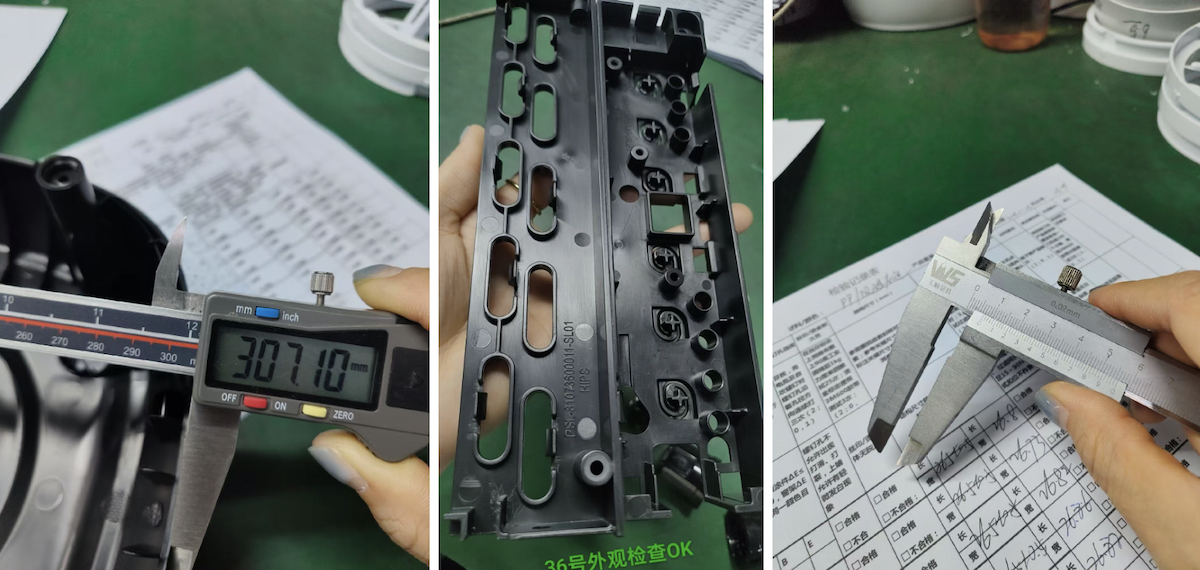
TEAM Rapid supports customers with prototype tooling, rapid tooling, low-volume injection molding, bridge production, and mass production. Our goal is to help customers move from initial prototypes to reliable plastic part production.
Frequently Asked Questions About Packing Pressure vs Holding Pressure
Q:What Is the Difference Between Packing Pressure and Holding Pressure?
A:Packing pressure is the initial pressure applied after the mold cavity is filled to add more molten plastic and compensate for shrinkage, while holding pressure maintains pressure during subsequent cooling until the gate freezes.
Q:Is Packing Pressure Higher Than Holding Pressure?
A:Packing pressure is often higher than holding pressure in a multi-stage injection molding process. However, the actual pressure profile depends on the material, part geometry, mold design, and machine settings.
Q:What Happens If Holding Pressure Is Too Low?
A:If holding pressure is too low, insufficient material may enter the mold cavity to compensate for shrinkage. This can result in sink marks, internal voids, excessive shrinkage, and inconsistent part weight.
Q:What Happens If Packing Pressure Is Too High?
A:Excessive packing pressure can cause flash, excessive part weight, residual stress, and difficulty with part ejection. The correct pressure should be determined through mold trials and part quality inspection.
Q:How Long Should Holding Pressure Be Applied in Injection Molding?
A:Holding pressure should generally be applied until the gate freezes and additional pressure can no longer increase part weight. The required holding time depends on material properties, gate dimensions, part wall thickness, and mold temperature.
Q:How Do You Determine the Correct Packing and Holding Pressure?
A:Manufacturers can determine suitable packing and holding pressure through controlled mold trials, pressure adjustments, part weight studies, gate seal studies, and dimensional inspections. The final settings should provide consistent part quality without causing flash or excessive residual stress.
Conclusion
Packing pressure and holding pressure are closely related but play different roles in the injection molding process. Packing pressure initially adds material to compensate for shrinkage after cavity filling, while holding pressure maintains pressure during subsequent cooling until the gate freezes.
Both parameters affect part weight, dimensional accuracy, surface quality, and production consistency. The correct settings depend on plastic material, part geometry, mold design, and production requirements.
If you are planning a custom plastic injection molding project, TEAM Rapid can help with tooling, mold trials, and injection molding production to meet your part quality and volume requirements. Contact us today to learn more about our capabilities.



 Contact